Last Updated: June 28, 2026 | Originally Published: February 20, 2026
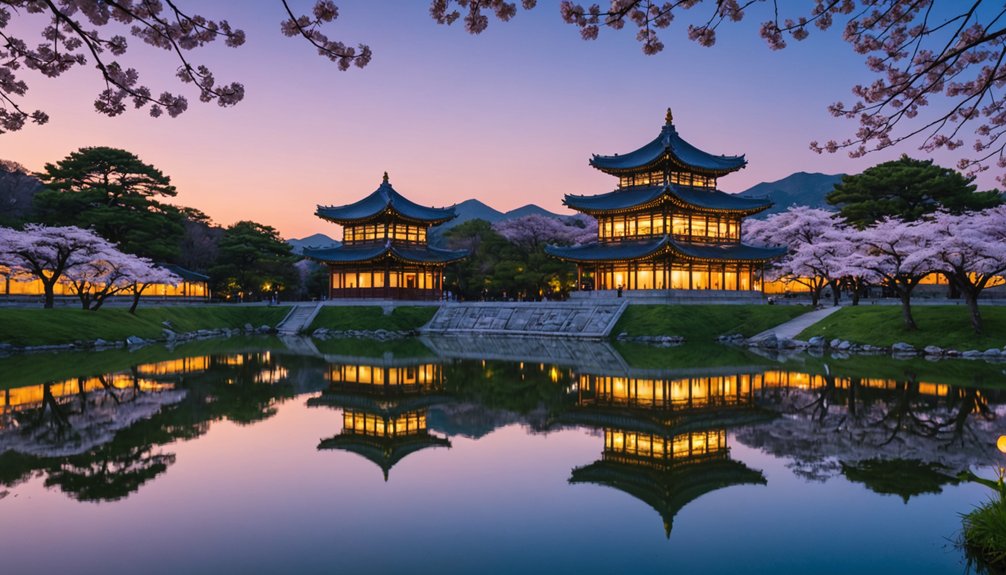
Gyeongju’s ancient sites pack a serious historical punch. At Daereungwon, you’ll walk among 23 grassy royal tombs hiding thousands of Silla Dynasty artifacts, including that famous 5th-century gold crown. Don’t miss Wolji Pond at sunset when illuminated pavilions reflect perfectly in still waters. Both UNESCO sites showcase Korea’s thousand-year dynasty through impressive architecture and serene landscapes. The entrance fee’s a bargain for time-traveling back to Korea’s golden age.
Read our full South Korea Travel Guide 2026 for everything you need to plan your Korea trip.
Explorer Insights
- Daereungwon houses 23 royal burial mounds with thousands of Silla Dynasty artifacts, earning UNESCO World Heritage status in 2000.
- Wolji Pond (formerly Anapji) transforms at sunset with illuminated reflections of pagodas for 3000 KRW entrance fee.
- Both sites showcase Silla Dynasty’s cultural significance, with the tombs featuring gold crowns from the 5th century.
- Donggung Palace exemplifies Taoist design principles with its 8th-century architecture and three strategically placed islands.
- Plan a 2-hour visit at sunset to experience both attractions, with Gyeongju’s historic area offering additional nearby sites.
The Royal Legacy: Exploring Daereungwon Tomb Complex
Majesty in mounds. That’s what you’ll find at Daereungwon Royal Tomb Complex, where over 23 grass-covered bumps hide Silla Dynasty royals. Pretty humbling, right? (see Korea Tourism Organization)
Beneath these emerald hills sleep ancient kings, their silent stories waiting beneath layers of time and grass.
This isn’t just some random burial ground – it’s where King Muryeong and his fancy gold crown have rested since the 5th century.
The place is eerily peaceful. Ancient trees. Curved mounds. Tranquility you can’t manufacture. Thousands of artifacts tell stories that history books can’t – ceramics that real people once touched, weapons that actually killed.
UNESCO slapped their World Heritage badge on this archaeological site back in 2000. Well deserved.
Part of Gyeongju’s historic areas, this complex offers unmatched cultural significance. Sure, they’re basically just hills covering dead people. But these hills changed how we perceive an entire civilization.
Like Changdeokgung Palace, this site exemplifies Korea’s dedication to preserving its royal heritage while harmonizing with the natural landscape.
Moonlight Magic: Evening Splendor at Wolji Pond
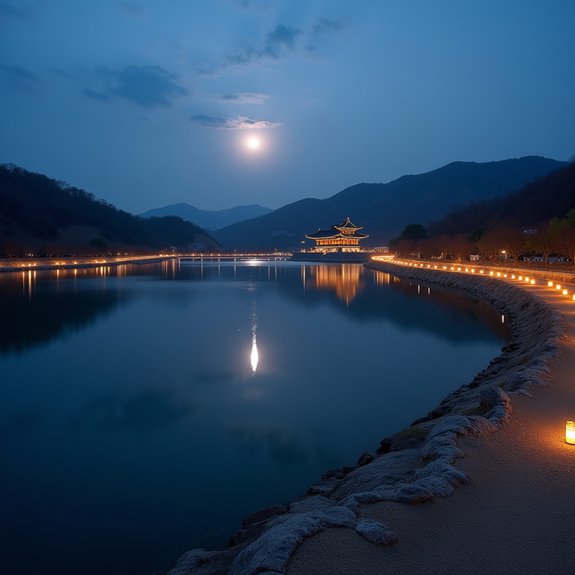
Ever witnessed a thousand years melt into twilight? Wolji Pond transforms after sunset. What was once Anapji during the Silla Dynasty becomes a mirror for illuminated pagodas and trees. Pure magic.
King Munmu’s crown prince lived here. Now you can experience this UNESCO World Heritage site for a measly 3000 KRW entrance fee. Worth every won.
| Time to Visit | What You’ll See |
|---|---|
| Sunset | First golden reflections |
| Early evening | Pagodas lighting up |
| Night | Full illumination spectacle |
| After 9 PM | Fewer crowds |
| Any time | Cultural significance |
Serious photographers come at dusk. The romantic beauty isn’t just hype – the tranquil atmosphere makes even cynics emotional. It’s Taoist heaven on earth. Literally.
A visit to royal burial mounds in Tumuli Park nearby deepens your connection to the Silla kingdom’s enduring legacy.
Historical Significance: Silla Dynasty’s Cultural Footprint
While Wolji Pond dazzles after dark, the stone and soil beneath your feet whisper stories from a thousand years ago.
You’re walking on the cultural footprint of the Silla Dynasty, a powerhouse that dominated Korea for nearly a millennium. No small feat.
Donggung Palace wasn’t just some fancy royal crash pad—it embodied Taoist philosophies, connecting heaven and earth through deliberate design.
The excavation of 33,000 relics proves these folks weren’t amateurs at craftsmanship. They knew what they were doing.
Nearby, Daereungwon Royal Tombs house burial mounds of kings and nobles who once ruled this land.
Kind of humbling, isn’t it?
The historical significance wasn’t lost on UNESCO either—they slapped World Heritage status on both sites.
Because sometimes, even bureaucrats recognize greatness when they see it.
Andong’s mask dance traditions play a vital role in preserving Korea’s intangible cultural heritage, showcasing ancient storytelling and intergenerational cultural exchange. (see Korail)
Architectural Marvels: Design Elements of Donggung Palace
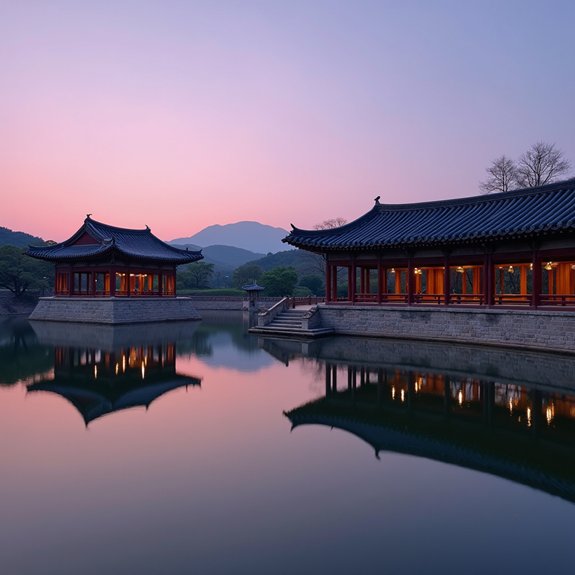
The architects of Donggung Palace didn’t just throw together some fancy buildings—they crafted a masterpiece that’s stood the test of time since the 8th century.
This royal complex showcases traditional Silla dynasty architectural elements that’ll make your jaw drop. The artificial pond, Wolji, created in 674 CE, literally brings Taoist philosophies to life by depicting heaven on earth. Not subtle at all. Similar to Kinkaku-ji’s design, the structure perfectly complements its surrounding water feature, creating a harmonious visual experience.
Marvel at the Silla dynasty’s bold vision—where artificial ponds and Taoist principles collide to create literal heaven on earth.
- Three islands strategically placed in the original design create a serene environment perfect for royal ceremonies
- The reconstructed pavilion offers killer views, especially at night when lights reflect on the water
- The entire layout emphasizes harmony with nature—these folks weren’t messing around with their design principles
The cultural significance is obvious. Donggung Palace represents everything the Silla dynasty valued: beauty, tranquility, and historical legacy. Period.
Visitor Experience: Best Times and Ways to Enjoy Both Sites
To truly appreciate these ancient Silla treasures, you’ve got to nail the timing. Hit Donggung Palace and Wolji Pond at sunset. Trust me. The illuminated structures reflecting on the water? Magical.
You’ll need about 2 hours to explore properly – don’t rush this experience.
The night tours are absolutely worth it. Romantic, peaceful, and frankly, pretty darn spectacular. Those lights on the water? Instagram gold.
For maximum historical immersion, combine your visit with Daereungwon Royal Tombs. They’re practically neighbors, and together they tell the complete Silla Dynasty story. Connected history, connected experience.
The best part? Admission’s only 3000 KRW. Ridiculously cheap for what you’re getting. Historical beauty on a budget. Can’t beat that.
If you’re inspired by timeless experiences, consider staying at a Kyoto ryokan for a deeper cultural connection during your travels.
Beyond the Sites: Connecting Attractions in Gyeongju’s Historic Area
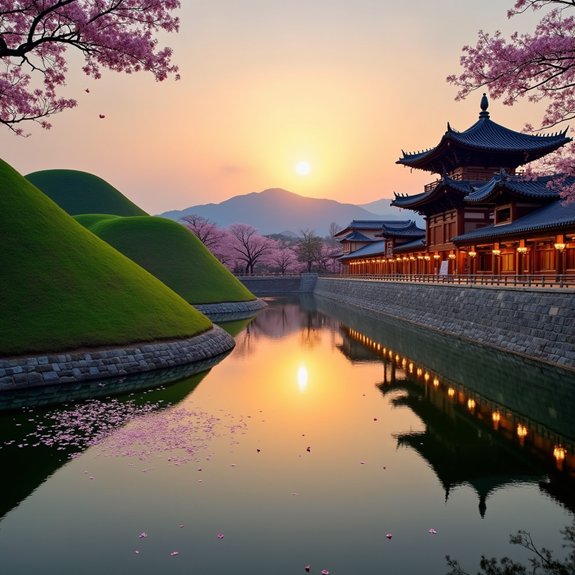
Gyeongju isn’t just about one or two isolated monuments – it’s a historical playground. Within a mile from Donggung Palace and Wolji Pond, you’ll find yourself tripping over 1,500-year-old Silla dynasty treasures. Seriously, they’re everywhere.
- The Daereungwon Royal Tombs, less than a mile away, houses those massive burial mounds where kings and queens are snoozing eternally. Pretty impressive real estate.
- Check out Cheomseongdae Observatory (0.4 miles) – oldest astronomical site in East Asia. Yeah, the Silla people were stargazing geniuses while Europe was still figuring things out.
- The Gyeongju National Museum boasts a 4.5/5 rating and sits just 0.4 miles from the palace. Their artifact collection? Ridiculous.
The entire historic area ties together the cultural heritage narrative. One site makes little sense without the others. Like Beijing’s imperial palace complex, these interconnected sites reveal how royal power and cultural sophistication shaped an entire era.
Frequently Asked Questions
Are There Any Restricted Areas Tourists Cannot Access?
Yes, there are restricted areas at these historic sites.
You can’t enter the actual burial mounds at Daereungwon—they’re sealed tight. Only one tomb, Cheonmachong, allows limited interior access.
At Donggung Palace & Wolji Pond, some reconstructed buildings have roped-off sections where you can’t walk.
Makes sense. These are 1,500-year-old treasures, not your backyard playground. Conservation trumps your selfie opportunities.
What Indigenous Plants Surround the Tombs and Palace Grounds?
You’ll find pine trees everywhere – they’re basically Korea’s national tree.
Around the tombs and palace, there’s a mix of native plants: azaleas, cherry blossoms, lotuses (especially at Wolji Pond), chrysanthemums, and maples. (see Korea Rail Pass)
The landscaping combines natural Korean flora with manicured gardens. During spring, it’s a riot of color.
In fall? The maples turn fiery red. Pretty stunning contrast against ancient stones.
Not exactly wilderness, but definitely authentic Korean vegetation.
How Were the Royal Tombs Constructed to Prevent Looting?
The royal tombs were genius anti-theft machines. You’d be impressed. They built these massive earth mounds over the burial chambers—some reaching 23 meters high!
The tombs were constructed in layers: stone chamber, covered with wooden structure, then tons of earth and rocks. No visible entrance. Smart, right?
They also buried the dead with attendants who’d report looters in the afterlife. Yeah, that’s commitment to security.
Do Any Traditional Silla Dynasty Festivals Still Occur Here?
Yes, you can experience several Silla festivals at these historic sites.
The Silla Cultural Festival happens annually, showcasing traditional performances and ceremonies.
There’s also Wolji Night Journey, where they light up the pond just like in ancient times. Pretty magical stuff.
The Silla Moon Festival recreates royal court ceremonies right where they originally happened.
These events aren’t just tourist traps—they’re living connections to a 1,000-year dynasty.
What Underwater Archaeological Discoveries Have Been Made in Wolji Pond?
Wolji Pond coughed up some serious treasures when they drained it in the 1970s.
You’ll find over 30,000 artifacts there now. Stone sculptures, gilt-bronze ornaments, tons of pottery. The coolest finds? Those dragon-head water spouts that once decorated the pond’s edge. Completely intact.
They’ve also recovered wooden structures and building materials showing how the palace actually functioned.
Pretty wild to think it was underwater for centuries, just waiting.
Conclusion
As you stand between Daereungwon’s grassy mounds and Wolji’s mirror-like waters, you’re literally walking through pages of history. The Silla kings are long gone, but their legacy? Unmistakable. These aren’t just tourist traps—they’re time machines. Gyeongju doesn’t brag; it doesn’t need to. The ancient capital whispers its secrets if you’re smart enough to listen. Spectacular at sunset. Haunting at dawn.
More on Budget Travel:

Written by East Asia Explorer Editorial Team
Sam Konneh is an AI strategist and digital marketer based in Seoul, South Korea. With years spent living, working, and exploring across Korea, Japan, and China, he shares firsthand insights into East Asia's cultures, hidden gems, and everyday life. A graduate of Inha University and KDI Graduate School, Sam combines data-driven expertise with on-the-ground experience. His journey also includes studying in Malaysia and traveling through Southeast Asia. Through practical tips, local stories, and travel guides, he helps fellow explorers discover both the celebrated highlights and the lesser-known corners of East Asia.