Last Updated: August 25, 2026 | Originally Published: March 10, 2026
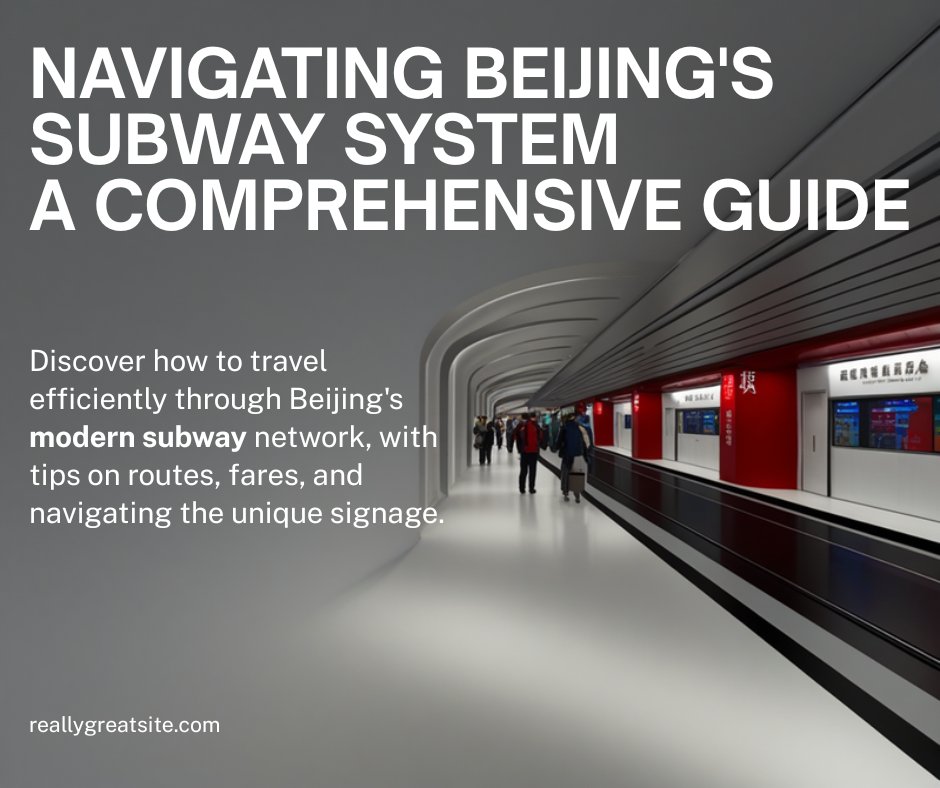
Beijing’s subway system is the fastest, cheapest, and most reliable way to get around the city in 2026. With 27 lines covering over 800 km of track, it reaches almost every major attraction, neighborhood, and transport hub. I have used it on every Beijing trip since 2019 and it has never let me down.
Read our full Beijing Travel Guide 2026 for a complete overview of getting there, where to stay, what to eat, and daily itineraries.
Beijing Subway at a Glance (2026)
| Detail | Info |
|---|---|
| Total Lines | 27 lines |
| Stations | 490+ |
| Operating Hours | 5:00 AM to 11:30 PM (varies by line) |
| Fare | 3-10 CNY ($0.40-$1.40) based on distance |
| Daily Riders | 12+ million |
How to Pay for the Beijing Subway
There are three main payment options for tourists in 2026: (see Travel China Guide)
1. Yikatong Transit Card (Recommended)
The Yikatong card is a rechargeable IC card that works on the subway, buses, and some taxis. Buy one at any station service counter for a 20 CNY deposit plus whatever balance you want to add. Tap it at the turnstile and go. You get a small discount on bus fares too. (see Trip.com (Ctrip))
When you leave Beijing, return the card at any service counter for a full deposit refund plus remaining balance.
2. Mobile Payment (WeChat Pay / Alipay)
If you have already set up WeChat Pay or Alipay (which you should), you can link them to the Beijing Subway app or use the built-in QR code scanner at turnstiles. This is the method most locals use.
3. Single-Journey Tickets
Ticket machines at every station sell single-journey tokens. They accept coins and small bills (5 and 10 CNY notes). The machines have an English language option. This works fine for occasional rides but gets tedious if you are using the subway daily.
Pro Tip: The Yikatong card saves time but mobile payment is the most flexible option. Whichever you choose, avoid buying single tickets at rush hour. The ticket machine lines can be 10+ minutes long.
Key Lines for Tourists
You do not need to memorize all 27 lines. These five cover 90% of what tourists want to see:
Line 1 (Red) — The Main East-West Route
Runs straight through central Beijing. Key stops: Tiananmen East (Tiananmen Square), Wangfujing (shopping), Jianguomen (CBD), and Military Museum. This is the line you will use most.
Line 2 (Blue Circle) — The Inner Loop
Follows the old city wall route in a circle. Key stops: Beijing Railway Station, Dongzhimen (Airport Express connection), Gulou (Drum Tower area), and Qianmen (Temple of Heaven area).
Line 5 (Purple) — North-South Spine
Key stops: Tiantandongmen (Temple of Heaven), Dongsi (hutong area), and Yonghegong (Lama Temple).
Line 8 (Green) — Olympic Park
Key stops: Olympic Sports Center (Bird’s Nest, Water Cube), Nanluoguxiang (popular hutong alley), and Shichahai (lakeside bar area).
Airport Express — Capital Airport
Runs from Dongzhimen to Terminal 2 and Terminal 3. Fixed fare of 25 CNY, takes about 30 minutes. Much cheaper than a taxi (100+ CNY) and avoids traffic entirely. (see China Highlights)
Riding Tips for First-Timers
- Security screening is mandatory. All bags go through an X-ray machine at every station entrance. Allow an extra 5 minutes, or 15 minutes during morning rush.
- Rush hour is brutal. Avoid Lines 1, 2, 4, 5, 10, and 13 between 7:30-9:30 AM and 5:00-7:30 PM on weekdays. Trains run every 2 minutes but carriages are packed.
- Follow the arrows. Platforms have floor markings showing where to stand while waiting. Yellow arrows point to exit zones, so passengers can get off before you board.
- Last train times vary. Most lines stop between 10:30 and 11:30 PM. Check the display board at your station for the last departure time.
- Free transfers are automatic. Switching between lines inside a station does not cost extra. Your fare is calculated at the exit gate based on total distance traveled.
Warning: Do not eat or drink on Beijing subway trains. It is against the rules and you can be fined. Water bottles are technically allowed but anything else (snacks, coffee, fruit) is not. (see Seat 61 China rail guide)
Getting from the Airport to the City
Beijing has two airports. Here is how to get from each one to central Beijing by subway:
Capital Airport (PEK)
Take the Airport Express from Terminal 2 or Terminal 3 to Dongzhimen Station (30 minutes, 25 CNY). From there, transfer to Line 2 or Line 13 for anywhere in the city.
Daxing Airport (PKX)
Take the Daxing Airport Express to Caoqiao Station (19 minutes, 35 CNY). Transfer to Line 10 (the big loop) for most destinations. Daxing is newer and less crowded than Capital Airport, but further south.
Useful Apps
Download these before your trip:
- Beijing Subway (official app) for route planning and QR code entry
- Amap (Gaode Maps) for real-time transit directions (more accurate than Google Maps in China)
- MetroMan for offline subway maps and first/last train times
Google Maps works with a VPN but often gives inaccurate transit directions in Beijing. Stick with Amap or Baidu Maps for reliable results.
Frequently Asked Questions
Is the Beijing subway safe?
Very safe. Stations are well-lit, have CCTV everywhere, and security staff are present at all times. Pickpocketing can happen on crowded trains during rush hour, so keep valuables in front pockets.
Can I bring luggage on the subway?
Yes. Suitcases go through the X-ray scanner and are allowed on trains. During rush hour, you may struggle to fit a large suitcase through the crowds. For airport transfers, consider taking the Airport Express which has luggage racks.
Do subway staff speak English?
Most do not, but all station signage, announcements, and ticket machines have English. The route maps inside trains show station names in both Chinese and English (pinyin).
What if I get lost?
Show a station staff member the Chinese name of your destination on your phone. They will point you to the correct platform. Every station has clear directional signs in English too.
Subway Etiquette
A few unwritten rules will help you avoid awkward moments on the Beijing subway.
Let passengers exit before you board. This sounds obvious but it is enforced by platform staff during rush hour and locals take it seriously. Stand to the side of the doors, not in front of them. (see Lonely Planet China guide)
Give up priority seats for elderly passengers, pregnant women, and people with disabilities. The seats are clearly marked in a different color (usually orange or yellow) at the ends of each carriage. You can sit there when the train is not crowded, but be ready to stand if someone who needs it boards. (see Australian government China travel advice)
Keep phone calls short and keep your voice down. Many commuters nap during their rides and loud conversations are frowned upon. Music should always be played through headphones.
During rush hour, backpacks go in front of you or between your legs. This frees up space and prevents accidentally hitting other passengers as you move through the carriage.
Subway vs. Taxi vs. Bus: When to Use Each
The subway is best for long-distance travel across the city, reaching major attractions, and avoiding traffic. But it is not always the best option.
| Transport | Best For | Avoid When |
|---|---|---|
| Subway | Cross-city trips, airport runs, avoiding traffic | Hutong areas, late night (after 11 PM) |
| Taxi / Didi | Short hops, late night, carrying luggage | Rush hour (traffic jams double travel time) |
| Bus | Short routes in central areas, seeing the city | Tight schedule (buses get stuck in traffic) |
For the hutong neighborhoods around Nanluoguxiang and Shichahai, the subway gets you close but the final stretch requires walking. Taxis can navigate the narrow hutong lanes but many are one-way or pedestrian-only, so expect to be dropped at the entrance.
If you are heading to the Great Wall sections outside Beijing, the subway will not get you there. You will need a bus, tour shuttle, or hired car depending on which section you are visiting.
Money-Saving Tips
The Beijing subway is already cheap, but there are a few ways to stretch your budget even further.
If you take 100+ rides in a calendar month, fares drop by 20% after the 100th ride and 50% after the 150th ride. This mainly benefits residents, but if you are staying in Beijing for several weeks and commuting daily, you could trigger the discount.
For shorter distances within the same neighborhood, consider walking or renting a shared bike instead. Meituan, Hello, and Didi all offer dockless bikes parked on sidewalks throughout the city. Scan the QR code with your phone, ride to your destination, and park anywhere. Typical cost is 1.5 CNY per 15 minutes.
One more tip: the cheapest accommodation in Beijing is often located near subway stations on the outer ring lines (Line 10, Line 13, Batong Line). Staying one or two stops outside the city center can save 200-400 CNY per night on hotels while keeping you well-connected to everything by train.
Related Reading
Related Reading
Related Guides
More on Transportation:

Written by Sam Konneh
Sam Konneh is an AI strategist and digital marketer based in Seoul, South Korea. With years spent living, working, and exploring across Korea, Japan, and China, he shares firsthand insights into East Asia's cultures, hidden gems, and everyday life. A graduate of Inha University and KDI Graduate School, Sam combines data-driven expertise with on-the-ground experience. His journey also includes studying in Malaysia and traveling through Southeast Asia. Through practical tips, local stories, and travel guides, he helps fellow explorers discover both the celebrated highlights and the lesser-known corners of East Asia.