Last Updated: September 1, 2026 | Originally Published: November 23, 2024
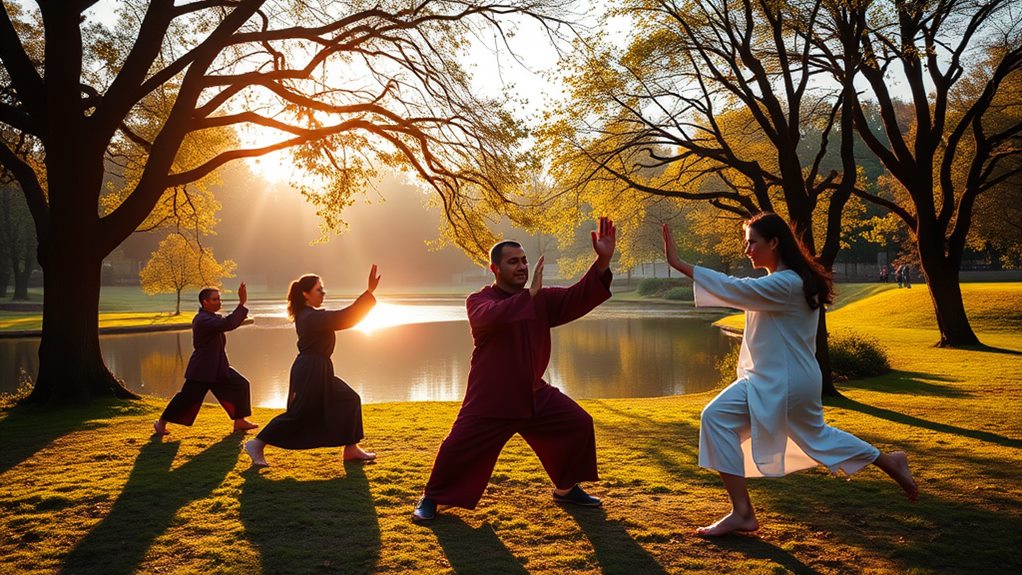
Quick Answer: Where to See Tai Chi in China’s Parks
- Best spots: Temple of Heaven Park (Beijing), Beihai Park (Beijing), and People’s Park (Chengdu) draw the largest daily groups.
- Best time: 6:00-8:00 AM — practitioners clear out before tour buses arrive.
- Cost to watch: Free at Beihai and People’s Park; Temple of Heaven charges a ¥15 park-entry ticket (¥34 combo with the historical sites).
- Can you join? Usually yes — most groups welcome quiet observers and beginners who ask first.
Most “tai chi in the park” articles describe a feeling — serenity, mindfulness, connection to nature — without saying which park, what time, or what it costs to actually see it.
Here’s the practical version: three real parks where tai chi happens every morning, the three styles you’ll recognize, and what it takes to book a lesson instead of just watching from a bench.
Where to Actually See It: Three Parks That Deliver
Tai chi groups form in thousands of parks across China every morning, but a handful of public parks are reliable enough that a first-time visitor can plan around them.
| Park | City | Entry Fee | What Else Is There |
|---|---|---|---|
| Temple of Heaven Park | Beijing | ¥15 park-only / ¥34 combo | Opera singers, dancers, and games under the cypress trees around the altar complex |
| Beihai Park | Beijing | Free (park); ¥10 for the White Dagoba area | Lakeside groups, often with sword forms (taijijian) |
| People’s Park | Chengdu | Free | Heming Teahouse, mahjong tables, ear-cleaning stalls after the practice wraps up |
All three are large enough that arriving without a plan means wandering past several unrelated activities — ballroom dancing, mahjong, opera singing — before finding the tai chi group. Head toward open plazas or lakeside paths rather than the shaded seating areas, where the older social games tend to cluster.
None of the three parks are walkable from a Kyoto– or Seoul-style single downtown core — each needs its own subway ride. Temple of Heaven is a two-minute walk from Tiantandong Men station on Beijing Subway Line 5. Beihai Park‘s north gate sits directly outside Beihai North station on Line 6. In Chengdu, People’s Park is a five-minute walk from Renmin Park station on Metro Line 2 — the exit is signposted in English.
Pro Tip: Beihai Park’s groups often practice sword-form tai chi (taijijian) along the lakeside path near the North Gate — look for practitioners carrying straight, thin swords rather than empty-hand forms.
Not headed to Beijing or Chengdu? Fuxing Park in Shanghai‘s former French Concession is free, open 24 hours, and a five-minute walk from Xintiandi station (Lines 10 and 13). Its plane-tree-lined lawns fill with the same mix of tai chi, sword forms, and ballroom dancing every morning from around 6:00 AM, making it the practical Shanghai substitute for travelers whose itinerary skips Beijing entirely.
What Time to Show Up (and Why 8 AM Is Already Late)
Tai chi groups in Chinese parks form early — most sessions run from around 6:00 AM to 8:00 AM, before the day’s heat and tour groups arrive. By mid-morning the same open spaces fill with ballroom dancers, badminton games, and tour groups, and the tai chi groups have already dispersed.
At Temple of Heaven specifically, arriving before 7:00 AM is the difference between watching quietly from the edge of a group and pushing through a crowd of photographers who arrived after the practitioners were already mid-session.
Pro Tip: Book same-day tickets through the park’s official WeChat mini-program the night before — Temple of Heaven limits daily foreign-passport registrations, and weekend slots fill fastest.
The Three Styles You’ll See — and Where They Came From
Nearly everything practiced in a Chinese park today traces back to one village and three families.
- Chen style is the original: it developed in Chenjiagou village, Henan province, credited to the Chen family in the 1600s. It’s more visibly martial — sudden bursts of speed and low stances mixed into the slow movements.
- Yang style is the one most visitors actually see. Yang Luchan learned Chen-style tai chi starting in 1820 and later taught it to the Imperial Guards in Beijing from 1850 onward, softening the movements for a broader, non-martial audience. Its slow, even pace is why it became the basis for public health practice.
- Wu style developed later, adapted from Yang’s smaller-frame movements by the Wu family in the early 1900s — more compact stances, often practiced by older groups who want less knee strain.
What most park visitors are actually watching is a fourth, newer form: the 24-form Simplified Tai Chi, created in 1956 by China’s National Physical Culture and Sports Commission.
A committee of five masters — Chu Guiting, Cai Longyun, Fu Zhongwen, Zhang Yu, and Li Tianji — condensed the 108-movement traditional Yang sequence into a 24-posture routine, taking about six minutes, so it could be taught nationwide for public health.
It’s the version you’ll see performed in near-perfect unison by park groups today.
Warning: Don’t confuse a tai chi group with a qigong or fan-dance group nearby — parks often host all three within sight of each other, and only tai chi uses the continuous, flowing whole-body sequence. Fan dancing involves props and faster tempo; qigong groups often stand mostly still.
Can You Join In? Etiquette for Visitors
Most groups welcome onlookers, and many will wave a curious visitor into the back row without being asked. A few basics make it easier:
- Watch one full round before joining — group leaders don’t always restart from the beginning for latecomers.
- Wear flat, closed shoes; the movements shift weight low and slow, and sandals slip on dew-covered stone.
- Don’t photograph individual practitioners’ faces up close without asking — wide shots of the group are generally fine.
- A short bow or nod to the group leader before leaving is the norm, not a formal requirement.
Key Takeaway: Temple of Heaven, Beihai, and People’s Park Chengdu are the three most reliable places to see tai chi in China, best visited before 8 AM. What you’re watching is most likely the 1956 24-form routine — a modern, standardized descendant of the older Chen and Yang styles, not an unbroken ancient ritual.
“Tai chi is a slow-motion exercise that improves balance, muscle strength, and flexibility, and can be practiced by people of nearly all ages and fitness levels.”
Frequently Asked Questions
Is it free to watch tai chi in Chinese parks?
Yes, at most parks — Beihai and People’s Park Chengdu have no entry fee for the areas where tai chi happens. Temple of Heaven charges a park-entry ticket even if you’re only there to watch.
Do I need to book in advance?
Only for Temple of Heaven’s paid tai chi classes, which run through the official WeChat mini-program and require a foreign passport for registration. Just watching a public group in any park needs no booking at all.
What should I wear?
Comfortable, flat closed-toe shoes and layers — mornings are cool even in summer, and the practice itself doesn’t require special clothing.
Which style will I most likely see?
The 24-form Simplified routine, based on Yang-style movements. It’s the standardized form taught nationwide since 1956, which is why groups across different cities move in near-identical unison.
Can children or older travelers join in?
Yes — tai chi’s low-impact, slow pace is part of why it’s practiced by such a wide age range in the parks themselves; groups typically include everyone from young adults to practitioners in their 80s.
Last updated: September 1, 2026.
Related Reading
More on Hiking & Nature:
Planning a trip to China?
Check out our China Travel Hub for more guides, including China Digital Survival Guide.

Written by Sam Konneh
Sam Konneh is an AI strategist and digital marketer based in Seoul, South Korea. With years spent living, working, and exploring across Korea, Japan, and China, he shares firsthand insights into East Asia's cultures, hidden gems, and everyday life. A graduate of Inha University and KDI Graduate School, Sam combines data-driven expertise with on-the-ground experience. His journey also includes studying in Malaysia and traveling through Southeast Asia. Through practical tips, local stories, and travel guides, he helps fellow explorers discover both the celebrated highlights and the lesser-known corners of East Asia.