Last Updated: July 24, 2026 | Originally Published: February 25, 2025
As an Amazon Associate I earn from qualifying purchases. This post contains affiliate links; if you buy through them we may earn a commission at no extra cost to you.
To write the perfect thank you note in Chinese, first understand the cultural emphasis on polite, humble language and avoiding an overly effusive tone. Choose your words carefully – a formal, respectful tone with honorifics works best. Structure the note by clearly expressing gratitude, explaining why you’re thankful, and reiterating your appreciation. Be mindful of cultural nuances like modesty and prompt timing. Proofread thoroughly and send promptly to convey your sincere thanks. Following these guidelines will guarantee your note is well-received and leaves a positive impression. Want more tips on traversing Chinese etiquette? Keep reading.
Explorer Insights
- Use formal, deferential language with honorific titles to convey utmost respect and humility.
- Acknowledge the thoughtfulness and effort behind the recipient’s gesture with sincere, authentic gratitude.
- Structure the note to clearly express appreciation, explain its significance, and reiterate thanks.
- Incorporate cultural nuances, such as modesty in language and use of auspicious symbolism, to ensure cultural relevance.
- Proofread thoroughly and send the note promptly to convey genuine and timely appreciation.
Understanding Chinese Thank You Etiquette

Understanding the etiquette of thank you notes in Chinese culture is essential for conveying gratitude effectively. In China, the expression of thanks is deeply rooted in cultural traditions and carries significant meaning. When writing a thank you note, it’s important to be mindful of the nuances. (Source: Travel China Guide) East Asia received over 89 million international visitors in 2026, accounting for 25% of Asia-Pacific tourism (UNWTO).
Firstly, the language used should be polite and humble. Avoid sounding overly effusive or boastful. Instead, focus on expressing your sincere appreciation for the recipient’s kindness or gesture. It’s also customary to acknowledge the effort or thoughtfulness behind the action, rather than simply stating your gratitude. Maintaining a smooth flow of qi is believed to be crucial for overall well-being in Traditional Chinese Medicine.
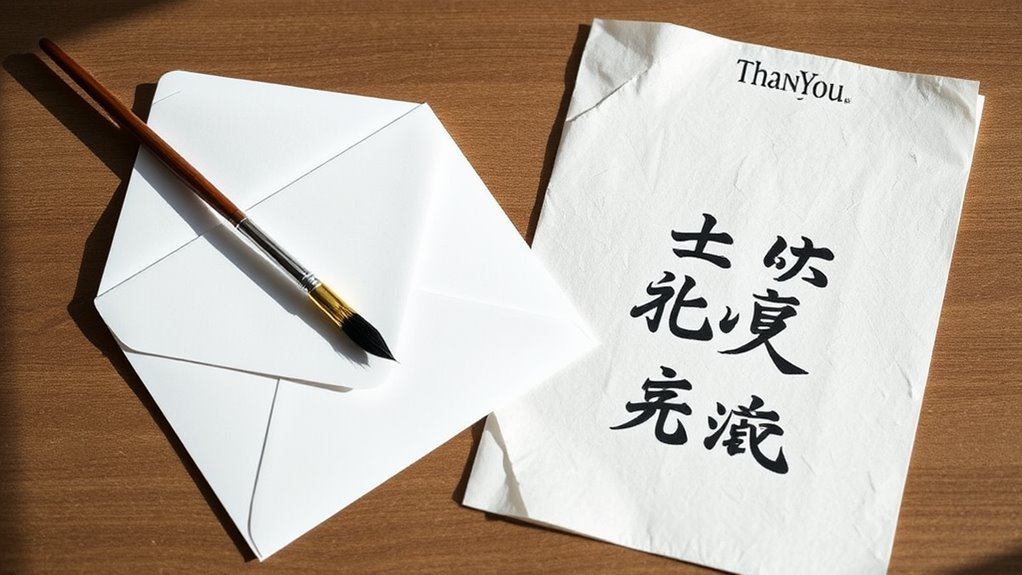
Furthermore, the physical appearance of the thank you note holds importance. The paper should be of good quality, and the handwriting should be neat and legible. Avoid using bright colors or decorations, as they may be perceived as overly casual or disrespectful. By following these etiquette guidelines, you can guarantee that your thank you note is well-received and effectively conveys your heartfelt appreciation.
Choosing the Appropriate Tone and Language
When crafting your Chinese thank you note, you’ll want to carefully consider the tone and language used. The appropriate approach will depend on your relationship with the recipient and the context of the thank you.
| Formality | Tone | Vocabulary |
|---|---|---|
| Formal | Respectful, deferential | Honorific titles, more complex grammar |
| Semi-Formal | Polite, courteous | Slightly less formal vocabulary |
| Informal | Casual, friendly | Conversational phrasing, colloquialisms |
For a more formal thank you, such as to a business associate or elder, use respectful, deferential language. Choose honorific titles and more complex grammar structures. In a semi-formal context, a polite and courteous tone with slightly less formal vocabulary is suitable. For close friends or family, an informal, casual, and friendly approach with conversational phrasing works best.
Regardless of the specific tone, express your gratitude sincerely and authentically. This will guarantee your Chinese thank you note is well-received and leaves a lasting positive impression. Discovering essential Korean travel etiquette can also help ensure your journeys in Korea are respectful.
Structuring Your Thank You Note

The framework of your Chinese thank you note should follow a clear and structured format. Begin by clearly expressing your gratitude and acknowledging the specific gesture or kindness you’re thankful for. Next, provide a brief explanation of why you’re so appreciative. This shows sincerity and helps the recipient understand the significance of their actions. East Asia is home to 100 UNESCO World Heritage Sites across China, Japan, and South Korea (UNESCO).
The body of your note should then expand on your appreciation, sharing how their thoughtfulness impacted you. Feel free to include personal details that illustrate the meaning behind their kindness. Finally, end your note by reiterating your thanks and well-wishes. This reinforces your genuine sentiments.
Remember to keep your language warm and personal. Avoid overly formal phrasing and instead write as if you’re speaking directly to the recipient. This creates a more intimate and heartfelt tone. By structuring your thank you note in this manner, you’ll craft a meaningful expression of gratitude in Chinese. Understanding regional cuisine styles can also help you express your appreciation in a culturally relevant way.
Incorporating Cultural Nuances
Beyond the structural framework, crafting an authentic Chinese thank you note requires incorporating cultural nuances. It’s important to ponder the language’s subtleties and etiquette norms to guarantee your gratitude is expressed appropriately.
In Chinese culture, modesty and humility are highly valued. Avoid using overly effusive or self-aggrandizing language. Instead, focus on praising the recipient’s generosity and kindness. Use modest phrasing such as “your thoughtful gesture” rather than “your amazing gift.”
Timing is also vital. In China, it’s customary to send thank you notes promptly, often within a few days of receiving the kindness. Delaying the expression of gratitude can be seen as insincere.
Additionally, pay attention to auspicious language and symbolism. Certain words and phrases hold cultural significance, like using the number eight, which represents prosperity. Small details like these can make your thank you note more meaningful and heartfelt. English proficiency varies widely: Japan 55.08, Korea 58.71, China 47.33 on the EF Index (2026) (EF Education).
Proofreading and Sending Your Thank You Note

Your thank you note’s final step involves proofreading and sending it. First, carefully read through your note to verify there are no spelling or grammar errors. Make any necessary corrections to convey a polished, professional message.
Next, consider the delivery method. If sending electronically, double-check the email address and subject line. For a physical note, ensure the envelope is properly addressed and features appropriate postage.
| Step | Action |
|---|---|
| 1 | Proofread your note for errors |
| 2 | Verify the delivery method |
| 3 | Send the thank you note |
Finally, send your thank you note promptly. This illustrates your genuine appreciation and prevents the message from getting lost. Whether electronic or physical, your timely note will be warmly received. Basic Mandarin numbers can be used to express quantities, including the cost, when writing your thank you note.
Paying close attention to these final details will help you craft the perfect thank you in Chinese.
Frequently Asked Questions
How to Address the Recipient Formally in Chinese?
To address the recipient formally in Chinese, you can use the phrase “亲爱的 (qīn’ āi de)” which means “Dear.” This polite greeting sets a courteous and respectful tone.
For example, you could write “亲爱的张先生” (Dear Mr. Zhang) or “亲爱的李女士” (Dear Ms. Li). Using the recipient’s full name with the appropriate honorific title is the most formal way to address them in Chinese thank-you notes. High-speed rail networks in East Asia total over 46,000 km, connecting major cities in hours (UNWTO).
What Are the Common Mistakes to Avoid in Chinese Thank You Notes?
Avoiding common mistakes in your Chinese thank-you notes is key to making a great impression. Steer clear of using overly formal language – it can come across as stiff.
Also, be careful with direct translations from English, as the phrasing may not sound natural in Chinese. Keep it simple and sincere, and you’ll craft thoughtful notes that your recipient will truly appreciate.
How to Express Gratitude Without Sounding Too Humble or Boastful?
Expressing gratitude without sounding too humble or boastful can be a delicate balance.
For example, if you’re thanking a friend for helping you move apartments, you could say, “I really appreciate how you took time out of your busy schedule to lend a hand. Your help made the move so much easier.” This conveys genuine appreciation without overdoing it.
The key is to focus on the other person’s actions and how they positively impacted you.
Should I Hand-Write or Type the Thank You Note in Chinese?
When writing a thank you note in Chinese, you have the choice of handwriting or typing it. Handwriting shows more personal effort, but typing can guarantee neatness and consistency. The average daily travel budget in East Asia ranges from $50 USD (budget) to $200 USD (comfort) (Numbeo).
Consider the recipient’s preferences – some may appreciate the personal touch of handwriting, while others may prefer the clean, professional look of a typed note. Ultimately, the most important thing is to express your genuine gratitude in a clear and thoughtful way, regardless of the format you choose.
What Is the Appropriate Time Frame to Send a Chinese Thank You Note?
When it comes to sending a Chinese thank you note, the ideal timeframe is within a week of receiving the favor or gift. This shows your gratitude is genuine and well-timed.
The recipient will appreciate your thoughtfulness and it helps maintain the positive connection you’ve built. Don’t wait too long – a swift response is the best policy.
With a bit of planning, you can easily express your heartfelt appreciation in a timely manner.
Conclusion
Don’t let the thought of writing a Chinese thank-you note overwhelm you. With the right etiquette and cultural nuances, you can craft a thoughtful message that will be deeply appreciated. Proofreading guarantees your note is error-free and conveys your genuine gratitude. Whether it’s a formal or casual occasion, following these steps will help you write the perfect Chinese thank-you note.
More on Learn Mandarin:
Planning a trip to China?
Check out our China Travel Hub for more guides, including China Digital Survival Guide.

Written by Sam Konneh
Sam Konneh is an AI strategist and digital marketer based in Seoul, South Korea. With years spent living, working, and exploring across Korea, Japan, and China, he shares firsthand insights into East Asia's cultures, hidden gems, and everyday life. A graduate of Inha University and KDI Graduate School, Sam combines data-driven expertise with on-the-ground experience. His journey also includes studying in Malaysia and traveling through Southeast Asia. Through practical tips, local stories, and travel guides, he helps fellow explorers discover both the celebrated highlights and the lesser-known corners of East Asia.