Last Updated: February 15, 2026 | Originally Published: May 9, 2025
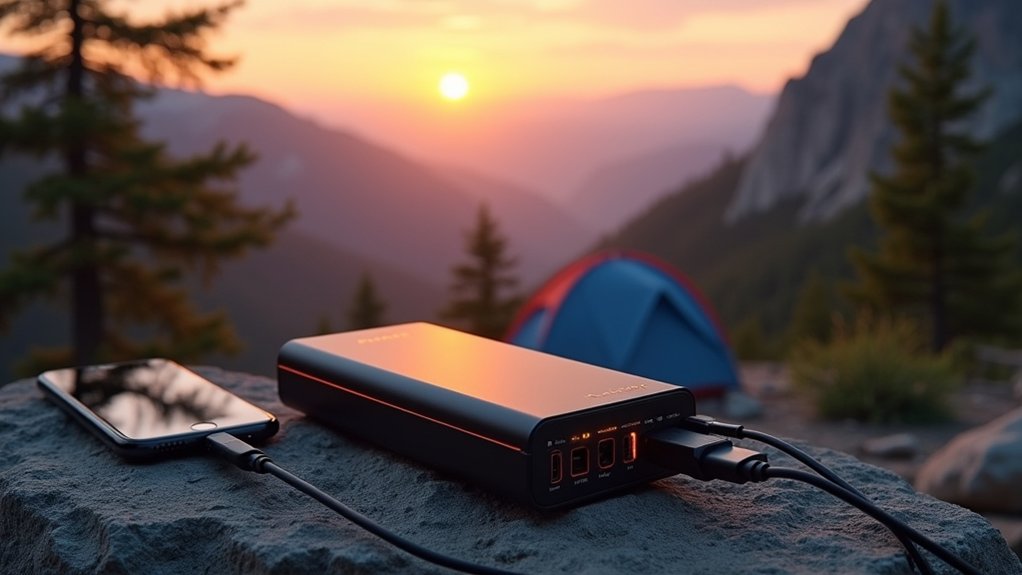
While the Anker Solix C300 might not revolutionize your power needs, it packs a compact punch with 300W of continuous power and a 288Wh LiFePO4 battery. This thing’s 15% smaller than rivals, making it a breeze for travel – yeah, like fitting into your backpack without the drama. Oh, and there’s an optional strap if you’re too lazy to grip it yourself.
Two models exist: the standard C300 with AC and DC outlets, and the DC-only version for minimalists. Durability? It’s got LiFePO4 batteries for 3,000 cycles, up to 10 years of life, plus smart temperature control. Impact-resistant, too. Moreover, Anker offers a 5-year warranty to back its reliability. And quiet? At just 25dB from a meter away, it’s like a library whisper – no annoying hum to ruin your vibe.
The battery delivers 288Wh, or 90,000mAh, with 300W continuous output and a 600W surge on the AC model. The DC version caps at 300W total. LiFePO4 tech keeps it going strong, retaining 80% capacity after 3,000 cycles – Anker claims a decade of use. Using navigation apps like Google Maps in Japan can quickly drain your battery, making portable power stations essential for travelers exploring off-grid locations. As a UPS, the AC model switches in under 10ms if the power cuts out, or 20ms if it’s not a full blackout.
This bad boy’s 288Wh battery pumps 300W continuous power, surges to 600W on AC, and lasts 3,000 cycles like a champ!
Efficiency? Tests show 80.8% for DC and 71.5% for AC. Not groundbreaking, but hey, it gets the job done without wasting too much juice.
Charging’s versatile, almost like the power station’s got options for days. Hit 80% in 50 minutes via AC for the main model. Solar? Up to 100W input with Anker panels – perfect for off-grid adventures. USB-C rocks with 140W two-way fast charging; the DC model recharges fully in 70 minutes using dual ports at 280W. Car charging via a 12V outlet? Check. This setup includes 100W solar input for seamless charging with compatible panels.
Four methods total: wall, solar, car, or USB-C. No fuss, no drama.
Ports seal the deal, offering flexibility for gadgets. The AC model boasts three AC outlets, a 120W car socket, two 140W USB-C ports, a 15W USB-C, and a 12W USB-A. The DC version swaps in four USB-C ports – two at 140W, one at 100W, one at 15W – plus two USB-A and that 120W car socket.
App control via Bluetooth or Wi-Fi adds smarts, letting you monitor everything. And a built-in light? Handy for dark campsites. All in all, it’s reliable, if a bit cheeky in its simplicity.
More on Product Reviews:

Written by East Asia Explorer Team
With years spent living, working, and exploring across Korea, Japan, and China, I share firsthand insights into East Asia's rich cultures, hidden gems, and everyday life. My journey also includes studying in Malaysia and traveling through Southeast Asia, experiences that have deepened my appreciation for the region's diversity. Through practical tips, local stories, and travel guides, I aim to help fellow explorers discover both the celebrated highlights and the lesser-known corners of East Asia.