Last Updated: April 6, 2026 | Originally Published: February 22, 2026
Last updated: February 2026
I’ve taken more than 40 bullet train rides across China over the past six years. From the flagship Beijing-Shanghai route to short hops between Guangzhou and Shenzhen, I’ve sat in every seat class, dealt with the headaches of 12306, and eaten more instant noodles on trains than I care to admit. This guide covers everything you actually need to know to ride China’s high-speed rail network in 2026 — prices, booking steps, rookie mistakes, and the stuff nobody tells you until you’re standing confused in a massive Chinese train station.
- Top Speed: 350 km/h (217 mph) on major routes
- Network Size: 45,000+ km — the world’s largest high-speed rail system
- Daily Trains: Over 4,000 high-speed departures per day
- Cheapest Ticket: ~73 CNY ($10) for Shanghai to Hangzhou, 2nd class
- Booking: Use Trip.com (English) or the 12306 app (Chinese, accepts foreign passports)
- Book Early: Tickets release 15 days before departure and sell out fast on holidays
- Passport Required: Foreigners must carry their passport — no exceptions
Why the Bullet Train in China Beats Flying
China’s Top HSR Routes — Distance & Journey Time
Second Class (二等座)
★★★★☆
Price: ¥553 BJ→SH
Crowds: Busy
Comfortable, airline-style seats. Best value for most trips. (see Travel China Guide)
First Class (一等座)
★★★★☆
Price: ¥933 BJ→SH
Crowds: Comfortable
Wider seats, more legroom, quieter carriage.
Business Class (商务座)
★★★★★
Price: ¥1,748 BJ→SH
Crowds: Spacious
Lie-flat seats, premium service — like domestic business class. (see China Highlights)
Let me be direct: for distances under 1,200 km, the bullet train in China is almost always better than flying. I learned this the hard way after spending half a day at Shanghai Pudong Airport waiting for a delayed domestic flight to Beijing. The equivalent train takes 4.5 hours, departs every few minutes, and drops you in the city center. (see Lonely Planet China guide)
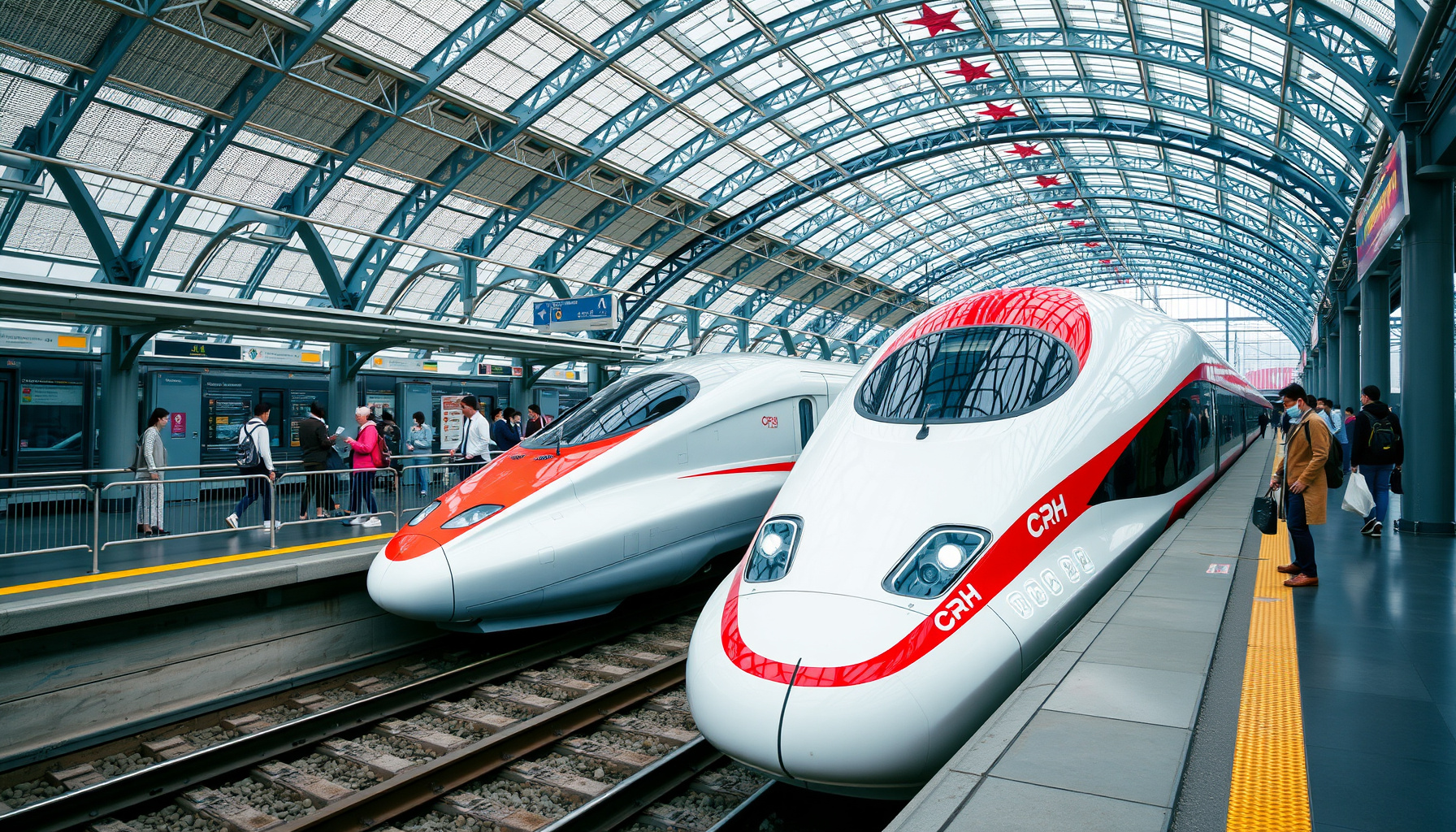
China’s high-speed rail network is now the largest on the planet, with over 45,000 kilometers of track. Trains labeled “G” (gaotie) hit 350 km/h. Trains labeled “D” (dongche) run at 250 km/h. Both are clean, punctual, and shockingly affordable compared to equivalent distances in Europe or Japan.
The stations are usually located in or near city centers, so you skip the long airport transfers. Security screening takes 5-10 minutes, not 45. And you get far more legroom than any economy airline seat. If you’re planning a trip across China, high-speed rail should be your default mode of transport.
✅ High-Speed Rail: Pros
- City-center to city-center — no airport transfers
- On-time rate above 95%
- Far cheaper than flying on most routes
- More legroom and space to walk around
- No liquid restrictions, bring your own food
- Use your phone the entire trip (no flight mode)
- Scenery — you actually see the country
- Departs every 5-30 minutes on popular routes
❌ High-Speed Rail: Cons
- Slower than flying for distances above 1,500 km
- 12306 website/app is painful in Chinese
- Tickets sell out during holidays (Golden Week, CNY)
- Huge stations — allow 30+ min to find your platform
- Wi-Fi is spotty or nonexistent on most trains
- Limited luggage storage for oversized bags
- Onboard food options are overpriced and mediocre
- Announcements primarily in Mandarin
Major Bullet Train Routes in China and What They Cost in 2026
Prices on China’s bullet trains are regulated by the government, so they don’t fluctuate like airline tickets. What you see is what you pay — no surge pricing, no last-minute markups. The table below covers the most popular routes for tourists in 2026.
| Route | Distance | Travel Time | 2nd Class (CNY) | 2nd Class (USD) |
|---|---|---|---|---|
| Beijing → Shanghai | 1,318 km | 4.5 hours | ¥553 | $76 |
| Beijing → Guangzhou | 2,298 km | 8 hours | ¥862 | $119 |
| Beijing → Xi’an | 1,216 km | 4.5 hours | ¥515 | $71 |
| Shanghai → Hangzhou | 202 km | 1 hour | ¥73 | $10 |
| Shanghai → Chengdu | ~1,900 km | 14 hours | ¥1,075 | $148 |
| Guangzhou → Shenzhen | ~115 km | 30 min | ¥75 | $10 |
The Beijing to Shanghai bullet train is the flagship route and the one most tourists ride first. At 4.5 hours for ¥553 ($76), it’s a steal when you consider the Shinkansen from Tokyo to Osaka costs roughly $130 for a shorter distance. The Shanghai to Hangzhou route is perfect for a day trip — one hour and only ¥73 ($10) to reach one of China’s most beautiful cities.
For the Beijing to Xi’an route, you’ll cross through the heart of northern China to reach the Terracotta Warriors. The 4.5-hour ride at ¥515 ($71) beats a flight when you factor in airport wait times. I’d only recommend flying over the bullet train for the Shanghai-Chengdu route, where 14 hours on a train is a serious time commitment unless you genuinely enjoy the journey.
How to Book Bullet Train Tickets in China: Step-by-Step
Booking is the single biggest pain point for foreign travelers. China’s official booking system, 12306, was built for domestic users with Chinese ID cards. It technically supports passport numbers now, but the interface is entirely in Chinese and the payment options can be tricky without a Chinese bank account. Here’s what actually works in 2026.
Trip.com (formerly Ctrip) is the easiest option for foreigners. It has full English support, accepts international credit cards, and lets you search routes by English city names. You’ll pay a small service fee of ¥20-40 per ticket. Alternatively, download the 12306 app and register with your passport number — it’s cheaper but the entire process is in Chinese.
Enter your departure city, arrival city, and travel date. Tickets are released 15 days before the travel date at 8:00 AM China time. For popular routes during holidays, set an alarm and book the moment they drop. Search results show train numbers (G = fastest, D = fast, C = intercity short), departure times, duration, and available seats by class.
Pick 2nd class for value, 1st class for comfort, or business class for the luxury experience. Enter your passport details exactly as they appear on your passport — mismatches will cause problems at the gate. Double-check name spelling and passport number carefully.
On Trip.com, pay with Visa, Mastercard, or PayPal. On 12306, you’ll need Alipay or WeChat Pay (linking a foreign card to these apps is possible but inconsistent). After payment, you’ll receive an e-ticket confirmation with your booking reference number.
Arrive at the station at least 30 minutes before departure. Go through security screening (bag X-ray, similar to airports), then scan your passport at the automated gates. Some stations still require foreigners to use the staffed counter instead of the automated gates — look for the “manual check” window. Your ticket is tied to your passport, so just carry your passport and your booking reference.
A third option: buy at the station counter. Every major train station has ticket windows where you can purchase same-day or advance tickets. Bring your passport, know your destination in Chinese characters (show it on your phone), and point at the time you want. This works fine but lines can be long, and popular trains may be sold out.
Seat Classes on China’s Bullet Trains Explained
China’s high-speed trains offer three main seat classes, and the differences are worth understanding before you book. I’ve ridden in all three, and your choice depends entirely on your budget and trip length.
2nd Class (二等座, er deng zuo) is where most travelers sit, and it’s genuinely comfortable. Seats are arranged 3+2 across the aisle, similar to a wide-body airplane but with significantly more legroom. Every seat has a power outlet, a fold-down tray, and reclines slightly. For trips under 5 hours, 2nd class is all you need. On the Beijing-Shanghai route, 2nd class runs about ¥553 ($76).
1st Class (一等座, yi deng zuo) bumps you up to a 2+2 configuration with wider seats, more recline, and a quieter car. Prices are typically 60-70% more than 2nd class. On Beijing-Shanghai, expect to pay around ¥930 ($128). I’d recommend 1st class for rides over 4 hours or if you need to work — the extra space makes a real difference with a laptop.
Business Class (商务座, shangwu zuo) is the big splurge. Seats are arranged 1+2 or even 1+1, and they recline almost flat — like a domestic first-class airline seat. You get complimentary snacks, drinks, and slippers. Business class on Beijing-Shanghai is around ¥1,748 ($240). I’ve done it once for the experience. It’s fantastic, but hard to justify at nearly 3x the 1st class price unless someone else is paying.
What It’s Actually Like Riding a Bullet Train in China
The first thing that surprises most foreign travelers is how smooth the ride is. At 350 km/h, you barely feel any vibration. I’ve balanced a full cup of coffee on the tray table and watched it sit perfectly still. The trains use a dedicated track system that’s separate from conventional rail, which eliminates the bumps and jolts you’d get on older train networks.
Each car has overhead luggage racks and a storage area at the end of the car for larger bags. There’s no strict luggage limit, but anything over 20 kg or oversized suitcases can be awkward to store. I travel with a 40L backpack and never have issues. The bathrooms are clean by train standards — both Western-style and squat toilets are available, and they’re cleaned regularly on longer routes.
There’s a food cart that rolls through every hour or so, selling instant noodles (¥15), boxed meals (¥40-60), snacks, and drinks. The boxed meals are edible but uninspiring — think rice with braised meat and a small vegetable side. My strong recommendation: buy food before you board. Every train station has convenience stores and fast food near the waiting halls. Bring snacks, fruit, and a water bottle. Hot water dispensers are available in every car if you want to make your own instant noodles or tea.
One thing to know: Chinese trains are generally quieter than you’d expect, but phone calls on speaker are socially accepted. Noise-canceling headphones are your best friend on any bullet train ride in China. The overhead displays show your current speed, next station, and remaining time — useful since announcements are primarily in Mandarin with brief English station names on major routes.
Critical Tips for Foreign Travelers on China’s Bullet Trains
- Carry your passport at all times. You cannot enter the station, pass security, or board a train without it. A photocopy or photo on your phone is not accepted.
- The 12306 app and website are entirely in Chinese. Unless you read Chinese, use Trip.com or have a Chinese-speaking friend help you navigate 12306.
- Automated gates may not read your passport. Many stations have passport-compatible e-gates now, but they sometimes fail for foreign passports. Head to the staffed service window — look for the counter with a human, usually near the far end of the gate area.
- VPN issues affect booking. If you’re already in China, your VPN may interfere with 12306 or Trip.com. Disconnect your VPN before attempting payment.
- Arrive early — stations are enormous. Beijing South has over 20 platforms. Allow 30-45 minutes before departure to clear security, find your waiting hall, and locate your platform gate.
- No name changes on tickets. The name on the ticket must match your passport exactly. If there’s a typo, you’ll need to cancel and rebook.
- Chinese New Year and Golden Week (Oct 1-7) are blackout periods. Tickets sell out within minutes. If you must travel during these periods, book the instant tickets are released — 15 days in advance at 8:00 AM China Standard Time.
- Download offline maps. Cell data can drop in rural stretches and tunnels. Have your destination station name saved in Chinese characters on your phone so you can show it if needed.
A few more practical details that trip up first-timers. Chinese train stations do not have open platforms like in Europe — you sit in a waiting hall and your platform gate opens about 15 minutes before departure. If you miss the gate opening, you miss the train. Listen for your train number on the announcement or watch the departure boards carefully.
Getting between the train station and your hotel is usually straightforward. Most high-speed rail stations connect directly to the city’s metro system. In cities like Beijing, Shanghai, Guangzhou, and Shenzhen, you can step off the bullet train and walk directly into a subway station. For other cities, ride-hailing apps like Didi work well, or there are taxi queues outside every station.
If you’re building an itinerary across China, the bullet train network lets you cover enormous distances efficiently. A popular two-week route might look like: Beijing (3 days) → Xi’an (2 days) → Chengdu (3 days) → Guilin (2 days) → Guangzhou/Shenzhen (2 days) → Hong Kong. Every leg of that trip is connected by high-speed rail, and you’d spend roughly ¥2,500-3,000 ($345-415) total on train tickets in 2nd class.
Best Bullet Train Routes in China for Tourists
Not all routes are created equal. Some are primarily about getting from A to B efficiently, while others give you genuinely great scenery along the way. Here are my picks for the best tourist routes on China’s high-speed network in 2026.
Beijing to Shanghai is the route you’ll likely take first. It’s China’s busiest high-speed corridor with trains departing every 5-10 minutes. The 4.5-hour ride at ¥553 ($76) connects the country’s political capital with its financial capital. The scenery is flat farmland for most of the journey, but the efficiency is unbeatable. Plan to visit both cities during any serious China trip.
Shanghai to Hangzhou is the perfect day trip. One hour, ¥73 ($10), and you’re at West Lake — one of the most photographed spots in China. Trains run every few minutes. You can leave Shanghai after breakfast, spend the full day exploring Hangzhou’s tea plantations and lakeside trails, and be back in Shanghai for dinner.
Beijing to Xi’an takes you to the Terracotta Warriors in 4.5 hours for ¥515 ($71). Xi’an’s Muslim Quarter and city wall cycling loop make it one of the best two-day stops in northern China. The return trip gives you a different angle on the same terrain — I’ve done it both ways and preferred the westbound views in the afternoon light.
Guangzhou to Shenzhen is just 30 minutes at ¥75 ($10). It’s the commuter run of southern China, and it’s ideal if you’re crossing into Hong Kong from the mainland. Shenzhen connects onward to Hong Kong via the Futian or Lo Wu border crossings, making this a practical link in any southern China itinerary.
📱 How to Book China Bullet Train Tickets
- Trip.com — Best English-language app for foreigners. Accepts international cards.
- 12306.cn — Official Chinese rail site. Requires Chinese ID or foreign passport registration.
- Station windows — Take your passport. Staff at major stations often speak basic English.
- Klook / KKday — Pre-purchase tickets with English support, slight markup.
Frequently Asked Questions About Bullet Trains in China
Can I buy bullet train tickets in China without a Chinese phone number?
Yes. Trip.com does not require a Chinese phone number and works with international email addresses. The official 12306 app now accepts foreign phone numbers for registration, though verification texts can be unreliable. If you’re booking through 12306, try using your foreign number first. If it fails, Trip.com is the backup that always works. Station ticket counters also sell tickets to anyone with a valid passport and require no phone number at all.
Is the bullet train in China safe for solo travelers and families?
Extremely safe. China’s high-speed trains have an outstanding safety record, and the security screening at every station means you go through airport-style bag checks before boarding. Solo travelers, including women traveling alone, will find the trains safe and well-monitored with CCTV throughout. Families should know that children under 1.2 meters tall ride free without a seat, and children between 1.2m and 1.5m get half-price tickets. There are no dedicated family cars, but 2nd class seats are spacious enough for a child on your lap.
Do I need to print my ticket, or can I use a digital ticket?
Paper tickets have been mostly phased out in China. For Chinese ID card holders, it’s fully digital — they just swipe their ID at the gate. For foreign passport holders, the system works similarly at stations with passport-compatible e-gates. Scan your passport at the automated gate, and you’re through. At stations where the e-gates don’t support foreign passports, show your passport and booking reference at the staffed counter. Keep a screenshot of your booking confirmation just in case, but you do not need a printed ticket at most stations in 2026.
What happens if I miss my bullet train in China?
If you miss your train, your ticket for that specific departure is forfeited. However, you can go to the ticket counter and exchange it for a later train on the same route on the same day — subject to availability and possible fare differences. You’ll need to pay any price difference if the later train costs more. There’s no penalty fee for the exchange, but you can only do this once. If no same-day trains are available, you’ll need to buy a new ticket entirely. This is why I always recommend arriving at the station 30-45 minutes early.
Can I bring luggage on China’s bullet trains? Is there a weight limit?
There’s no enforced weight limit for carry-on luggage, and there’s no checked baggage system. You bring everything with you onto the train. Each car has overhead racks (similar to airplane bins but larger) and a luggage storage area at the end of the carriage. In practice, one large suitcase and a carry-on bag per person is manageable. Two large suitcases per person gets tight, especially on full trains. There’s no porter service, so you’ll need to handle your own bags through security, up escalators, and down the platform. Pack light if you can — I’ve watched people struggle with four suitcases at Beijing South Station, and it’s not a fun experience.
Is there Wi-Fi on China’s bullet trains?
Some newer trains offer free Wi-Fi, but the speeds are slow and the connection drops frequently, especially in tunnel sections and rural areas. Don’t count on it for video calls or streaming. A Chinese SIM card with 4G/5G data is a much more reliable option — your phone will work for most of the journey except through tunnels. Buy a SIM card at any China Mobile or China Unicom store, or order a travel eSIM before your trip. Budget about ¥100-200 ($14-28) for a 30-day data plan with enough bandwidth for maps, messaging, and basic browsing.
Plan your China trip: The bullet train network is the backbone of independent travel in China. For more destination guides, visa tips, and travel planning resources, check out our complete China travel hub on East Asia Explorer.
Related Reading
More on Transportation:

Written by Sam Konneh
Sam Konneh is an AI strategist and digital marketer based in Seoul, South Korea. With years spent living, working, and exploring across Korea, Japan, and China, he shares firsthand insights into East Asia's cultures, hidden gems, and everyday life. A graduate of Inha University and KDI Graduate School, Sam combines data-driven expertise with on-the-ground experience. His journey also includes studying in Malaysia and traveling through Southeast Asia. Through practical tips, local stories, and travel guides, he helps fellow explorers discover both the celebrated highlights and the lesser-known corners of East Asia.