Last Updated: April 4, 2026 | Originally Published: February 20, 2026
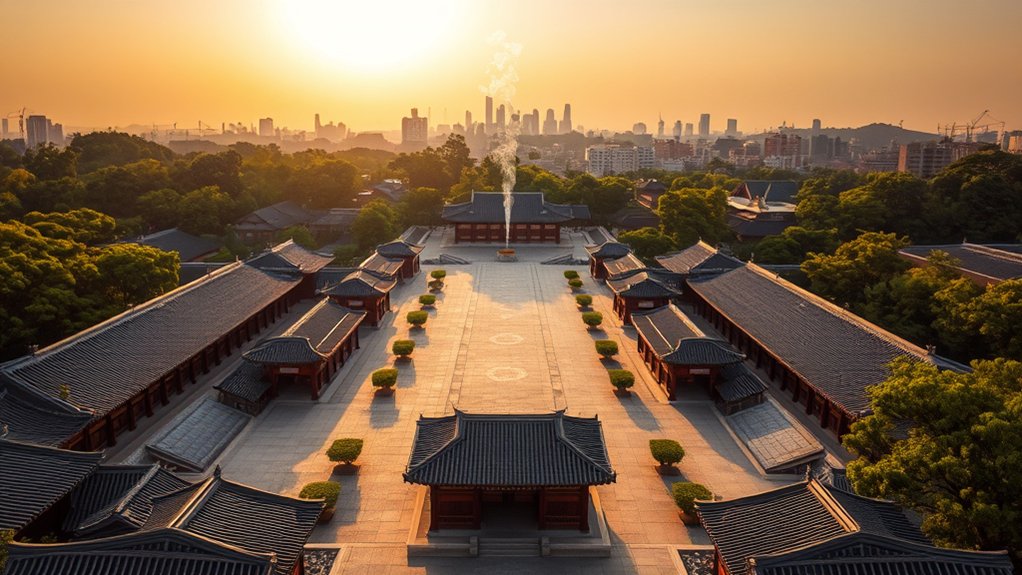
At Jongmyo Shrine in Seoul, you’ll step into Korea’s most sacred royal memorial site, where 600-year-old ancestral rites still happen today. This UNESCO marvel houses 49 royal tablets in its massive wooden halls, where elaborate ceremonies honor Joseon Dynasty kings and queens. You’ll find no fancy decorations here – just pure Confucian minimalism at its finest. Every May, over 1,000 participants don traditional garb to perform ancient rituals that’ll transport you straight back to the 15th century. The secrets of Korea’s royal spirits await within these hallowed grounds.
Read our full South Korea Travel Guide 2026 for everything you need to plan your Korea trip.
Explorer Insights
- Jongmyo Shrine, established in 1394, is Korea’s most sacred royal shrine where ancestral rites have been performed continuously for over 600 years.
- Annual Jongmyo Daeje ceremonies preserve 15th-century ritual protocols, with over 1,000 participants performing traditional rites every May.
- The shrine houses 49 royal spirit tablets in 19 niches, representing the Joseon Dynasty’s legacy through elaborate ancestral offerings.
- UNESCO recognizes both the shrine’s physical structure and its ceremonial rituals as significant cultural heritage elements.
- Traditional Jongmyo Jeryeak music, ancient prayer chants, and ceremonial dances maintain authentic royal ritual atmosphere during performances.
Ancient Royal Confucian Shrine
You’re about to explore Korea’s most sacred royal shrine, where kings have honored their ancestors for over 600 years through elaborate Confucian ceremonies.
The massive Jeongjeon hall stretches an incredible 101 meters, making it Korea’s longest wooden structure – and trust me, they weren’t messing around with the austere design.
Inside those halls, you’ll find 49 royal tablets housed in 19 special niches, each one capturing the essence of Joseon Dynasty’s royal legacy. The shrine was first built in 1394 by Taejo, the visionary founder who established the powerful Joseon dynasty.
- Ancient tablets survived invasions by being hidden in a commoner’s home – talk about dedication
- Three-lane stone paths feature a center lane reserved just for spirits (no jaywalking allowed)
- Annual Jongmyo Daeje ceremonies still follow 15th-century ritual protocols to the letter
- Every architectural detail screams “serious business,” from minimal decoration to precise geomantic alignment
For those interested in accessibility features, visitors will find that many of Seoul’s historic sites, including Jongmyo Shrine, have implemented ramps and accessible pathways, though advance planning is recommended for the most comfortable experience.
Sacred Hall Architecture
While most ancient buildings were built to show off wealth and power, Jongmyo Shrine flips the script with its dead-serious dedication to ritual function. You’ll find sacred geometry at work in its massive 101-meter main hall, where 20 perfectly curved columns create architectural harmony that’ll make your jaw drop. There’s nothing flashy here – just pure, unpainted wood and riveted joints. No nails. No nonsense. Today’s shrine complex spans 19.4 hectares surrounded by tranquil hills and forest. Unlike Changdeokgung Palace, which was designed to embrace the topography in accordance with pungsu principles, Jongmyo focuses purely on ritual purpose.
| Feature | Main Hall | Hall of Eternal Peace |
|---|---|---|
| Purpose | Primary Rituals | Additional Tablets |
| Design | 25 Bay System | Smaller Scale |
| Layout | South-Facing | Follows Main Hall |
| Style | Open Corridor | Matches Main Hall |
This isn’t your typical fancy palace. The shrine’s minimalist design screams “we mean business” with every beam and post serving a ritual purpose. It’s basically the world’s most impressive wooden container for ancestor tablets.
Ancestral Tablet Ceremonies
Sacred smoke rises as 49 royal spirit tablets take center stage in one of Korea’s most mind-blowing religious spectacles.
You’ll witness ancestral offerings that’ll make your head spin – raw meat and grains arranged with cosmic precision. No cooking allowed here, folks.
These aren’t your average family ceremonies. The ancestral tablets, representing Joseon royalty‘s spiritual essence, get the VIP treatment in Jeongjeon Hall.
The ceremonial significance? Massive. We’re talking about a 600-year-old tradition that’s outlasted empires. Everything’s meticulously planned – from the east-west food placement (hello, yin-yang balance) to those specially shaped vessels called Bo and Gwe. It’s ancient feng shui on steroids.
The whole show’s got UNESCO’s stamp of approval. Pretty impressive for a ritual that started in the 14th century. The shrine was originally established in the 4th year of King Taejo to honor the royal ancestors. The intangible cultural heritage system continues to play a crucial role in preserving ceremonies like this for future generations.
Ancient Korean Memorial Traditions
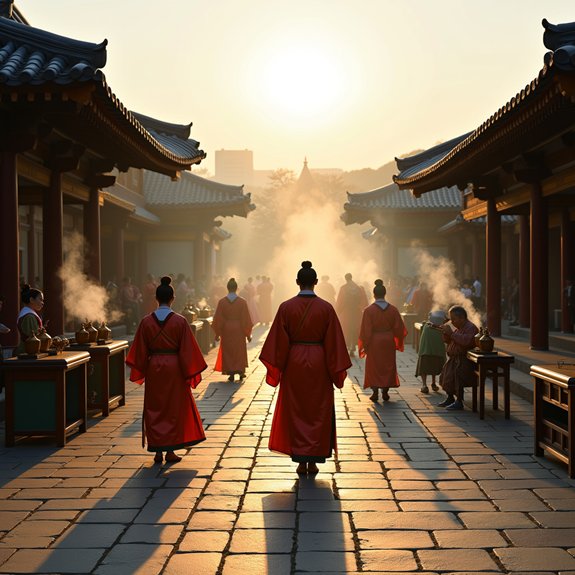
Ancient Korean memorial traditions weren’t just simple ceremonies – they were intricate cosmic dances between the living and the dead. You’d find sacred geography everywhere: burial sites aligned with mountains, graves positioned to harness natural energy flows, and coffins built with six planks representing the cardinal directions plus heaven and earth. The significance placed on Confucian structure and shamanistic soul can still be seen today in Korean cultural and academic practices.
Pretty detailed stuff.
These funeral traditions weren’t playing around. The corpse had to face south or toward spiritually significant landscapes. These ceremonies were performed with utmost sincerity to honor ancestors, just as if they were still alive.
And talk about commitment – Korean families kept building those massive burial mounds long after other cultures had moved on. It’s all about that perfect blend of Confucian structure and shamanistic soul.
Think meticulous timing meets cosmic energy, with a dash of ancestor worship thrown in for good measure.
Ancestral Royal Ceremonies Still Performed
You’d think ancient royal ceremonies would be forgotten by now, but Korea’s got other plans.
Every May, over 1,000 participants dress up in traditional garb and march from Gyeongbokgung Palace to Jongmyo Shrine for a massive ancestral ritual that’ll blow your mind. To reach the Jongmyo Shrine easily, many visitors use Korea’s comprehensive public transit network, with the subway offering signage in English and the handy T-money card accepted throughout the system.
Since its revival in 1969, this UNESCO-recognized ceremony hasn’t missed a beat – proving some traditions just refuse to die. The 2026 ceremony marks 50 years as National Intangible Cultural Heritage.
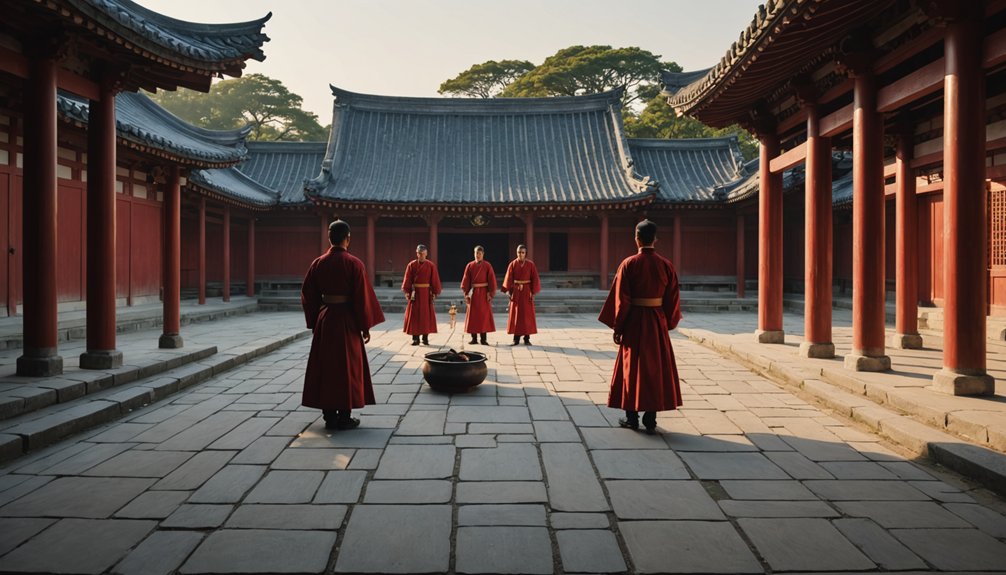
- Priests in full ceremonial attire make offerings of food and wine to royal spirits
- Traditional music called Jongmyo jeryeak fills the air during performances
- The grand procession (eogahaengnyeol) recreates the exact royal parade route
- The newly restored Main Hall hosts the climax of these ancient rites
Annual Royal Memorial Rituals
While modern life in Korea races forward at breakneck speed, there’s one ancient tradition that refuses to fade away. The royal ancestral rites at Jongmyo Shrine, once performed multiple times throughout the year, now take place just once annually – every first Sunday in May. Talk about keeping things simple.
The ceremonial significance hasn’t diminished though. The Jeonju Yi Clan Association, direct descendants of the Joseon Dynasty, still shows up to keep this centuries-old tradition kicking. Traditional ceremonies showcase identical brass ritual vessels arranged on tables to create an atmosphere of classical elegance.
It’s not just some stuffy old ritual – it’s cultural preservation in action. You’ll witness everything from spirit invocations to elaborate food offerings, all following strict Confucian protocols. Sure beats watching it on YouTube.
This living piece of history continues to unite Korean people, bridging the gap between ancient traditions and our fast-paced modern world. For those interested in experiencing other aspects of Korean culture, participating in Kimchi Academy workshops provides insight into traditional Korean cuisine and its importance to national identity.
Modern Day Ceremonial Roles
Ever since Jeongjeon Hall’s stunning $14.1 million makeover, Jongmyo Shrine’s gotten serious about its ceremonial game.
You’ll find over 1,000 participants decked out in traditional garb, performing modern rituals that would make their ancestors proud. Not your average tourist trap, this place.
The cultural significance? It’s everywhere. Those 49 royal spirit tablets aren’t just collecting dust – they’re front and center during annual ceremonies where priests and officials still offer food and wine to royal spirits.
Talk about dedication. And if you think it’s all stuffy tradition, think again. They’re mixing it up with contemporary performances and nighttime music shows. The recent hwanan ceremony marked a historic moment as the first such ritual performed since 1870.
The shrine’s not just living in the past. It’s evolving, adapting, keeping traditions alive while making sure today’s visitors stay interested. Pretty clever, right? Visitors should remember that in Korea, proper etiquette rules are essential for showing respect during these ceremonial occasions.
Korea’s Royal Ancestral Shrine
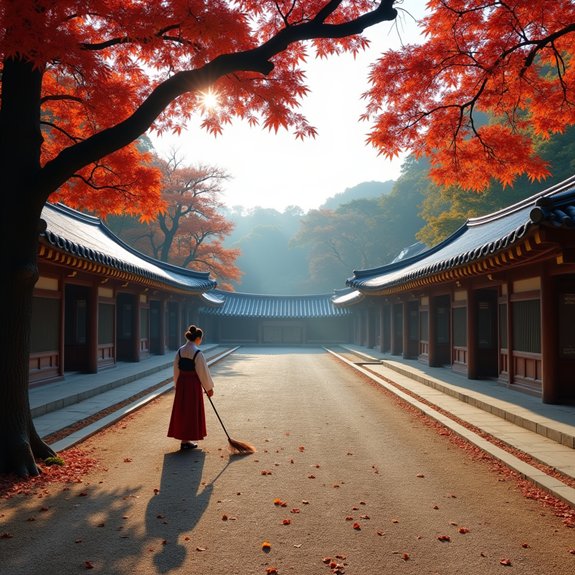
As Korea’s oldest surviving Confucian shrine, Jongmyo stands as a symbol of the nation’s royal heritage with its minimalist yet powerful architecture.
The shrine’s design follows traditional Confucian protocols that strictly define which ancestors can be honored and how they are enshrined.
You’ll find an impressive collection of 49 royal memorial tablets housed within Jeongjeon hall – the longest traditional Korean building that’s survived centuries of turmoil.
These sacred grounds still host annual ceremonies where descendants of the Jeonju Yi clan perform ancestral rites that’ll transport you straight back to the Joseon dynasty. During cherry blossom season, visitors can experience the beauty of Seoul’s blooms in nearby spots like Yeouido Park, adding a touch of spring color to their cultural journey.
- The shrine’s no-nonsense design reflects Confucian values – think straight lines and zero bling
- Hidden heroes saved many royal tablets during the 1592 Japanese invasions
- UNESCO recognized these rituals as Intangible Cultural Heritage in 2008
- The Jongmyo Jaerye ceremony includes traditional music, dance, and enough food to feed an ancient royal court
Sacred Architecture and Layout
Since its construction in 1394, Jongmyo Shrine has stood as a tribute to Korea’s royal architectural genius. You’ll find sacred symbolism everywhere – from the three parallel stone paths of the Sillo to the strategically placed gates. Each element’s got a purpose, and it’s not just for show. The shrine’s remarkable design mirrors the efficiency and precision seen in Korea’s high-speed rail system, which boasts a world-record 99.9% punctuality rate.
The shrine’s layout is a masterclass in architectural harmony. Spread across 19.4 hectares, it’s got two main halls – Jeongjeon and Yeongnyeongjeon. They’re not your average buildings. The design’s perfectly balanced with the surrounding hills and valleys. The emphasis on simplicity and natural harmony reflects core Confucian architectural principles.
Even the gates are thoughtfully placed: spirits enter from the south, the king from the east, and performers from the west. Pretty specific, right? Those square stone platforms outside the east gates? That’s where the king and crown prince showed their respect. No casual strolling allowed here.
Royal Ancestral Tablets Preserved
The royal tablets at Jongmyo Shrine aren’t your average family heirlooms. We’re talking about 49 sacred tablets housing the spirits of Joseon Dynasty rulers – and they’re getting the VIP treatment during a massive restoration project. These sinju tablets, believed to contain ancestral spirits, are temporarily chillin’ at Seonwonjeon Hall until 2026. The handmade clay tiles now adorning Jeongjeon Hall represent a return to traditional materials after years of modern alternatives. For visitors planning to see this cultural treasure, booking tickets in advance is highly recommended, especially during peak tourism seasons.
| Period | Location | Significance |
|---|---|---|
| 1392-1910 | Jeongjeon Hall | Original housing |
| 2021-2026 | Seonwonjeon | Temporary home |
| Post-2026 | Restored Jeongjeon | Grand return |
| Annual Events | Shrine Grounds | Jongmyo Jerye |
| Since 1995 | UNESCO List | World Heritage |
Let’s be real – these aren’t just fancy wooden blocks. They’re the spiritual anchors of Korea’s royal heritage, demanding strict ritual protocols and perfect preservation conditions. UNESCO agrees – they’re kind of a big deal.
Annual Memorial Rites Performed
While modern Seoul buzzes with K-pop and tech, there’s one ancient tradition that stops the city in its tracks every first Sunday in May – the Jongmyo Daeje.
You’ll witness over 1,200 participants in a grand royal parade, starting at Gyeongbokgung Palace and winding through Seoul’s bustling streets.
No quick affair, this one. The memorial significance runs deep – from 9:30 am to 3 pm, you’re looking at pure ancestral reverence in action.
The Japanese tried to shut it down during colonial rule, but you can’t keep a good tradition down. Since 1969, it’s been back and stronger than ever.
UNESCO gets it – they’ve slapped their seal of approval on both the shrine and the ritual. Think of it as Korea’s ultimate family reunion, just with royal ancestors and way more pomp.
If you’re planning to navigate your way to this cultural spectacle, Google Maps offers real-time transit information and offline maps that are invaluable for foreign visitors.
Originally, the ritual was held five times each year during the prosperous Joseon dynasty era.
Spring and Autumn Ceremonies
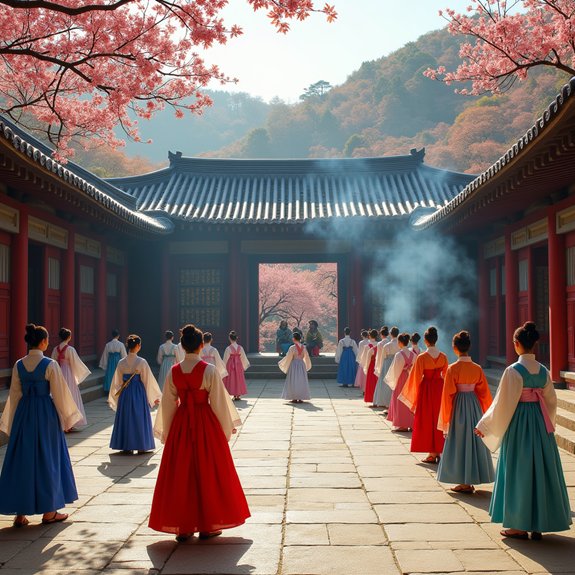
Dating back to ancient Joseon traditions, Korea’s spring and autumn ceremonies at Jongmyo Shrine pack a powerful cultural punch.
You’ll find these seasonal rituals at Yeongnyeongjeon Hall, where they’ve been keeping the ancestors happy for centuries. Sure, they used to do this five times a year during Joseon times, but now it’s mainly just spring and autumn. Talk about streamlining.
What’s really cool is how these ceremonies haven’t lost their edge. They’re still pure Confucian, through and through. The rituals showcase 64 female dancers performing the mesmerizing Parilmu dance.
The music hits different here – authentic court tunes that’ll transport you straight back to imperial times. UNESCO even gave it their stamp of approval.
The enduring popularity of these traditions echoes other grand East Asian festivals, like the Yuyuan Garden Lantern Festival in Shanghai, where intricate rituals and vibrant gatherings illuminate cultural heritage for generations.
Both seasons, same deal: offerings, performances, and enough cultural significance to make your head spin. Ancient wisdom meets modern preservation. Pretty impressive stuff.
Royal Ancestral Ceremonies Calendar
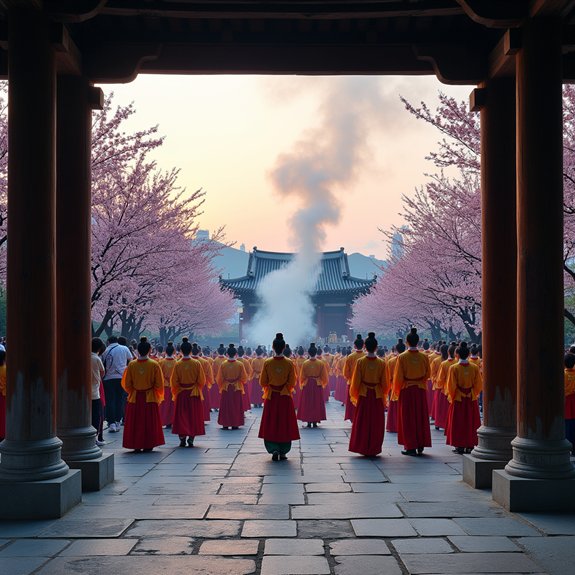
Since ancient times, Korea’s royal ancestral ceremonies have marched to their own beat – and you’d better believe they’re still keeping time.
The ceremonial significance hasn’t wavered: one grand primary rite on May’s first Sunday, plus nighttime shows from late April through early May. Talk about ritual evolution – what was once five seasonal ceremonies during Joseon times has streamlined into one major event that’s been going strong since the 15th century. Beyond royal rituals, off-the-beaten-path destinations across Korea like Gyeongju and Seoraksan offer travelers even more immersive glimpses into the country’s living history.
Mark your calendars for 2026’s special lineup. They’re pulling out all the stops for the 30th anniversary of UNESCO’s World Heritage designation. The Jongmyo Jeryeak music has been an integral part of these sacred rituals for over 600 years.
You’ll catch 1,000+ participants in full regalia at Jongmyo Shrine, complete with traditional music and those signature sacrificial rites. Just hop off at Jongno 3-ga Station. Can’t miss it.
Jongmyo’s Sacred Ancestral Ceremonies
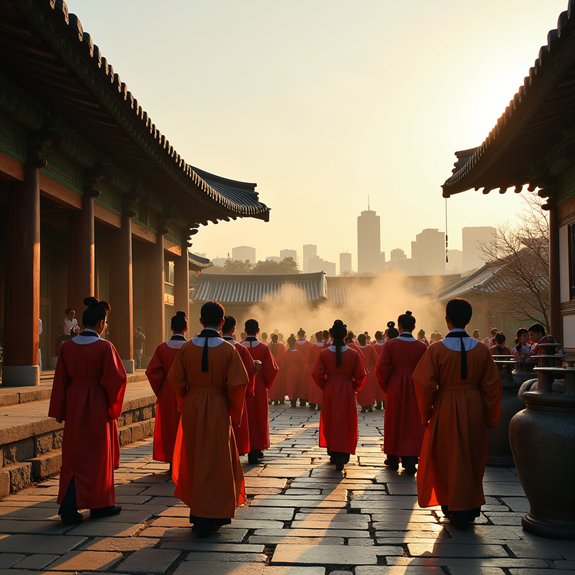
As Korea’s most prestigious state ritual, Jongmyo’s sacred ceremonies pack quite the historical punch. You’ll find five main rituals performed annually in Jeongjeon Hall, where Korea’s ancestral lineage is honored with a precision that’d make your high school band director weep. And yeah, they’ve kept doing it the exact same way since the 14th century – talk about commitment issues. The ceremonies feature elaborate performances of Jerye-ak music accompanied by traditional dancers and musicians. For a different cultural immersion, many visitors also participate in Templestay programs across Korea to experience Buddhist traditions firsthand.
| Ceremony Type | Ritual Significance | Location |
|---|---|---|
| Main Rituals | State Honor | Jeongjeon Hall |
| Crisis Rites | Natural Disasters | Both Halls |
| Life Cycles | Royal Milestones | Jeongjeon Hall |
| Cheonsin | First Harvests | Yeongnyeongjeon |
| Cheongeum | First Hunt | Yeongnyeongjeon |
Today’s ceremonies still follow those strict Joseon-era protocols – bronze bells, jade chimes, and all. The Hereditary Prince Imperial Yi Won presides, sporting traditional hanbok because, let’s face it, you don’t show up to a 600-year-old ceremony in jeans.
Immersive Ancestral Ritual Performances
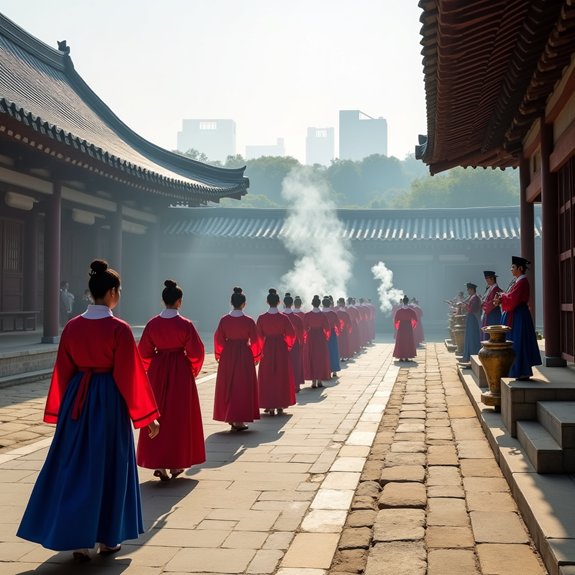
You haven’t lived until you’ve experienced the full sensory blast of a Jongmyo ritual performance – those haunting traditional instruments, the perfectly synchronized dancers in their royal court getups, and yeah, even the ancient prayer chants that’ll give you goosebumps.
The whole thing unfolds like a carefully choreographed time machine, with performers decked out in historical garb moving through designated ritual areas while wielding symbolic objects that would’ve made the Joseon royals proud. The ritual reaches its peak when 64 dancers move in perfect formation, embodying the ancient forces of nature.
And let’s be real – when UNESCO slaps their “Intangible Cultural Heritage” label on something this immersive, with its mix of sacred music, dance, and centuries-old ceremony, you know you’re in for more than just your average tourist trap. The experience rivals the vibrant atmosphere of Korea’s spring flower festivals where cultural performances blend with natural beauty.
Sacred Music and Dance
The haunting melodies of Jongmyo Jeryeak transport visitors straight into Korea’s royal past. These aren’t your typical sacred melodies – they’re deliberately slow, solemn, and packed with centuries of tradition.
The orchestra hits different, with bronze bells and stone chimes creating an otherworldly atmosphere. Yeah, it’s UNESCO-recognized. For good reason.
You’ll witness 64 dancers moving in perfect formation, their ritual dances synchronized to ancient rhythms. Every step matters. Every gesture counts. Audiences interested in UNESCO World Heritage sites will find similar immersive traditions preserved at places like Gyeongju, which was the Silla dynasty’s capital for nearly a thousand years.
They’re wearing color-coordinated jeryeok robes that’ll make your head spin with symbolic meaning. The whole performance is based on two main melodic modes: Botaepyeong for peace and Jeongdaeeop for achievement.
Trust me, when those classical Chinese lyrics start flowing, you’ll feel the weight of 600 years of history. Pure magic.
This Joseon Dynasty ritual connects modern audiences to royal ceremonies dating back to 1392.
Royal Court Ritual Attire
Speaking of mesmerizing performances, let’s talk about what everyone’s wearing – because these aren’t your average Sunday best outfits.
You’ll see officials decked out in Gwanbok, their ceremonial robes dripping with historical significance. And those aren’t just random decorations – every pattern, color, and badge means something. Colors were particularly meaningful, with civil officials wearing cranes on their rank badges to indicate their status.
The real showstopper? The Jeokui, a pheasant-patterned robe that queens wore. Talk about making an entrance. The five colors woven throughout these garments represent virtues like wisdom and trust. Pretty deep stuff for clothing, right?
And don’t even get me started on the silk gauze hats and rank badges – they’re basically the original status symbols. These aren’t just fancy costumes; they’re walking history books, each thread telling a story of ceremonial symbolism and cultural identity.
This tradition continues today in places like Jeonju, where visitors can experience traditional hanok guesthouses and immerse themselves in the rich cultural heritage of Korea’s royal past.
Traditional Ceremony Staging Areas
Sacred spaces demand precise choreography, and Jongmyo’s staging areas are a masterclass in ritual coordination.
You’ll find meticulously planned ceremonial spaces throughout this sprawling complex, from the imposing Jongjeon hall with its 49 royal tablets to the elevated Woldae platform where ancient rites unfold. These sacred grounds host UNESCO World Heritage ceremonies that preserve centuries of Korean royal traditions.
The ritual pathways aren’t random – they’re perfectly calculated. Over 1,100 participants follow strict processional routes through Geumhomun Gate, while musicians take their positions at the Akgongcheo platform. Travelers to Korea can also experience carefully arranged ferry-accessible islands that showcase a similar attention to detail in cultural and natural preservation.
It’s quite the production. The designated kitchen areas prepare traditional offerings like tteokguk, and bronze incense burners mark the cardinal points.
Even the hidden drainage systems play their part, because nothing ruins a solemn ceremony quite like soggy ceremonial robes.
Every detail matters. Every step counts.
Ancient Prayer Chanting Practices
From haunting chants to ethereal melodies, Jongmyo’s ancestral rituals pack a serious spiritual punch.
You’ll witness ancient chants that have survived centuries, passed down from the Joseon Dynasty’s glory days. Let’s be real – these aren’t your average prayers.
The spiritual significance hits different when you realize what you’re hearing. These chants? They’re literally inviting dead royalty to the party. Talk about a high-stakes performance.
The ritual blends Confucian traditions with mystical vibes, creating an atmosphere that’s absolutely electric. Envision this: 64 female dancers moving in perfect sync, while traditional instruments – gongs, bells, and zithers – fill the air. The annual ceremony known as Jongmyo Jerye continues to preserve these sacred traditions.
These ceremonies share roots with Korea’s ancient possessive shamanism where practitioners allow spirits to temporarily inhabit their bodies during rituals.
And yes, they’re offering 64 different kinds of food to the spirits. Because apparently, even ancestral spirits enjoy a good buffet.
Symbolic Offerings and Objects
When you step into Jongmyo Shrine’s ritual space, you’re not just walking into another historic site – you’re entering a spiritual powerhouse where every object tells a story.
The spiritual significance hits you immediately: 49 royal spirit tablets, perfectly arranged, watching over centuries of Korean history.
You’ll spot priests in traditional garb handling ritual vessels with the kind of care you’d give a newborn. The ancestral connections are everywhere. These ongoing rituals embody the deep-rooted principles of Neo-Confucian traditions.
Traditional instruments fill the air with Jongmyo Jeryeak music, while food and wine offerings sit in meticulously designed containers. The priests and participants often demonstrate respectful body language by bowing with straight posture and measured movements, reflecting the reverence central to the rites.
Even the Mangmyoru, where kings once stood to contemplate their predecessors, stands as a symbol of royal reverence.
And yes, they keep all these precious ritual items in the Hyangdaecheong – because even sacred objects need a proper storage space.
Breathtaking Royal Shrine Architecture
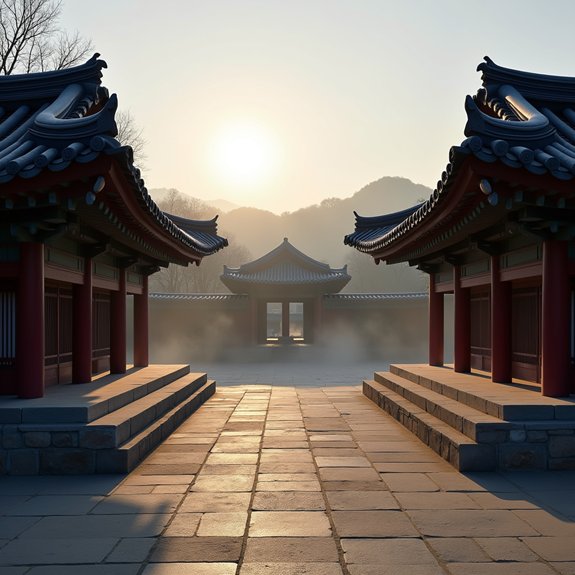
Although many ancient structures claim architectural supremacy, Jongmyo Shrine‘s main hall literally stretches the imagination at a staggering 109 meters – making it the world’s longest single wooden structure.
And get this: every inch screams sacred geometry and architectural symbolism. You’ll find perfectly balanced symmetry that’s almost obsessive, reflecting Korea’s deep-rooted Confucian values. The shrine maintains its simple and elegant design, emphasizing its historical significance. Similar to Japan’s ferry networks, this structure connects visitors to cultural heritage across the region.
Want to know what makes this place truly mind-blowing? Here’s what you’ll see:
- A three-lane spirit path where the middle lane’s reserved for, well, spirits (no shortcuts allowed)
- Rough stone paths that force you to walk slowly (they were definitely not messing around)
- Cedar wood construction that’s stood since the 16th century without a single nail
- Multi-tiered stone platforms that keep everything high and dry (and looking mighty impressive)
Traditional Dance Performances at Jongmyo
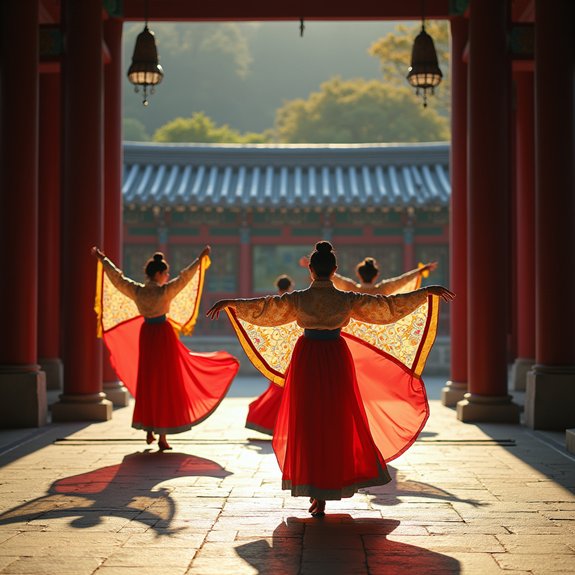
At Jongmyo Shrine, you’ll witness ancient royal dances that haven’t changed much since the 14th century – yeah, they’re that old.
These aren’t your typical K-pop moves; we’re talking about 64 dancers in perfect formation, performing slow, deliberate steps that connect heaven and earth through ritual gestures. You can’t help but be mesmerized by the contrasting styles of civil and military dances, where performers wield everything from ritual wands to wooden shields while traditional instruments set the solemn pace. Much like how lantern festivals such as the Seoul Lantern Festival showcase Korea’s dedication to cultural heritage, these ceremonial dances are a living testament to the country’s reverence for tradition. The ritual dances are part of ceremonies that were traditionally performed five times yearly to honor Korea’s royal ancestors.
- Civil dancers start with their left foot, carrying ritual wands and flutes in muted jeogori outfits.
- Military performers get the cooler props – wooden shields and swords, with right-foot-first movements.
- Two orchestral sections play opposing styles (botaepyong and *jeongdaeeop*) to maintain cosmic balance.
- Dancers form an exact 8×8 grid, because apparently the cosmos loves perfect squares.
Royal Postures and Gestures
Since the royal ancestors deserve nothing less than perfection, every dance move in Jongmyo’s ritual performances must be flawless.
You’ll witness two distinct styles of royal movements: the graceful civil dance (munmu) and the fierce military dance (mumu). Talk about a cultural expression of opposites!
In munmu, 64 dancers move left first, wielding dragon scepters and flutes in perfect formation. It’s slow, controlled, and honestly a bit hypnotic.
But don’t get too comfortable – mumu comes charging in with swords and shields. These warriors aren’t messing around.
The Jongmyo Jeryeak music accompanies each carefully choreographed step of these ancient dances.
The whole thing’s UNESCO-listed, which means it’s kind of a big deal.
If you’re lucky, you can catch these performances during special evening events. Just imagine: flawless choreography under the stars at Korea’s longest wooden hall.
When arriving at the shrine, remember to greet your Korean taxi driver with a polite “annyeonghaseyo” before asking them to take you to Jongmyo.
Sacred Symbols Through Movement
When you’re watching the sacred dances at Jongmyo Shrine, you’re not just seeing any old performance – you’re witnessing a cosmic balancing act.
Sixty-four dancers, perfectly arranged in eight lines, move in slow, deliberate patterns that’ll make your average flash mob look downright chaotic.
The dance symbolism here isn’t subtle. Left steps, right steps. Yin meets Yang. Civil meets military. These ritual movements are a spiritual tug-of-war that somehow ends in perfect harmony.
You’ll see dancers wielding jeok and yak devices while traditional instruments like the piri and daegeum create this haunting backdrop. The scheduled 2026 nighttime performance promises to illuminate these ancient traditions in a mesmerizing new light.
Pretty impressive stuff for a once-a-year show, right? But that’s the point.
UNESCO didn’t slap their “Intangible Cultural Heritage” label on this for nothing. It’s ancient cosmic balance in motion, served with a side of Confucian values.
International students can immerse themselves in Korea’s rich cultural heritage while pursuing their academic programs at prestigious universities across the country.
Musical Score and Steps
The musical backbone of Jongmyo’s sacred performances isn’t your typical orchestra setup. Instead, you’ll find two distinct sections facing off – a perfect Yin and Yang showdown. They’re armed with piri, daegeum, haegeum, and janggu. Pretty intense stuff.
When it comes to dance synchronization, you’ll see eight rows of eight dancers moving with almost painful precision. Left foot first – always.
They’re clutching jeok props with dragon heads in their right hands, small flutes called yak in their left. The musical notation guides them through the botaepyong – soft, gentle tunes that welcome ancestral spirits. The Jongmyo Jeryeak music accompanies these ancient rituals as Korea’s most treasured intangible cultural asset.
No wild martial moves here. Just slow, controlled movements that’ll make you hold your breath. These dancers mean business, and they’ve got five hours to nail it perfectly. Traditional perfection. No pressure.
When observing these performances, remember that silence is considered a sign of respect in Korean communication, showing appropriate thought and consideration for the sacred ritual.
Interactive Jongmyo Ritual Games
You’ve probably never thought about becoming a 15th-century Korean royal dancer, but here’s your chance. At Jongmyo’s interactive ritual games, you’ll learn the precise movements of traditional dances and take part in ceremony reenactments that’ll make your high school theater productions look like amateur hour.
Whether you’re coordinating with 63 other dancers in the parilmu or playing the role of a Joseon king, these immersive experiences bring ancient rituals to life.
- Master the elegant hand gestures and foot positions of the munmu dance while holding traditional props like jeok and yak
- Join a mock royal procession (eogahaengnyeol) wearing period-accurate costumes
- Practice playing traditional instruments like the piri and daegeum in a divided orchestra setup
- Participate in simplified versions of actual Jeongjeon Jehyang ritual sequences
For foreign visitors, Papago translation app can help you understand the ritual instructions and historical context with greater accuracy than other translation services.
Traditional Dance Move Practice
Stepping into the world of Jongmyo ritual dances isn’t for the faint of heart – we’re talking about 64 dancers moving in perfect sync, arranged in meticulous lines of eight.
You’ll find yourself immersed in traditional dance techniques that’ll make your head spin. Left step first, always. No exceptions.
Each dancer embodies the cosmic dance of Yin and Yang, wielding traditional props like the dragon-headed jeok and notched yak flutes.
The cultural dance significance? Massive. We’re looking at a UNESCO Masterpiece here, folks.
The National Gugak Center preserves these moves with religious devotion, making sure every twist and turn stays authentic. It’s performed just once a year, on May’s first Sunday.
And trust me, when those piri and daegeum instruments start playing, you’ll understand why this ritual has survived centuries.
Royal Ceremony Role-Playing
While traditional ceremonies might seem stuffy and rigid, modern technology’s bringing Jongmyo’s royal rituals straight to your fingertips.
Slip into virtual ceremonial costumes through AR overlays, and suddenly you’re not just watching history – you’re living it. Pretty cool, right?
Through ritual storytelling and branching narratives, you’ll navigate King Sejo’s musical reforms and tackle spirit tablet placement puzzles in Jeongjeon’s 19-room layout.
Want to play king for a day? The hierarchical role selection lets you lead virtual spirit-invitation ceremonies. This ancient practice emphasizes the deep importance of ancestor veneration in Korean culture.
Or join 63 other dancers in the Pal Ilmu synchronization challenge – if you dare.
From mastering the Janggu drum mini-games to perfecting your ancestral prayer calligraphy, every detail’s authentic.
Just don’t mess up the 64-dish ceremonial feast. Those ancient spirits are watching.
Royal Court Cuisine Restaurants Nearby
The historic streets around Jongmyo Shrine boast some of Seoul’s finest royal court cuisine restaurants, each serving up dishes fit for a king – literally.
You’ll find Korea House’s legendary gujeolpan just steps away, while Jihwaja’s traditional cuisine has been wowing diners since 1991. For a modern spin, Mugunghwa at Lotte Hotel blends centuries-old recipes with contemporary flair. Many dishes are meticulously reconstructed from the 1795 royal banquet celebrating King Jeongjo’s mother.
- Every dish tells a story from Korea’s royal past
- Ingredients are locally sourced and meticulously prepared
- Presentations are Instagram-worthy works of art
- Staff explain each dish’s historical significance
These aren’t your average Korean restaurants. They’re living museums where culinary heritage comes alive through traditional ingredients and time-honored techniques.
The attention to detail is obsessive – from the delicate seasoning to the ceremonial presentation. Trust us, you haven’t truly experienced Korean cuisine until you’ve dined like royalty.
Traditional Craft Markets Nearby
You’ll find some seriously amazing craft markets within walking distance of Jongmyo Shrine, with the K-Heritage Market at Gyeongbokgung being the crown jewel.
The traditional vendors and artisans, many of whom are designated cultural heritage holders, set up shop with their handmade goods against the backdrop of palace architecture. The Royal Culture Festival brings an extra special energy to these markets each year.
If you’re into authentic Korean crafts, these markets are a gold mine of hanji paper works, ceramics, and royal-inspired designs that’ll make your Instagram followers drool.
- Antique stalls cluster around Insadong’s main strip, packed with everything from centuries-old pottery to questionably “vintage” trinkets.
- The K-Heritage Market showcases UNESCO-recognized craftspeople demonstrating their skills in real-time.
- Local artisans sell modern takes on traditional designs, perfect for those who want something less stuffy.
- Most vendors accept credit cards, but bring cash – you never know when you’ll spot that perfect handmade fan.
Antique Stalls and Vendors
Bustling with life and history, traditional craft markets near Jongmyo Shrine bring Korea’s cultural heritage right to your fingertips.
You’ll find antique craftsmanship on full display, with vendors offering unique pieces that tell stories of generations past. It’s not just shopping – it’s time travel.
These markets aren’t your typical tourist traps. They’re living, breathing cultural spaces where skilled artisans showcase their work. The Spring 2026 festival celebrates intangible heritage traditions through these local artisans and their crafts.
You’ll spot traditional goods everywhere you look, and the market’s location near historic sites adds an extra layer of authenticity.
Want to get hands-on? Many vendors offer craft demonstrations and workshops.
Sure, you could buy souvenirs at the airport, but where’s the fun in that? Here, every purchase supports local artisans and helps preserve Korea’s rich cultural heritage. Pretty neat, right?
Local Crafts and Souvenirs
Rich with heritage-certified artisans, traditional craft markets surrounding Jongmyo Shrine offer way more than your typical tourist trinkets. You’ll find genuine cultural souvenirs crafted by masters who’ve inherited centuries-old techniques. Let’s be real – this isn’t your average gift shop stuff. The 11th K-Royal Culture Festival showcases many of these artisans’ finest works for visitors to purchase and appreciate.
| Must-Have Traditional Crafts | What Makes It Special | Best Time to Buy |
|---|---|---|
| Hanji Paper Products | Handmade by certified artists | Spring Festivals |
| Najeonchilgi Lacquerware | Mother-of-pearl inlay | Year-round |
| Royal-style Embroidery | Authentic palace patterns | Cultural Events |
| Bronze Ritual Replicas | Limited edition pieces | Seasonal Markets |
| Heritage-branded Items | UNESCO certified designs | Festival Weekends |
From gold-leafed accessories to natural-dyed fabrics, every piece tells a story. Sure, they’re pricier than mass-produced souvenirs, but you’re literally buying a piece of Korean history.
Cultural Shopping Walking Routes
While Jongmyo Shrine stands as a solemn tribute to Korea’s past, the surrounding markets burst with life, creating an irresistible blend of history and commerce.
You’ll find five distinct cultural markets, each with its own personality. Dongmyo Flea Market‘s vintage cameras and retro fashion sit near an ancient shrine – how’s that for contrast? Popular designer handbags and jewelry pieces make this market a hotspot for finding vintage luxury items.
The Seoul Folk Flea Market‘s got your antique fix, while Gwangjang Market, Seoul’s first permanent marketplace, serves up both street food and traditional textiles.
Not to be outdone, Namdaemun Market flaunts 600 years of history and killer handicrafts.
For something different, hit up Tongin Market, where you can use old coins at the Dosirak Café.
These shopping routes aren’t just markets – they’re time machines with price tags.
Sacred Three-Day Ceremony Itinerary
You’ll be amazed at how the Jongmyo’s three-day ceremony packs centuries of tradition into one incredible weekend.
The first day kicks off with intense prayer offerings and a royal banquet that’d make your average food influencer weep, complete with traditional dance performances that’ll put your TikTok moves to shame. The sacred rituals take place along special paths for spirits that were designed specifically to separate the routes of kings and ancestral souls.
Day One Prayer Offerings
The scent of sandalwood fills the air as dawn breaks over Jongmyo Shrine, marking the start of an intricately choreographed ritual that would make any modern-day event planner’s head spin.
You’ll witness the *singwallye* begin with turmeric-infused wine, while officials in flowing *danryeong* robes present written prayers with precise, almost military precision.
The prayer symbolism? It’s everywhere – from the three-step backward shuffle after offerings to those maddeningly specific geometric patterns everyone must follow.
Let’s be real: this isn’t your casual Sunday service.
The offering significance gets intense when you notice the ceramic dishes loaded with cooked meats, arranged grains, and seasonal fruits.
Every cup, every bow, every breath seems calculated.
And those eight-direction bows? Yeah, you’d better not mix up your cardinal directions.
The ritual features both Botaepyeong and Jeongdaeeop musical compositions, carefully reorganized under King Sejong’s guidance.
Royal Banquet and Dance
At the heart of this three-day spectacle stands a royal banquet that’ll knock your socks off – we’re talking next-level ancestral respect here.
You’ll witness 64 dancers moving in perfect formation, representing that classic yin-yang harmony while traditional Korean court music fills the air. No big deal, just some UNESCO-recognized royal traditions in action.
The banquet’s got serious cultural significance, rooted in Joseon-era customs from way back in 1392.
Sure, it took a hit during Japanese colonial rule, but since 1969, it’s back and better than ever.
Today, you’ll see traditional Korean instruments like the geomungo and gayageum creating that perfect ceremonial vibe.
It’s basically a crash course in Korean court culture, served with a side of mind-blowing historical dishes. Ancient kings would approve.
Starting at Yeongnyeongjeon hall, the ceremony follows ancient royal protocols with meticulous attention to detail.
Sacred Closing Rituals
Speaking of royal spectacles, sacred closing rituals take this whole ancestral worship thing to another level.
You’ll find yourself in awe as trained officials and royal descendants perform these meticulous rites at Jongmyo Shrine. It’s not just some random ceremony – we’re talking UNESCO World Heritage stuff here.
The sacred significance hits you when you see the separate kitchens (Jeonsacheong) preparing specific offerings, while ritual symbolism comes alive in buildings like Eojaesil and Sejajaesil.
Everything’s got its place, right down to the spirit pathways. And don’t even think about waltzing into restricted areas during ceremonies. The world’s longest wooden structure, the main Jeongjeon hall stretches an impressive 109 meters.
Want to check it out? You’ll need a guided tour on weekdays.
Weekends are more relaxed – just remember to kick off those shoes when required. Pure tradition, no shortcuts.
Take Airport Train to Jongmyo
Getting from Incheon Airport to Jongmyo Shrine involves two main legs: a speedy AREX train ride to Seoul Station, followed by a quick subway hop to Jongno 3-ga Station.
The express train‘s your best bet. Terminal 1? 43 minutes flat. Terminal 2? Add eight more minutes. Sure, you’ll shell out 9,500 KRW, but it beats sitting in traffic. Trains run every 15 minutes – like clockwork. There’s plenty of room for your luggage, too. Travel with a group of three or more and enjoy discounted 8,000 KRW fares.
Just don’t count on those self-service machines taking your foreign credit card. Head straight to the counter instead.
Once you hit Seoul Station, jump on Line 1 to Jongno 3-ga. The subway runs every 10 minutes. A short walk later, you’re standing at one of Korea’s most important UNESCO sites. Simple as that.
Take Bus 162 to Jongmyo
Bus 162 offers another route to Jongmyo Shrine if you’re not keen on trains. The 43-minute journey starts at 중소기업진흥공단, making 38 stops before reaching its final destination. For tourist convenience, hop off at Jongno 3-ga Station – it’s right by the shrine. The bus operates from 4:00 AM to 22:36 daily.
| Feature | Details |
|---|---|
| Duration | 43 minutes |
| Total Stops | 38 stops |
| Key Stop | Jongno 3-ga |
Real-time tracking? You bet. Download Moovit or Citymapper to avoid playing the waiting game. The Bus 162 routes connect you to more than just Jongmyo – you’ll pass through Seoul’s historic neighborhoods and traditional markets. Perfect for cultural vultures who love to explore. Traffic can be unpredictable, so check those apps before heading out. Trust me, you’ll thank yourself later.
Closest Rideshare Pickup: North Gate
The North Gate stands ready as your prime rideshare pickup spot at Jongmyo Shrine. It’s at the northern end of the complex, right by Jongno Street – a busy thoroughfare that’ll be your lifeline to getting out of there.
Let’s talk rideshare logistics. You’ll need to hoof it to Jongno Street for your pickup – no fancy dedicated zones here. But hey, at least you’re near the Jongno 4-ga bus stop, where tons of routes converge.
The setup’s pretty straightforward: exit through the North Gate, hit the sidewalk, and wait for your ride. Just remember, north gate access means dealing with security checkpoints. Since the shrine is open 9:00 AM to 6:00 PM during spring months, plan your pickup accordingly.
And while there’s no direct subway station, you’ve got those charming historical stone paths to keep you company while you wait. Real-time traffic apps? You’ll want those.
Wheelchair Ramps at Shrine Entrance
While historic sites often present accessibility challenges, Jongmyo Shrine’s entrance breaks that mold with its thoughtfully designed ramps. The wheelchair accessibility here isn’t an afterthought – it’s built right into the shrine’s architecture with flat arch stones and gentle slopes.
Visitors should exercise caution on the sloped main entrance when using wheelchairs or strollers.
You’ll find these key features at the entrance:
- Free wheelchair rentals at the information desk (yes, actually free)
- Compacted sand surfaces for stable rolling
- Wide, gentle ramps connecting major shrine sections
- Flat pathways with minimal obstacles
The ramp design seamlessly integrates with the shrine’s historic aesthetic.
Sure, you might need a hand with manual wheelchairs on some uneven spots, but that’s just how ancient sites roll. The entrance area’s completely step-free, though – pretty impressive for a centuries-old shrine.
Remove Shoes Before Entering
Stepping into Jongmyo Shrine demands more than just wheelchair access – you’ll need to ditch those shoes. Proper shoe etiquette isn’t optional here; it’s a 600-year-old tradition that’s still strictly enforced.
Stone steps beneath wooden verandahs mark your barefoot zones, and you’ll spot your kicks lined up with everyone else’s outside. As part of the royal ancestral rituals, visitors must maintain the same respectful practices that have been observed for over 500 years.
Why so strict? Here’s what you’re preserving:
These sacred grounds preserve more than history – they protect living traditions that have shaped Korean culture for centuries.
- Ancient wooden floors that can’t handle modern soles
- Sacred spaces demanding ritual purity
- Traditional Korean architectural heritage
- Centuries-old Confucian ceremonial standards
Visitor respect means following the rules, no exceptions. Even in rain, snow, or scorching heat – those shoes stay out.
Pro tip: pack thick socks in winter, because those stone floors aren’t exactly cozy. Trust me, your Instagram shots will look better without clunky shoes anyway.
Senior Discounts on Wednesdays
Seniors aged 65+ don’t need to sweat the admission fees at Jongmyo Shrine – it’s totally free for them, any day of the week. Senior eligibility couldn’t be simpler: just show up. No special passes needed. No paperwork. No fuss. Period. The shrine’s UNESCO heritage status, granted in 1995, reflects its immense cultural significance.
| Day Type | Regular Price | Senior Price |
|---|---|---|
| Weekdays | 1,000 KRW | Free |
| Culture Wed | Free | Free |
| Weekends | 1,000 KRW | Free |
But here’s the kicker about those discount benefits – you’ll still need to join a guided tour on weekdays. Yeah, it’s mandatory. Though if you’re feeling spontaneous, hit up the shrine on Culture Day (last Wednesday monthly). Everyone gets in free then, and you can skip the tour altogether. Weekends? Those are your wild-card days. No tours required. Just stroll right in.
Traditional Korean Dress Welcome
Two killer perks await hanbok-clad visitors at Jongmyo Shrine: free admission and a deeper connection to Korea’s royal past.
But don’t think you can stroll in wearing just any old thing. There’s a dress code, and they mean business.
You’ll need proper hanbok – a traditional jeogori top with either chima skirt or baji pants. No T-shirt-style tops or ankle-baring bottoms allowed. That’s right – your legs stay covered.
The hanbok significance goes way beyond fashion; it’s about cultural expression and respect for centuries-old traditions. Only wearing a durumagi overcoat alone won’t qualify you for admission.
Can’t bring your own? No worries. Rental shops near Jongmyo offer affordable options.
Modern designs are fine as long as they maintain that classic silhouette. Just remember: buttons fastened, ribbons tied. This isn’t a costume party – it’s living history.
Free Traditional Tea Ceremonies
A reality check for tea ceremony seekers: Jongmyo Shrine doesn’t actually offer free traditional tea ceremonies.
If you try to access the information about ceremonies, you may encounter a CSS load error.
Sure, there are traditional tea offerings during ancestral rites, but those are strictly for royal descendants and officials. Not for tourists. Sorry.
But don’t despair – you’ve got options. The Seoul Global Cultural Center occasionally hosts free tea workshops. Nice.
Some temples near Jongmyo offer free tea meditation sessions, though you’ll need to register ahead.
During festivals like Chuseok, you might stumble upon free tea sampling booths. Score!
And if you’re really curious about Korean tea culture, Insa-dong’s cultural centers provide traditional tea experiences – though you’ll have to pay for those.
Hey, authentic cultural experiences rarely come free.
Travel Insurance Required for Entry
While many travelers assume they’ll need travel insurance to visit Jongmyo Shrine and South Korea, here’s the truth – it’s not actually required.
That said, you’d be crazy not to get it. Various travel insurance options typically cost around 5% of your trip cost. Not exactly bank-breaking stuff.
The travel insurance benefits are pretty sweet. You’ll get coverage for medical emergencies (because nobody plans on getting hurt abroad), trip interruptions (stuff happens), and lost luggage (airlines, am I right?). It’s especially important since Medicare and US health plans won’t cover your medical expenses in South Korea.
Most policies include 24/7 emergency assistance – handy when you’re halfway across the world. Some even cover those adrenaline-junkie activities like rock climbing, if that’s your thing.
Want to skip insurance? Sure, it’s your call. But remember – medical bills in foreign countries aren’t exactly pocket change.
Fire Station Near Jongmyo
Safety isn’t just about travel insurance when you’re visiting ancient wooden shrines. Jongmyo’s fire safety system is serious business, with the Jongno Fire Station keeping watch nearby. You’ll find it within a 3km radius of the shrine – close enough for rapid emergency response when seconds count.
| Location | Response Details |
|---|---|
| Distance | 1-3 km radius |
| Access | Jongno 3-ga Station |
| Coverage | 19-hectare zone |
Let’s be real – wooden structures from 1394 aren’t exactly fireproof. That’s why the UNESCO folks are always fretting about fire risks. The shrine’s already burned down once (thanks, 1592!). Today’s setup includes the Cultural Heritage Administration working with local fire departments, while that surrounding forest acts as nature’s firebreak. Not bad planning for a 600-year-old site. The shrine’s Jeongjeon wooden structure, stretching over 100 meters in length, requires particular attention in fire prevention.
Bring Comfortable Slip-On Shoes
Proper footwear can make or break your Jongmyo visit – literally.
You’ll be walking extensively through the shrine grounds, and those traditional wooden floors aren’t exactly cushioned.
Consider slip-on comfort as your top priority.
These shoes pack shock-absorbing midsoles that are 12.3% softer than average, and they’re super lightweight – essential for all that walking you’ll do.
The breathable mesh uppers will keep your feet from getting sweaty in Seoul’s humidity.
Plus, you won’t waste time with laces when you’re required to remove your shoes multiple times during the tour.
Just don’t expect miracle arch support.
These shoe styles prioritize convenience over stability.
But hey, at least they’re machine-washable when you inevitably step in something questionable.
And the memory foam insoles?
Your tired feet will thank you later.
For budget-conscious travelers, the Skechers Summits at $65 offer excellent value without sacrificing comfort.
Explore Ancient Confucian Wisdom
Beyond the physical grandeur of Jongmyo lies a fascinating web of ancient Confucian principles that’ll blow your mind. You’re not just walking through another old building – you’re stepping into a living embodiment of Confucian ethics and ancestral reverence that’s been kicking since 1394.
- The shrine’s design isn’t random – it’s a perfect balance of yin-yang energy along that north-south axis.
- Those 19 spirit chambers? They’re cosmic VIP rooms for royal ancestors.
- Every ritual move is choreographed down to the last bow (and there are lots of bows).
- The whole setup links royal authority to universal harmony – pretty clever political move, right?
The Royal Court Orchestra performs ancient ritual music that dates back to the Goryeo period, adding another layer of spiritual significance to the ceremonies.
Let’s be real – this place has outlasted empires, wars, and centuries of change.
Still standing. Still relevant. Still absolutely mind-bending in its philosophical depth.
Travel Insurance Coverage Options
When you’re exploring historic sites like Jongmyo Shrine, you’ll want solid travel insurance that covers medical emergencies up to $10,000 with basic plans or a whopping $8M with premium options like Patriot Platinum.
Your standard coverage should include trip cancellation protection for those inevitable travel disruptions, from sudden illnesses to extreme weather events that could derail your Korean cultural adventure. Emergency medical evacuation and repatriation services are essential features to look for in your policy when traveling to South Korea.
If you’re planning any adventurous side trips, look for policies with hazardous activity riders – they’ll keep you covered while you’re scaling those temple steps or attempting that precarious selfie angle at the shrine (though maybe don’t tell your insurance company about that last part).
Medical Emergency Coverage Limits
Let’s be real – skimping on medical coverage is a gamble you don’t want to lose. Standard emergency expenses typically range from $50,000 to $2 million, depending on your policy tier. Yeah, that’s a huge spread.
Here’s the deal: you’ll want at least $100,000 for high-risk trips. Those X-rays and hospital stays after a clumsy tumble? They add up fast. For proper peace of mind, most travelers opt for primary coverage plans.
And if you’re thinking your pre-existing conditions are covered – think again. They’re usually not, unless you’ve specifically added them.
The longer your trip, the more coverage you’ll need. Simple math, really.
And those fancy premium upgrades? Sometimes doubling your coverage only bumps up the cost a little. Go figure.
Trip Cancellation Protection Options
Ever wondered why trip cancellation coverage is like an escape hatch for your travel plans? Well, it’s your financial safety net when life throws curveballs at your travel dreams.
You’ll get reimbursed up to 100% of those non-refundable expenses – flights, hotels, tours – if you need to cancel for covered reasons.
But here’s the real kicker: insurance options aren’t all created equal. Standard trip cancellation covers the basics – illness, injuries, nasty weather. The average traveler spends about $414 per policy for a two-week trip.
Want more flexibility? Enter Cancel For Any Reason (CFAR). Yeah, it costs extra, but you’ll get 50-75% back even if you cancel because your cat looked at you funny.
Just remember – you’ve got to snag that CFAR coverage quick, usually within 10-21 days of booking. Timing is everything, folks.
Adventure Activities Insurance Benefits
Four critical types of coverage make adventure travel insurance worth its weight in gold – especially when you’re dangling off a cliff or plunging into ocean depths. From mountain climbing above 3,000 meters to scuba diving in the deep blue, adventure sports insurance benefits have got your back. No medical deductibles? Yes, please! And when your gear gets damaged or stolen, you’re covered there too.
| Coverage Type | What You Get |
|---|---|
| Medical | Emergency evacuation, injury treatment |
| Equipment | Gear damage, theft protection |
| Emergency | 24/7 assistance, search & rescue |
| Activities | Climbing, diving, rafting covered |
| Customization | Flexible plans, extreme sports bundles |
Let’s face it – nothing ruins an adrenaline rush quite like worrying about insurance. That’s why providers offer real-time policy adjustments and specialized bundles for the truly adventurous.
How to use
Visiting Jongmyo Shrine isn’t as simple as walking through the front door. You’ll need to follow specific protocols to experience this incredible piece of Korean history.
First things first – check the opening hours and grab a guided tour. Trust me, you’ll want one. The shrine’s traditional ceremonies and cultural significance aren’t exactly self-explanatory.
Want the full experience? Time your visit for the first Sunday in May when they perform the royal ancestral rituals. It’s quite a show – traditional music, ceremonial dress, the works. You’ll need to book in advance through a cultural organization though. No spontaneous ritual-crashing allowed.
For regular visits, there’s an entrance fee. And hey, while you’re exploring Asia’s longest wooden building, show some respect. This isn’t your average tourist trap – it’s a 14th-century masterpiece.
Replace Seoul, Korea with the palace name in your ZimmWriter bulk or custom outline tool
Deep in the heart of Korea’s cultural center, Jongmyo Shrine stands as a tribute to royal heritage, nestled between the grand Changdeokgung and Gyeongbokgung Palaces.
The royal lineage comes alive here – seriously, you can practically feel the centuries of traditional offerings and rituals seeping through the walls. It’s not just another tourist stop; it’s where history gets real.
| Feature | East Gate | West Gate |
|---|---|---|
| Access | Royalty Only | Ritual Performers |
| Purpose | Ceremonial Entry | Service Entry |
| Status | Super Fancy | Less Fancy |
Talk about playing favorites – even the gates had a strict hierarchy. Kings would strut through the East, while everyone else? Yeah, you’re using the West gate, buddy. That’s just how they rolled in Joseon Dynasty style.
Majestic Jongmyo Stone Pathways
Speaking of fancy entrances, you haven’t seen anything until you’ve checked out Jongmyo’s epic stone pathways. This isn’t just some random rock collection – it’s a masterpiece of stone path symbolism that’s been around since 1394.
The shrine features three distinct paths: one elevated center path for spirits (because apparently, ghosts need their own VIP lane), and separate paths for the king and crown prince.
The ritual movement significance here is no joke. Those irregular stones? They’re purposely rough to slow you down – can’t have anyone sprinting through sacred ceremonies.
And get this – they built the whole thing without mortar. Just rocks stacked perfectly for 600+ years. Now that’s what you call construction skills.
UNESCO clearly thought so too, making it part of their World Heritage list in 1995.
, , , and create structured subheadings and lists for richer content.
You’ll be amazed how Jongmyo Shrine still buzzes with spiritual energy after all these years – it’s not just some dusty old building.
The sacred rituals that once filled these halls continue today, preserved with the same careful attention that keeps the shrine’s impressive architecture intact.
Walking these grounds, you’re literally stepping into Korea’s royal past, where ancient Confucian traditions meet modern dedication to cultural preservation.
- Jongmyo Jerye rituals happen five times yearly, following the exact same steps kings used centuries ago
- The shrine’s unique spatial layout remains unchanged since the Joseon dynasty
- UNESCO recognized both the physical shrine and its intangible cultural practices
- Traditional ceremonies still include everything from ancestor worship to prayers for good harvests
Spiritual Rituals Still Practiced
While many ancient traditions have faded into history, Korea’s Jongmyo Shrine still pulses with spiritual energy every first Sunday in May. Over 1,000 participants – actual descendants of Joseon royalty – gather to honor their ancestors through an intricate ritual that’s survived since the 15th century. No shortcuts here.
The spiritual significance runs deep. You’ll witness a three-part ceremony where spirits are welcomed, entertained, and bid farewell.
UNESCO-recognized ritual music fills the air – we’re talking bronze bells, jade chimes, and double-reed flutes. Dancers perform civil and military routines while singers praise virtuous kings.
Sure, they’ve simplified things since 1971. But the core remains: precise offerings, three ritual cleansings, and strict protocols that’d make your high school principal look casual.
Architecture Preserves Royal History
Beyond the living rituals lies something equally extraordinary – the architecture that’s housed these sacred ceremonies for over 600 years.
You’ll find architectural symbolism everywhere at Jongmyo. That three-lane spirit path? The center’s strictly for ancestral spirits. No shortcuts allowed. The main hall stretches an impressive 109 meters – world’s longest wooden structure of its kind. Pure architectural flex, ancient Korea style.
The shrine’s cultural preservation efforts are intense. No artificial lighting in the main halls. Period. The wooden joints don’t even use nails – it’s all mortise-and-tenon for earthquake safety. Smart thinking, right?
Even the rough stone paths serve a purpose, forcing visitors to slow down and show some respect. Every detail here tells a story of power, restraint, and centuries of royal tradition.
Frequently Asked Questions
Are Photographs Allowed During the Sacred Ancestral Ceremonies?
Yes, you can take photos during ceremonies – but don’t be that person who ruins it for everyone.
Photography etiquette is essential: no flash, no commercial shots, and absolutely no disrupting the sacred respect of the ritual.
Keep quiet, follow the guides’ instructions, and stay off those spirit pathways.
Simple rule? If your camera might disturb others or the ceremony, put it away.
What Happens if It Rains During Scheduled Outdoor Ritual Performances?
Don’t worry – they’ve got a solid rain contingency plan.
Thanks to King Taejong’s smart thinking, there are east and west wings specifically designed for this purpose. When it pours, outdoor rituals smoothly shift indoors.
Everything’s built to keep the ceremonies going, rain or shine. The shrine’s architecture isn’t just pretty – it’s practical.
Those covered areas and indoor halls? They’re your weather backup plan.
How Long Does It Take to Train as a Ceremonial Ritual Performer?
You’ll need serious dedication – this isn’t like learning TikTok dances.
Training as a ceremonial performer takes multiple years of intensive study. You’re mastering everything from complex dance formations to ancient music compositions.
It’s a multi-year commitment where you’ll learn ritual protocols, ceremonial postures, and specific performance techniques.
First comes basic training, then advanced work on specialized rites.
No shortcuts here – just pure commitment and practice.
Can Visitors Participate in Any Parts of the Ancestral Ceremonies?
No, you can’t actively participate in the ancestral ceremonies – you’re strictly a spectator here.
Ceremonial etiquette is pretty clear-cut: visitor involvement is limited to respectful observation from designated areas. Period.
That’s just how it works. The ritual performers have trained for years to maintain these sacred traditions, and they’re the only ones who get to do the actual ceremonial stuff.
Just watch and learn.
Are There Age Restrictions for Attending the Nighttime Ceremonial Performances?
You’ll need to be at least 7 years old – born before 2018 – to catch these nighttime performances.
It’s not just some random rule. Safety first in those low-light conditions.
If you’re school-aged (that’s 7-18), don’t think you’re sneaking in solo – you’ll need a guardian tagging along.
But hey, if you’re older? Come on in. There’s no upper age limit to stop you from experiencing the magic.
Conclusion
You won’t believe this – Jongmyo Shrine‘s been hosting royal ancestral ceremonies since 1395! That’s over 600 years of continuous ritual practice. Today, it’s still going strong as the world’s longest-running Confucian ceremony. Pretty impressive for an ancient tradition, right? When you’re there, walking those majestic stone pathways, you’re literally stepping through centuries of Korean royal history. Not bad for a UNESCO World Heritage site that’s still kicking.
More on Transportation:

Written by Sam Konneh
Sam Konneh is an AI strategist and digital marketer based in Seoul, South Korea. With years spent living, working, and exploring across Korea, Japan, and China, he shares firsthand insights into East Asia's cultures, hidden gems, and everyday life. A graduate of Inha University and KDI Graduate School, Sam combines data-driven expertise with on-the-ground experience. His journey also includes studying in Malaysia and traveling through Southeast Asia. Through practical tips, local stories, and travel guides, he helps fellow explorers discover both the celebrated highlights and the lesser-known corners of East Asia.