Last Updated: June 28, 2026 | Originally Published: February 24, 2025
Learning Korean starts with mastering Hangul, the scientific alphabet created by King Sejong in 1446. You'll begin with 24 basic characters (14 consonants and 10 vowels) and progress to understanding essential rules like vowel harmony and consonant position changes. As you advance, you'll grasp the pivotal honorific system that reflects Korean social hierarchy. With consistent practice through K-dramas, music, and language apps, you'll
Read our full South Korea Travel Guide 2026 for everything you need to plan your Korea trip.
Explorer Insights
- Start with Hangul's 24 basic characters (14 consonants, 10 vowels) and master syllable formation rules: consonant first, then vowel.
- Practice Korean vowel harmony patterns, understanding how positive, negative, and neutral vowels affect word meanings and combinations.
- Learn the four essential rules governing consonant position changes, including nasalization and how ending consonants influence following syllables.
- Master honorific expressions and speech levels, adjusting formality based on age, status, and social context.
- Utilize modern learning tools like K-dramas, K-pop, and language exchange apps while labeling household items for constant exposure.
The Origins and Evolution of Hangul
How did a revolutionary writing system emerge that would forever change Korea's literacy landscape? In 1446, under the visionary leadership of King Sejong the Great, a remarkable alphabet called Hunminjeongeum (later known as Hangul) was created to help common people read and write. (Source: Korea Tourism Organization)
You'll be fascinated to learn that Hangul wasn't just another alphabet – it's a scientific system where consonants mirror the shape of your speech organs when pronouncing them. The vowels draw inspiration from philosophical concepts, with circles representing heaven and horizontal lines symbolizing earth. Prior to Hangul's creation, societal elites alone could read and write. While elite scholars initially rejected it as a "vulgar script," Hangul survived through determination and grassroots adoption. Consistent practice is key to mastering basic Korean vowel sounds. Today, it's UNESCO-recognized as a "Memory of the World," and you'll see its success reflected in South Korea's impressive 98.8% literacy rate, fulfilling King Sejong's dream of universal education.
Breaking Down Korean Alphabet Fundamentals

Now that you understand Hangul's incredible origins, let's explore the building blocks that make this writing system so remarkably efficient. The Korean alphabet consists of 24 basic characters – 14 consonants and 10 vowels – that you'll combine to create syllable blocks.
You'll start with consonants like ㄱ (similar to "g/k"), ㄴ ("n"), and ㅁ (which looks like "M"), then add vowels such as ㅏ ("a"), ㅓ ("eo"), and ㅗ ("o"). While Korean doesn't have sounds like F, V, R, or Z, you'll learn to create these using clever combinations of existing letters. King Sejong the Great created this revolutionary alphabet in 1443 to help improve literacy rates across all social classes.
To form syllables, you'll always follow a simple rule: consonant first, then vowel. With practice and proper stroke order, you'll soon be creating thousands of different syllable combinations with confidence. Koreans use honorific language and slight bows when asking for directions, an important aspect of cultural etiquette.
Essential Pronunciation Rules and Patterns
Understanding how Korean consonants shift positions between syllables will help you pronounce words more naturally, as you'll notice letters often move or change when they meet certain companions. You'll find that ending consonants tend to jump forward to the next syllable when it begins with a vowel, creating smoother passages between sounds. When you're learning vowel harmony patterns, you'll discover that certain vowels naturally group together, which will guide you in choosing the right vowel combinations as you build your vocabulary. Words containing ending consonants like ㄱ, ㄷ, or ㅂ followed by a nasal sound will undergo nasalization into ㅇ, ㄴ, ㅁ respectively. Additionally, mastering non-verbal communication is crucial for effective interactions with Koreans.
Consonant Position Changes
Four essential rules govern how Korean consonants change position and sound when they appear in different parts of a word. When you're learning Korean pronunciation, you'll notice that ending consonants often move to the next syllable if it starts with a vowel, though ㅇ (ng) stays put and ㅎ becomes silent. These position changes help maintain proper re-syllabification patterns in natural speech.
You'll also find that some consonants simplify at the end of words – aspirated sounds become basic ones, and double consonants reduce to single forms. When certain consonants appear at the end of a word, they can make the next syllable's initial consonant stronger, like in 학교 (pronounced as 학꾜). Finally, you'll encounter nasalization, where consonants like ㄱ change to ㅇ before ㄴ or ㅁ, making words flow more naturally when spoken. Using a map app or asking locals for directions can help navigate the complex addressing system in Japan.
Vowel Harmony Basics
Korean vowel harmony works like a musical balance, where certain vowels naturally pair together to create harmony in words and expressions. The system divides vowels into three main groups: positive (yang), negative (eum), and neutral, each carrying different emotional weights in the language.
You'll notice that positive vowels like 'a,' 'o,' and 'u' often express brightness and lightness, while negative vowels like 'e' and 'i' convey darker or heavier meanings. For example, when you're expressing sympathy, you'll use "아이고" (aigo), but when showing discomfort, you'll say "어이구" (eoigu). This harmony also affects how words change form, especially in adjectives and verbs. When you're learning conjugations, you'll need to match the suffix vowels with the stem vowels to maintain proper harmony. Traditional Korean displayed strong vowel harmony in both inflectional and derivational affixes, though this feature is less prominent in modern usage. Utilizing gamified language learning apps can help you practice and reinforce these important Korean pronunciation patterns.
Building Blocks of Korean Grammar

When building a strong foundation in the Korean language, the basic grammar structures serve as essential building blocks for effective communication. You'll notice that Korean sentence structure differs from English, with verbs always appearing at the end of sentences. This subject-object-verb order might seem challenging at first, but you'll get used to it with practice. Korean verbs can be divided into two main types: action and descriptive verbs, each serving distinct grammatical functions. One of the most important aspects you'll need to master is the honorific system, which shows respect through special verb endings and suffixes. When you're speaking to someone older or in a formal situation, you'll use polite endings like -요 or -니다. The good news is that Korean grammar offers some flexibility, allowing you to rearrange words while keeping the verb at the end. Remember, these patterns will become more natural as you practice them in real conversations.
Understanding the Korean Particle System
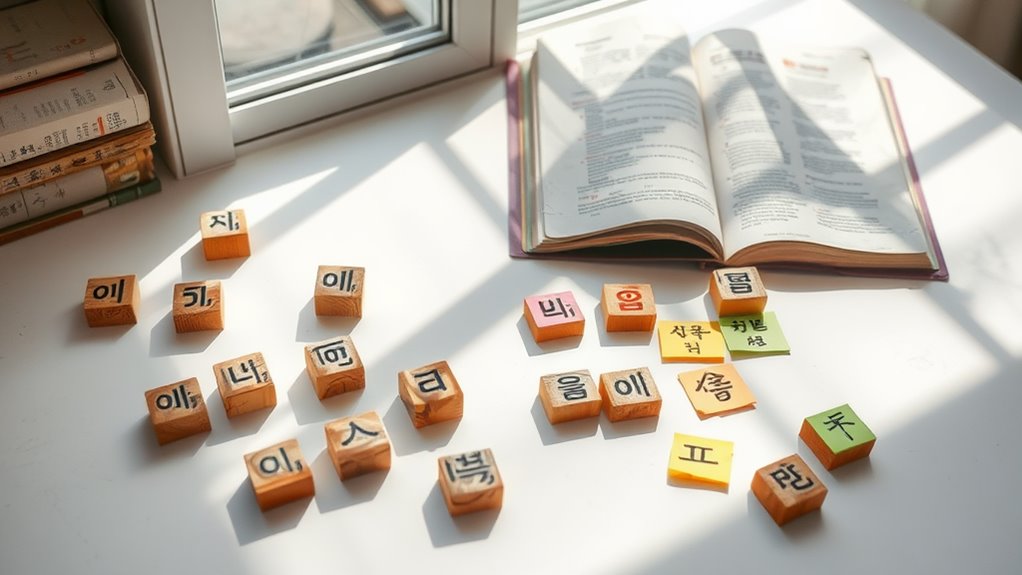
The intricate system of particles stands at the heart of Korean grammar, acting as essential building blocks that connect and modify words within sentences. You'll find that mastering these particles will help you express yourself more naturally in Korean, as they indicate the roles of different words in your sentences. Learning particles is crucial for achieving fluency in speaking Korean.
When you're learning Korean particles, focus on these key points to create vivid mental connections:
- Think of topic markers (은/는) as spotlights that highlight the main subject.
- Visualize subject markers (이/가) as name tags identifying who's performing the action.
- Picture object markers (을/를) as arrows pointing to what's receiving the action.
Recognizing key food-related characters will also help you better navigate Korean menus without speaking the language. You'll notice that particles change based on whether words end in consonants or vowels, making them adapt naturally to the flow of the language. Start with the basics, and you'll gradually build confidence in using them correctly.
Core Vocabulary Development Strategies
Building a strong vocabulary foundation is essential for your journey to Korean language mastery, and you'll find that using the right strategies can make this process both enjoyable and effective. Start by setting clear goals that align with your interests, whether you're learning Korean for travel, work, or entertainment.
Begin with foundational words you'll use every day, like greetings, numbers, and colors. Make flashcards and stick notes around your home to reinforce these basics. You'll learn faster when you study words in context, so try reading simple Korean texts or watching K-dramas with subtitles. Use vocabulary-building apps for daily practice, and don't forget to create your own sentences with new words. Regular exposure to Korean media content through movies and music provides authentic vocabulary in real-world contexts. For the best results, combine digital tools with immersive experiences like virtual language exchanges or Korean cultural activities.
Mastering Korean Honorific Expressions
When you're learning Korean, you'll quickly notice that honorific expressions form the backbone of polite social interactions, varying based on both the speaker's and listener's status. You'll need to master different speech levels, from casual to formal, which change depending on whether you're talking to friends, elders, or business colleagues. As Korean society evolves, understanding modern honorific trends is essential, as younger generations tend to use more relaxed forms while still maintaining respect in professional and family settings. The proper use of honorific titles with the suffix "-nim" is particularly important when addressing senior family members or respected professionals. Bowing is a fundamental gesture indicating varying levels of respect in Korean culture, with different degrees of bow reflecting the formality of the situation.
Speech Levels in Practice
Successfully mastering Korean honorific expressions opens up a whole new dimension of meaningful communication in Korean culture. When you're speaking Korean, you'll need to adjust your speech level based on who you're talking to and the social context. Korean language reflects its deep cultural values through lunar calendar traditions when determining age-based honorifics.
To help you navigate speech levels effectively, remember these key practices:
- Use -시/-으시 endings with verbs when speaking to elders or superiors
- Replace everyday words with honorific terms (집 → 댁, 사람 → 분) in formal situations
- Add polite particles like -께서 when referring to respected individuals
You'll find that Korean speakers appreciate your effort to use appropriate honorifics, even if you make small mistakes. With practice, switching between formal and casual speech will become more natural, helping you build stronger relationships in both professional and personal settings. Additionally, understanding the concept of banchan, the various side dishes served alongside the main meal, can enhance your dining experience in Korean restaurants.
Social Status Impact Rules
Understanding Korean social status rules forms the foundation of proper honorific usage in everyday communication. When you're speaking Korean, you'll need to contemplate both age and social position to choose the right honorific terms. For family members and elders, you'll use specific titles like 오빠 (older brother) or 할머니 (grandmother), adding the respectful suffix 님 when appropriate.
In professional settings, you'll want to use occupation-specific honorifics like 선생님 for teachers or 의사님 for doctors. Remember to pair these titles with formal speech levels and respectful gestures, such as bowing or using both hands when exchanging items. These practices aren't just about language – they're essential social customs that show respect and maintain harmony in Korean society. The honorific verb forms change significantly when addressing someone of higher status. You'll find that mastering these rules helps you navigate social interactions more confidently.
Modern Honorific Usage Trends
Modern Korean honorific usage has evolved considerably from its traditional roots. You'll notice that younger Koreans are embracing simpler, more flexible honorific styles that prioritize harmony over strict hierarchy. In today's digital age, you'll find that many traditional forms are giving way to more practical, context-dependent expressions. Understanding that formal polite form remains essential for daily interactions with strangers and elders helps navigate social situations appropriately.
Three key changes you'll encounter in modern Korean speech:
- The rise of banmal (반말) and haeyoche (해요 체) as preferred casual speaking styles
- Digital-friendly honorific abbreviations in text messages and social media
- Workplace settings shifting toward professional titles instead of complex honorific endings
When you're learning Korean, focus on mastering these contemporary patterns rather than outdated formal styles. Remember, it's perfectly acceptable to use simplified honorifics in most casual situations, as long as you maintain basic respect and awareness of social context.
Speech Levels and Social Context
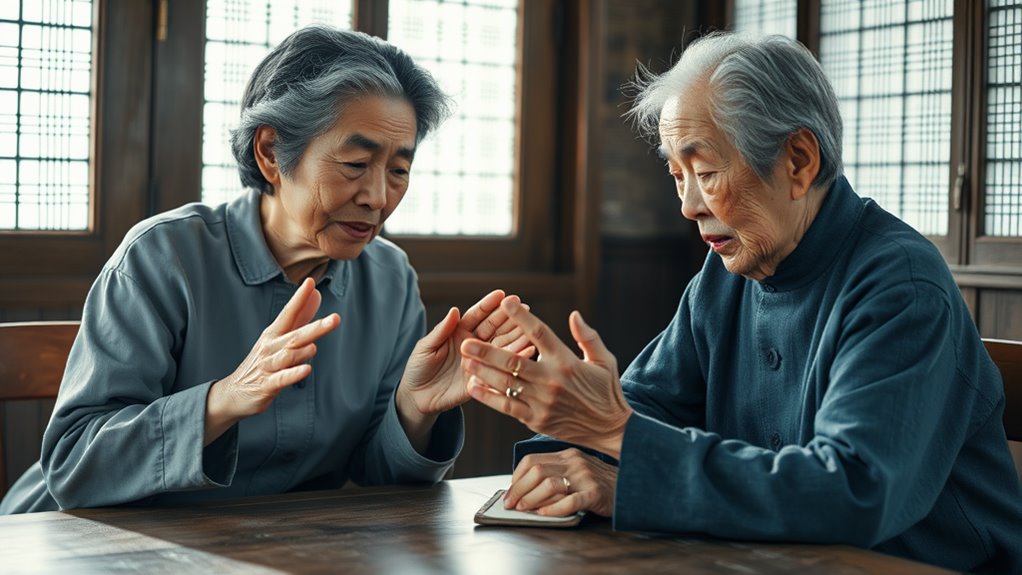
The intricate world of Korean speech levels reflects the deep cultural values and social hierarchy within Korean society. When you're traversing conversations in Korean, you'll need to master different levels of formality to show proper respect and build relationships effectively.
In everyday situations, you'll mainly use two informal levels: 해요체 (polite) for strangers and elders, and 해체 (casual) for close friends. You'll find that age plays a pivotal role, as even strangers who are older deserve respectful speech. Over 70 million speakers worldwide must navigate these complex speech patterns to communicate effectively. In professional settings, you'll need to use formal speech levels like 존댓말 with supervisors, regardless of how well you know them.
Common Speaking Challenges and Solutions

When learning Korean as an English speaker, you'll encounter several pronunciation challenges that stem from fundamental differences between the two languages. Common issues include consonant substitutions, vowel merging, and stress patterns that differ from English. Korean learners often struggle with certain word endings, where they tend to add a vowel sound after consonants. Don't worry though – with practice and awareness, you can overcome these obstacles.
Here are three visual ways to think about mastering Korean sounds:
- Imagine your tongue as a nimble dancer, learning to move between L and R sounds like stepping between two close positions
- Think of stress patterns as waves, flowing evenly across syllables instead of English's up-and-down rhythm
- Picture consonant clusters as building blocks that need gentle spaces between them, using small vowel sounds as cushions
Focus on these patterns, and you'll find your pronunciation improving naturally with consistent practice.
Regional Dialects and Language Variations
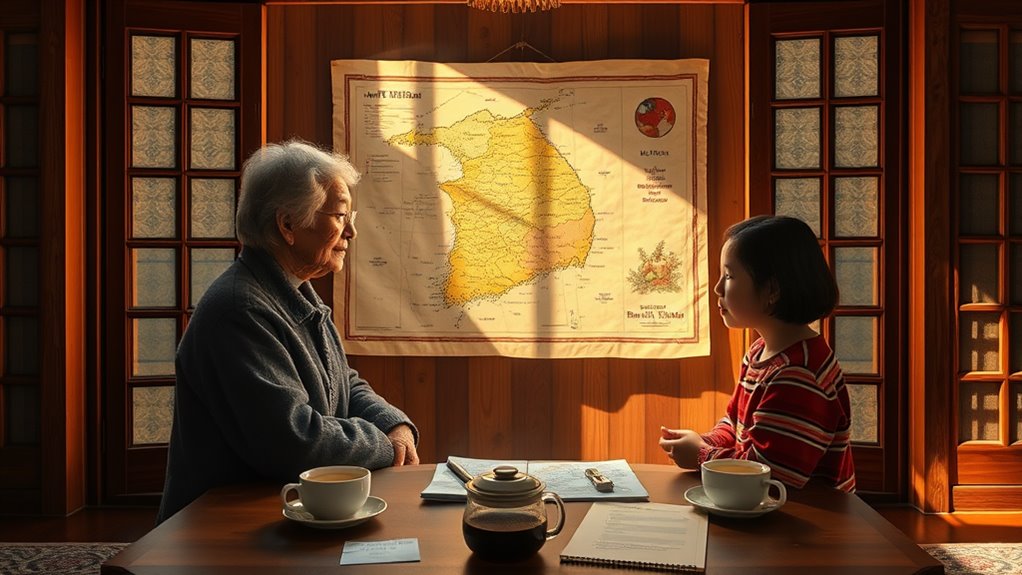
Now that you're getting comfortable with Korean pronunciation, let's explore the rich tapestry of regional dialects across the Korean peninsula. When you travel through Korea, you'll notice distinct variations in how people speak, especially as you move between different regions.
The Central Korean dialects, which include areas like Gyeonggi, Chungcheong, Gangwon, and Hwanghae, form the foundation of modern Korean language. If you're learning Korean, you'll be pleased to know that the Seoul dialect, part of the Gyeonggi region, serves as the standard language in South Korea. This makes it easier to communicate in major cities and tourist areas. The Chungcheong dialect offers an interesting blend, combining elements from both central and Jeolla regions, which you might notice when visiting these areas. The rugged mountainous terrain of Korea has historically played a significant role in shaping these distinct dialect zones.
Modern Korean Language Trends

As you explore modern Korean language trends, you'll notice how social media platforms like KakaoTalk have revolutionized the way young Koreans communicate, with creative emoticons and abbreviations becoming standard elements of daily conversations. Digital communication has brought new slang terms and expressions that reflect Korea's tech-savvy culture, especially among millennials and Gen Z users who seamlessly blend Korean and English vocabulary. The influence of globalization has led to an increasing number of English loanwords being incorporated into everyday Korean speech. While these informal trends continue to evolve, you'll still need to master traditional honorific patterns, as proper speech levels remain indispensable in professional and formal settings, particularly when interacting with older Koreans or in business environments.
Social Media Language Evolution
Since the rise of social media platforms in Korea, the Korean language has undergone fascinating changes that you'll want to understand for modern communication. You'll notice unique adaptations across different platforms, where traditional expressions transform into shorter, more casual forms that blend Korean and English elements. While modern social media language often simplifies communication, the speech level system remains an important consideration even in casual online interactions.
Here's what you'll commonly encounter in Korean social media:
- Platform-specific language, where Instagram uses different slang than KakaoTalk
- Emoji-heavy conversations replacing traditional emotional expressions, like using ?? instead of writing out feelings
- Shortened phrases that drop formal endings, making communication quicker and more casual
The influence of K-pop and popular shows like Squid Game has also shaped online language, introducing new terms that you'll frequently see in comments sections and fan discussions. Understanding these digital communication patterns will help you navigate Korean social media more naturally.
Digital Slang Among Youth
While digital technology continues to reshape modern Korean communication, you'll find that young people are at the forefront of creating innovative online slang. Teens and young adults shape their digital identity through creative language experimentation, especially on social media platforms where peer influence drives new expressions.
You'll notice that extended exposure to digital platforms enables Korean youth to develop unique slang combinations, often mixing English words with Korean or creating entirely new terms. This creativity stems from their tech fluency and desire for in-group belonging. Research shows that peer effects outweigh parental influence in shaping teenagers' online communication patterns and behaviors. Urban environments particularly accelerate these language trends, as young people blend global influences with local expressions.
When learning Korean, it's helpful to familiarize yourself with common digital slang, as it's become an integral part of modern communication, especially in casual online interactions with younger Koreans.
Changing Honorific Usage Patterns
Modern Korean honorifics have undergone dramatic changes in recent years, shifting from their traditional roots in strict social hierarchies to more flexible forms of showing respect. You'll notice these changes especially in digital communication and workplace settings, where younger Koreans are adopting more casual language patterns while maintaining core politeness principles. Even when relationships are close, age differences influence hierarchy in how people address each other.
Here are three key trends you'll encounter in contemporary Korean language use:
- Office workers increasingly use 해야체 (Haeyo form) instead of formal speech among peers
- Social media conversations feature shortened honorifics and emoji-based respect markers 🙏
- Text messages often replace traditional honorific letters with hashtags or simple symbols
When you're learning Korean today, focus on understanding these modern patterns rather than memorizing rigid rules. The language is evolving to reflect a more egalitarian society, particularly among younger generations who prioritize clear communication over strict formality.
Effective Study Methods for Quick Progress

Learning Korean effectively requires a structured approach that'll help you make quick, steady progress. Start by mastering the Hangul alphabet, which will give you the foundation for independent reading and writing. You'll want to focus on high-frequency vocabulary organized by themes, like food and travel, to build practical communication skills.
To accelerate your learning, set aside 60-90 minutes daily for consistent practice, and take advantage of Konglish loanwords that are similar to English. Working with language partners and joining exchange communities will give you valuable speaking practice, while tutoring platforms can provide personalized feedback on your progress. Watching Korean dramas with subtitles can expose you to natural, everyday language used by native speakers. Don't forget to study hanja-based word families, as understanding these common roots will help you recognize and remember related vocabulary more easily.
Cultural Elements in Language Learning

Three key cultural elements make learning Korean a uniquely enriching experience. You'll discover that understanding honorifics, participating in cultural festivals, and embracing modern K-culture will deepen your language journey. The respect-based nature of Korean society shapes how you'll communicate, from casual conversations to formal business meetings.
Learning Korean intertwines language with cultural respect, festive traditions, and modern entertainment, creating a uniquely immersive educational experience.
When learning Korean, you'll encounter these essential cultural touchpoints:
- Age-based social hierarchies that influence your word choices and speech levels
- Traditional celebrations like Chuseok, where specific greetings and customs enhance your cultural fluency
- Modern K-pop and K-drama influences that provide engaging ways to practice everyday expressions
Understanding these cultural elements isn't just about proper communication – it's about connecting with Korean society's heart and values, making your language learning more meaningful and effective. The journey to fluency becomes even more accessible thanks to the Korean alphabet system, which was specifically designed to be easy to learn and promote literacy among all social classes.
Practical Tips for Language Immersion

Building on your cultural understanding, you'll want to create an immersive Korean language environment in your daily life. Start by changing your phone's language settings to Korean and labeling household items with vocabulary sticky notes, creating constant exposure to the language.
Make the most of your daily routines by incorporating Korean media. You can listen to K-pop while analyzing lyrics, enjoy K-dramas with subtitles, and follow Korean YouTube channels during your downtime. Try exploring Korean audiobooks while doing household chores to maximize your daily learning opportunities. For interactive practice, connect with native speakers through language exchange apps and keep a Korean diary to track your progress.
Set aside specific times for structured learning using online courses and textbooks. Try implementing a weekly "Korean-only" day, where you'll challenge yourself to use Korean as much as possible in your activities.
Frequently Asked Questions
How Long Does It Typically Take to Achieve Business-Level Fluency in Korean?
You'll typically need around 2,200 hours of dedicated study to achieve business-level Korean fluency. If you're studying part-time (5-8 hours weekly), this could take 3-4 years. However, with full-time commitment (20-25 hours weekly), you can reach your goal in about 88 weeks. For faster results, try immersive learning with 40-45 hours weekly, which could get you there in just one year. Your progress will depend on your consistency and study methods.
Which Korean Dialect Is Most Beneficial for International Business Communication?
While some might argue that regional dialects add cultural flavor, Standard Korean (서울말) is clearly your best choice for international business. It's widely used in Seoul's business district, global corporations, and diplomatic settings. You'll find it's the most recognized dialect in K-dramas, news broadcasts, and formal education. Plus, it's easier to learn since most language resources and business Korean courses focus on Standard Korean's clear pronunciation and formal honorifics.
Can Learning Korean Significantly Improve Employment Opportunities in Asian Markets?
Yes, Korean language skills can remarkably boost your employment prospects in Asian markets! You'll find great opportunities in multinational companies, particularly in sectors like e-commerce, tech, and cultural exports. Your Korean proficiency will be valuable for roles in marketing, sales, content creation, and market research across the APAC region. Plus, you'll have an edge in growing industries like K-beauty, entertainment, and digital services where Korean business influence continues to expand.
How Different Is North Korean Language From South Korean?
Like two branches growing from the same tree, North and South Korean languages share roots but have grown differently. You'll find they're about 80% mutually intelligible, but there are notable differences. The North favors pure Korean words while the South embraces English loanwords. You'll notice distinct pronunciation patterns, and the North uses different vocabulary for modern concepts. Despite these variations, native speakers from both regions can generally understand each other in basic conversations.
Should I Learn Chinese Characters (Hanja) Alongside Korean?
While learning Hanja isn't essential for basic Korean fluency, it can dramatically boost your vocabulary since 60-70% of Korean words have Chinese roots. If you're serious about advanced Korean or plan to study Chinese/Japanese later, it's worth learning Hanja alongside Korean. However, if you're just starting out, focus on mastering Hangul and basic conversation first. You can always add Hanja to your studies later when you're more comfortable with Korean fundamentals.
Conclusion
Just like a seedling growing into a mighty oak, your Korean language journey transforms with each lesson learned. You'll find that mastering Hangul isn't just about memorizing characters, it's about connecting with a rich culture that's waiting to welcome you. Whether you're practicing with locals, watching K-dramas, or writing in your journal, remember that every small step brings you closer to fluency. Your dedication will bloom into lasting language skills.
More on Transportation:

Written by Sam Konneh
Sam Konneh is an AI strategist and digital marketer based in Seoul, South Korea. With years spent living, working, and exploring across Korea, Japan, and China, he shares firsthand insights into East Asia's cultures, hidden gems, and everyday life. A graduate of Inha University and KDI Graduate School, Sam combines data-driven expertise with on-the-ground experience. His journey also includes studying in Malaysia and traveling through Southeast Asia. Through practical tips, local stories, and travel guides, he helps fellow explorers discover both the celebrated highlights and the lesser-known corners of East Asia.