
Last Updated: April 4, 2026 | Originally Published: February 24, 2025
To master Japanese, you'll need to focus on three key areas: kanji characters, keigo (honorific language), and conversational nuances. Start by learning common radicals like 日 (sun) and 木 (tree) as building blocks for kanji recognition. Practice proper keigo usage in professional settings, paying attention to teineigo (polite form) and sonkeigo (honorific forms). Understanding regional dialects and their variations will help you connect authentically with locals. There's much more to discover about this fascinating language system. (Source: Japan National Tourism Organization)
Read our full Japan Travel Guide 2026 for everything you need to plan your Japan trip.
Explorer Insights
- Master radicals first as they form the essential building blocks for understanding and recognizing kanji characters effectively.
- Practice keigo's three forms: teineigo (polite), sonkeigo (honorific), and kenjougo (humble) for appropriate social and professional interactions.
- Use region-specific greetings and dialect patterns to connect authentically with locals across different Japanese regions.
- Employ systematic memorization techniques combining visual associations and multiple senses to build strong kanji retention.
- Understand the proper use of honorific suffixes (-san, -sama) and formal language patterns in professional communication.
The Building Blocks of Kanji Recognition
Three fundamental elements form the building blocks of kanji recognition, with radicals being the most essential component you'll need to master. These radicals act like puzzle pieces, helping you understand both the meaning and pronunciation of complex characters.
You'll find two main types of radicals in your learning journey: "true radicals" that look identical whether they're standalone or within characters, and "modified radicals" that change slightly when combined with other elements. Common examples you'll encounter include 日 (sun/day), 木 (tree), and 心 (heart), which serve as semantic indicators to give you clues about a character's meaning.
Just like learning the alphabet before reading English, mastering radicals is a crucial first step in your kanji journey. Conduct tone pair drills to distinguish between tones and reinforce your understanding of radicals.
To make the most progress early on, focus on learning the top 30 most frequent radicals first. This approach will give you a strong foundation for recognizing more complex kanji characters.
Strategic Approaches to Character Memorization
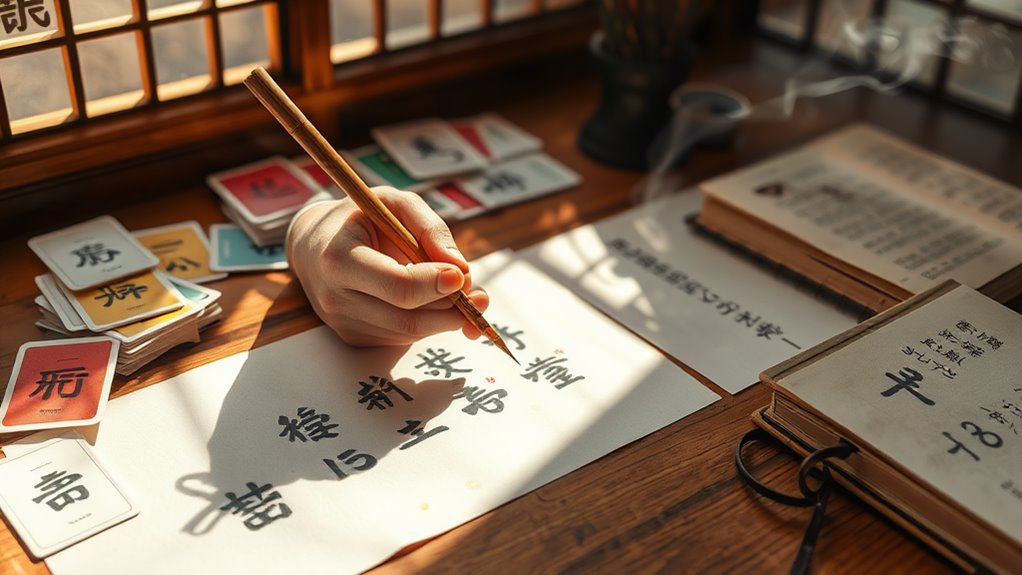
Building on your foundation of radicals, mastering kanji requires smart memorization techniques that'll make your learning journey smoother and more enjoyable. You can start by creating vivid visual associations, linking characters to familiar objects or stories that stick in your mind.
Since hiragana is simpler, many learners find it beneficial to master this writing system before diving deep into kanji memorization. Try using multiple senses in your practice routine by combining visual, tactile, and auditory learning methods. Write characters daily to build muscle memory, use flashcards for active recall, and create memorable stories around each character. You'll find it helpful to label objects in your living space with their Japanese characters, immerse yourself in manga or news articles with furigana, and practice writing with proper stroke order. Remember to space out your review sessions using a systematic approach, mixing daily drills with weekly and monthly reviews. Incorporating landmarks into questions when asking locals for directions can greatly enhance the experience of navigating Japan.
Mastering Keigo in Professional Settings
When you're working in Japanese professional settings, you'll need to master both situational Keigo usage and proper email etiquette. Understanding when to use Sonkeigo (honorific forms) versus Kenjougo (humble forms) will help you navigate workplace hierarchies and maintain respectful relationships with colleagues and clients. Teineigo expressions remain essential for maintaining basic politeness in all workplace interactions. Your success in Japanese business communication depends on correctly applying formal language patterns in emails, including proper greetings, connective expressions, and closing remarks that match your recipient's status. Arigatou gozaimasu is an essential phrase for expressing gratitude in formal situations.
Situational Keigo Usage Rules
Mastering keigo in professional Japanese settings requires a careful balance of respect, formality, and cultural awareness. When you're maneuvering workplace interactions, you'll want to use keigo consistently with superiors and clients while adjusting your formality level based on the situation.
Start with teineigo (polite form) when meeting new people or if you're unsure about someone's position. When speaking to your boss about their family members, always use sonkeigo expressions to show respect. You can then shift to more casual speech once you've built rapport with colleagues. Remember to match your body language with your keigo usage, including appropriate bowing and respectful positioning. When dealing with senior management or clients, combine kenjōgo (humble language) and sonkeigo (respectful language) to show proper deference. Keep your keigo simple and clear rather than using overly complex expressions that might lead to misunderstandings.
Business Email Honorific Patterns
Professional email etiquette in Japanese business settings follows strict honorific patterns that you'll need to master for effective communication. When addressing colleagues, you'll consistently use "san" after surnames, while reserving "sama" for clients and managers. Remember to capitalize surnames and keep first names lowercase, as in TAKADA Kenichi.
You'll want to skip using "Dear" in your greetings since the honorific suffix already shows respect. Starting too casually can create a poor first impression that may be difficult to overcome. While some Japanese professionals might use Western nicknames to simplify communication, it's best to avoid using first names, even with long-term colleagues. For new connections, start with "Hajimemashite" as your formal introduction. When crafting subject lines, maintain formality by using proper Japanese formatting, such as "本日のお礼" for thank-you messages. It's also important to be mindful of public displays of affection and volume when communicating in professional settings.
Regional Dialect Variations and Their Impact
When you travel through Japan's diverse regions, you'll notice striking differences in how locals greet each other, from Kyoto's elegant "Oideyasu" to Okinawa's cheerful "Haitai." These regional variations extend beyond just greetings into honorific speech, where you might hear Kansai speakers using "-haru" instead of the standard "-masu" for politeness. As you move between cities, you'll find that adapting to local dialect patterns can help you connect more authentically with residents, especially in areas like Osaka where the dialect carries a strong sense of cultural identity. The capital city's influence on language has made the Tokyo dialect neutral, serving as the standard form of Japanese used in media and business communication nationwide. Language apps can be essential for bridging the communication gap when navigating these regional dialect variations.
Dialect Greeting Pattern Shifts
Throughout Japan's diverse regions, you'll discover fascinating variations in how people say hello and goodbye, with each area adding its own unique flavor to everyday greetings. In Hokkaido, you'll hear softer consonants and weather-inspired phrases, while Kansai locals might greet you with a friendly "maido" in the morning. The Tohoku region keeps its rural charm with traditional expressions like "tadaima mama." Regardless of regional differences, showing respect through bowing when greeting remains a consistent cultural practice throughout Japan. The importance of familiarity with Korean spatial concepts and landmarks can help travelers better navigate through different regions in Japan as well.
| Region | Common Greeting | When to Use |
|---|---|---|
| Hokkaido | Yottsukē orē | Casual meetings |
| Kansai | Maido | Morning hello |
| Tohoku | Attakatta | Weather-related |
| Kyushu | Uchinanchu | Local friends |
When traveling through different regions, you'll want to listen for these unique patterns in greetings. While standard Japanese works everywhere, learning regional expressions can help you connect more deeply with locals and experience authentic cultural interactions.
Standard Vs Regional Honorifics
Many Japanese regions add their own special touch to honorific language, creating a rich tapestry of local expressions that you'll encounter during your travels. You'll notice how urban and rural areas differ markedly in their use of keigo, with each region maintaining its unique character.
When exploring Japan's diverse linguistic landscape, you'll discover:
- In Kansai, people often say "-han" instead of "-san" when addressing others
- Rural communities maintain stricter honorific rules than modern city centers
- Young urban professionals use fewer formal expressions with their peers
- Traditional regions blend honorifics with local job titles, like "nikuya-san"
While regional variations exist, the fundamental principle of using desu and masu forms remains consistent across all areas as a safe, polite option. As you travel between cities and countryside, you'll find that Tokyo's business culture is shifting toward simpler honorifics, while rural areas preserve more traditional language patterns. Traditional Korean architecture using natural materials and sustainable design principles can also offer insights into the cultural heritage of a region.
Essential Elements of Honorific Language
Understanding Japanese honorific language starts with mastering its three essential pillars: sonkeigo (respectful speech), kenjōgo (humble speech), and teineigo (polite speech). When you're communicating in Japanese, you'll need to adjust your language based on social context and your relationship with others.
You'll use sonkeigo when speaking about superiors or customers, changing verbs like "eat" to "meshiagaru." For your own actions, you'll want to use kenjōgo, the humble form, especially in workplace situations or when addressing higher-status individuals. Women tend to incorporate more honorific prefixes in casual settings than men do. Teineigo serves as your everyday polite speech, perfect for interactions with strangers or casual acquaintances. By adding "-masu" or "-desu" to verb endings, you'll maintain a respectful tone that's appropriate for most daily situations. Practicing daily can help reinforce these essential honorific language skills.
Breaking Down Complex Kanji Components
You'll find that understanding kanji patterns becomes much easier when you break down characters into their basic components, like recognizing how water-related kanji often contain the 水 radical. Once you start grouping kanji by their shared components, such as the way 学 and 斈 are related through their common elements, you'll begin seeing clear families of characters that share similar meanings or sounds. By focusing on the most common radicals and components first, you'll quickly build a strong foundation that makes learning more complex kanji feel less overwhelming and more systematic. Starting with the 50 most common components is an efficient way to begin your kanji learning journey.
Radical Patterns Boost Memory
Three simple yet powerful patterns can transform your kanji learning journey by breaking complex characters into manageable chunks. You'll find that radicals serve as building blocks, making even the most intimidating kanji less formidable when you understand their components.
Once decoded, semantic-phonetic composition reveals how most kanji combine meaning and sound elements to create their full character structure. [Ikebana, the unique Japanese floral art, emphasizes balance, harmony, and simplicity – qualities that can enhance one's understanding of kanji structure as well.]
- Traditional radicals help with visual recognition, while phonetic ones give pronunciation hints.
- Semantic connections emerge when radicals combine, like 日(sun) + 月(moon) = 明(bright).
- Position and structure help distinguish similar characters.
- Common elements like 心(heart) make complex kanji more recognizable.
Breaking Down Character Families
Mastering complex kanji becomes more manageable when you break down characters into family groups, especially those related to home and relationships. You'll find common patterns, like the roof radical 宀 that appears in 家 (house/family), which helps you understand related concepts more easily.
When you're studying family-related kanji, look for the person radical 人, as it's often used in characters describing human connections. For example, you'll see it in words like 姓 (family name) and within compound words like 家族 (family). The meanings shift based on how these components combine, just as 家 changes from "house" to "family" when paired with 族 (group). By recognizing these patterns, you'll start seeing connections between characters and remember them more naturally. The character 家 is particularly important to master since it's a JLPT N4 level kanji that appears frequently in everyday Japanese writing.
Daily Study Routines for Optimal Progress
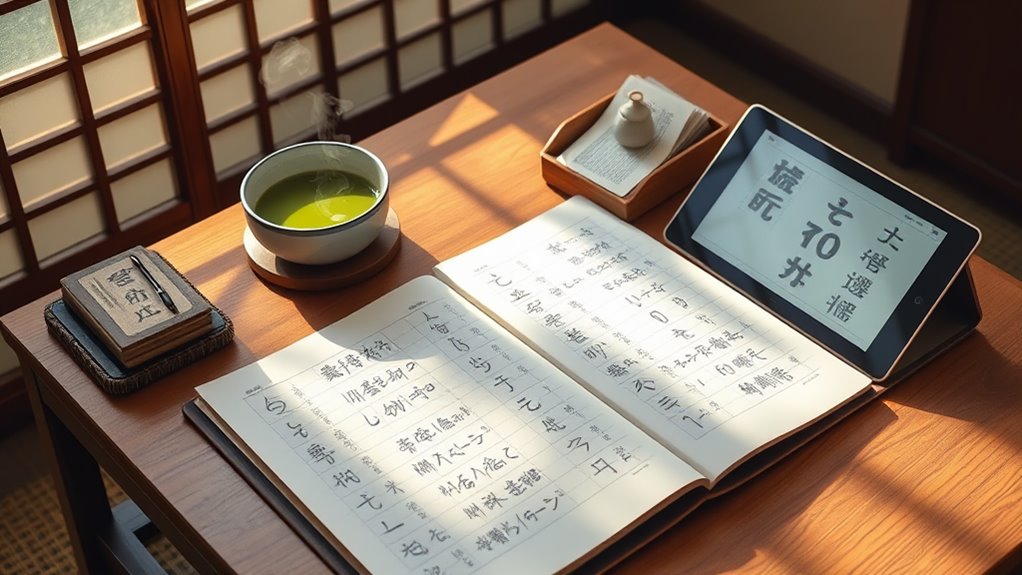
A successful Japanese language journey begins with a well-structured daily study routine that incorporates multiple learning methods. You'll want to balance your time between active learning and passive immersion, making the most of every opportunity to engage with the language.
To maximize your daily progress, focus on these key activities:
- Start your morning with 15 minutes of kanji practice using WaniKani or Anki
- Review vocabulary during your commute using language apps
- Practice writing for 30 minutes during lunch breaks
- End your day with Japanese media consumption, like anime or podcasts
It's essential to maintain regular study sessions rather than attempting intensive cramming periods.
Remember to label items around your home in Japanese and change your device settings to Japanese for extra exposure. When you're doing chores or cooking, play Japanese audio in the background to maintain constant contact with the language.
Navigating Social Context in Conversations
Successful social navigation in Japanese conversations requires much more than just knowing the right words – it's about understanding the intricate dance of status, relationships, and cultural expectations.
You'll need to quickly assess whether you're dealing with an uchi (insider) or soto (outsider) situation, as this determines your level of formality. When speaking with superiors or clients, stick to keigo (honorific speech), while using more relaxed language with peers. Keep in mind that social rank determines which politeness level is appropriate in each interaction. Pay attention to subtle nonverbal cues, as Japanese communication often relies on "reading the air" rather than direct statements.
Watch for indirect feedback through body language and hints, and remember that maintaining group harmony is key. Don't worry if you make mistakes – most Japanese people will appreciate your efforts to respect their cultural norms.
Advanced Communication Patterns and Customs
While Japanese language skills form the foundation of communication, understanding advanced patterns and customs will help you navigate the subtle art of Japanese conversation with confidence. Learning these cultural elements will make your interactions smoother and more natural, especially when you need to convey respect or handle delicate situations.
When communicating in Japanese, remember these essential customs:
- Practice "reading the air" (*kuki yomi*) by paying attention to unspoken social cues
- Use appropriate keigo levels based on your relationship with others
- Incorporate polite pauses before responding to show thoughtfulness
- Include *aizuchi* responses like "*hai*" or "*sou desu ne*" to show active listening
When receiving praise, it's customary to display humble behavior by gracefully deflecting compliments. You'll find that mastering these patterns helps you blend seamlessly into Japanese social situations, making your language skills more effective and culturally appropriate.
Preparing for JLPT Success: N1 to N5

The Japanese Language Proficiency Test (JLPT) offers five distinct levels, from N5 (beginner) to N1 (advanced), letting you demonstrate your growing mastery of Japanese. You'll need to prepare for different exam durations and passing requirements, with N5 taking 105 minutes and N1 extending to 170 minutes. Chinese learners typically progress more quickly through the JLPT levels due to their prior kanji knowledge.
| Level | Time Required | Passing Score |
|---|---|---|
| N5 | 105 minutes | 80/180 points |
| N3 | 140 minutes | 95/180 points |
| N1 | 170 minutes | 100/180 points |
To build your kanji knowledge effectively, you'll want to combine Anki flashcards with daily writing practice. Try writing 400-character diary entries and use WaniKani's radical-based learning system to decode characters systematically. The Genki textbook series pairs perfectly with structured kanji practice, helping you progress naturally through the JLPT levels.
Frequently Asked Questions
How Do Japanese People Handle Kanji They've Forgotten How to Write?
When Japanese people forget how to write a kanji, they'll often rely on their smartphones' predictive text, drawing the character with their finger on the screen, or looking it up in a digital dictionary. You'll find that in today's digital age, they're not ashamed to use technology as a memory aid. They might also write the pronunciation in hiragana first, then select the correct kanji from the suggested options.
What Strategies Help Maintain Kanji Knowledge After Reaching Fluency?
While you might think maintaining kanji is impossible after reaching fluency, you'll find it's actually manageable with the right approach. Make kanji practice a daily habit by reading varied materials, from manga to news articles, and write regularly in a journal. You can also use spaced repetition apps like Anki to review characters, and label items around your home with kanji stickers for passive exposure. Regular, varied practice keeps your skills sharp.
When Is It Appropriate to Use Casual Language With Workplace Superiors?
You'll want to be very cautious about using casual language with workplace superiors in Japan. Even if your boss seems relaxed, it's best to maintain polite speech (keigo) during business hours and formal settings. You might occasionally use casual language in after-work social gatherings, but only if your superior explicitly invites you to do so. Remember, maintaining proper workplace hierarchy through formal speech shows respect and professionalism.
How Do Japanese Natives Learn Proper Keigo Usage Growing Up?
You'll find that Japanese children learn proper keigo naturally through daily life experiences. At home, they observe how family members use polite language with elders and guests. At school, they practice formal speaking with teachers through structured activities and role-play exercises. As they grow up, they refine their skills by watching public interactions and receiving gentle corrections from adults when needed. This cultural immersion helps them master keigo organically.
Why Do Some Japanese People Struggle With Keigo Despite Being Native Speakers?
You might be surprised to learn that even native Japanese speakers can struggle with keigo. The formal language system isn't typically taught thoroughly in schools, so most people learn through trial and error in real-life situations. When you combine this with the intense social pressure to use keigo correctly and the complex rules that change based on social status, you'll understand why many Japanese adults feel anxious about using these polite forms.
Conclusion
You're now equipped to begin your exciting journey into Japanese language mastery. With over 2,000 kanji characters in regular use and 5 distinct levels of politeness in keigo, you'll find plenty to explore and master. By following structured study habits, embracing cultural nuances, and practicing consistently, you'll develop the skills needed to communicate confidently in Japanese. Remember, even native speakers take years to perfect keigo, so be patient with your progress.
More on Transportation:

Written by East Asia Explorer Editorial Team
Sam Konneh is an AI strategist and digital marketer based in Seoul, South Korea. With years spent living, working, and exploring across Korea, Japan, and China, he shares firsthand insights into East Asia's cultures, hidden gems, and everyday life. A graduate of Inha University and KDI Graduate School, Sam combines data-driven expertise with on-the-ground experience. His journey also includes studying in Malaysia and traveling through Southeast Asia. Through practical tips, local stories, and travel guides, he helps fellow explorers discover both the celebrated highlights and the lesser-known corners of East Asia.