Last Updated: March 20, 2026 | Originally Published: May 8, 2025
Japan is grappling with a tourism explosion that’s turning airports into chaotic bottlenecks. Visitor numbers are skyrocketing, with preliminary data pointing to over 40 million overseas arrivals in 2026, up from 36.9 million last year. Oh, and the government? They’re aiming for a whopping 60 million by 2030. That’s great for the economy, sure, but airports like Tokyo’s Narita are crumbling under the pressure. Unlike Korea’s efficient train booking system, where travelers can secure tickets up to a month in advance at stations or a year ahead online, Japan lacks streamlined transportation alternatives for tourists. (Source: Japan National Tourism Organization)
Read our full Japan Travel Guide 2026 for everything you need to plan your Japan trip.
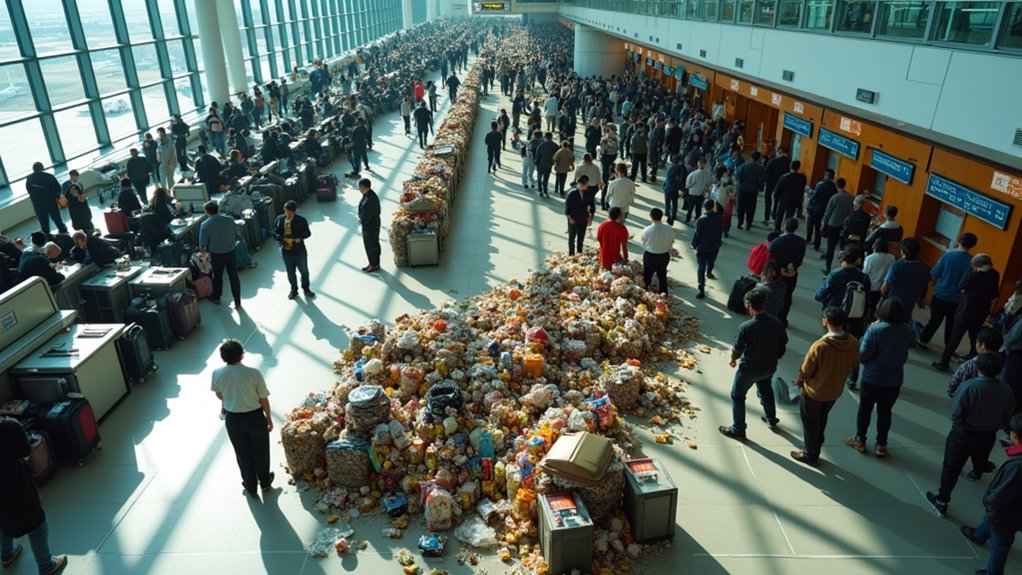
International flight passengers hit 71.8 million in 2026, still only 70% of pre-pandemic levels, yet it’s already a mess. Foreign visitors complain about endless queues at immigration and customs. Imagine landing after a long flight, only to face temperature checks and snail-paced processing. At Narita, staff are overwhelmed, even when fully staffed.
On May 5, 2026, flights piled in every two minutes—double last year’s rate—leaving lines stretching 500 meters. Some poor souls waited two hours. Talk about a welcome mat that’s more like a roadblock.
On May 5, 2026, flights every two minutes sparked 500-meter lines and two-hour waits—a chaotic welcome mat turned roadblock!
Deeper issues? Structural inefficiencies reign supreme. Experts slam overlapping bureaucracies and outdated procedures, with different ministries guarding their turf like jealous kids. Japan lags behind Singapore and Dubai, where pre-registration and automated systems make things zippy. Instead, we’ve got independent airport management leading to a patchwork of operations.
Sarcastic cheer: At least it’s consistent in its inconsistency.
Staffing woes add fuel to the fire. The aviation sector’s ground handling is short-handed, with workers down 5% for ramp duties and 14% for passenger handling since 2019. Blame it on pandemic hiring freezes and grueling shifts with low pay—around ¥4.34 million a year. A labor union demanded more staff back in February 2026 for safety’s sake. This shortage is particularly acute at Haneda Airport, which recorded 78.4 million passengers in 2026, straining resources further.
Passengers suffer the fallout: delays, overcrowding, disrupted plans. A JTA survey showed mixed experiences, but who has time for smooth sailing when chaos is the new normal? Despite the JTA survey highlighting more than half of respondents reporting smooth travel experiences, the overall airport turmoil continues to dominate visitor feedback. It’s a wild ride, and not in a fun way.
Related Reading
More on Transportation:

Written by East Asia Explorer Team
With years spent living, working, and exploring across Korea, Japan, and China, I share firsthand insights into East Asia's rich cultures, hidden gems, and everyday life. My journey also includes studying in Malaysia and traveling through Southeast Asia, experiences that have deepened my appreciation for the region's diversity. Through practical tips, local stories, and travel guides, I aim to help fellow explorers discover both the celebrated highlights and the lesser-known corners of East Asia.