Last Updated: October 14, 2026 | Originally Published: October 31, 2024
Quick Answer:
- Online reservations are also possible through the JR website or app
- Pay attention to the numbered exits for easy meeting points
- Download a train app for real-time updates and navigation
Quick Answer
- Tokyo to Kyoto on a Nozomi takes about 2 hours 15 minutes and costs roughly ¥14,000 reserved.
- The Japan Rail Pass does not cover Nozomi or Mizuho trains. On the Tokaido line it works on Hikari and Kodama only.
- Book through the SmartEX app or at a JR ticket office. Sit in seat E on Tokyo to Osaka trains for Mt Fuji views.
- Bags with total dimensions of 160-250 cm need an oversized-baggage seat reservation.
Most Shinkansen guides tell you the trains are fast and punctual. You already know that. The real problems are smaller: a rail pass that does not cover the fastest train, a bag that is too big, and no food cart.
This guide covers the Tokaido-Sanyo corridor from Tokyo to Osaka first, then the northern and Kyushu lines. Fares and rules change, so confirm on JR Central before you buy.
Which Shinkansen train should you take: Nozomi, Hikari or Kodama?
Pick the train by stops, not by price. On the Tokaido line the three services share the same track and the same fare, plus a small supplement for the fastest.
Nozomi is the express. Hikari skips some stations. Kodama stops at every station and is slow by design.
| Service | Tokyo to Kyoto (approx.) | Japan Rail Pass |
|---|---|---|
| Nozomi | 2 h 15 min | Not covered without a supplement |
| Hikari | 2 h 40 min to 3 h | Covered |
| Kodama | About 3 h 40 min | Covered |
Nozomi runs up to 285 km/h on the Tokaido line. Trains on the Tohoku and Hokkaido lines, such as Hayabusa, reach 320 km/h.
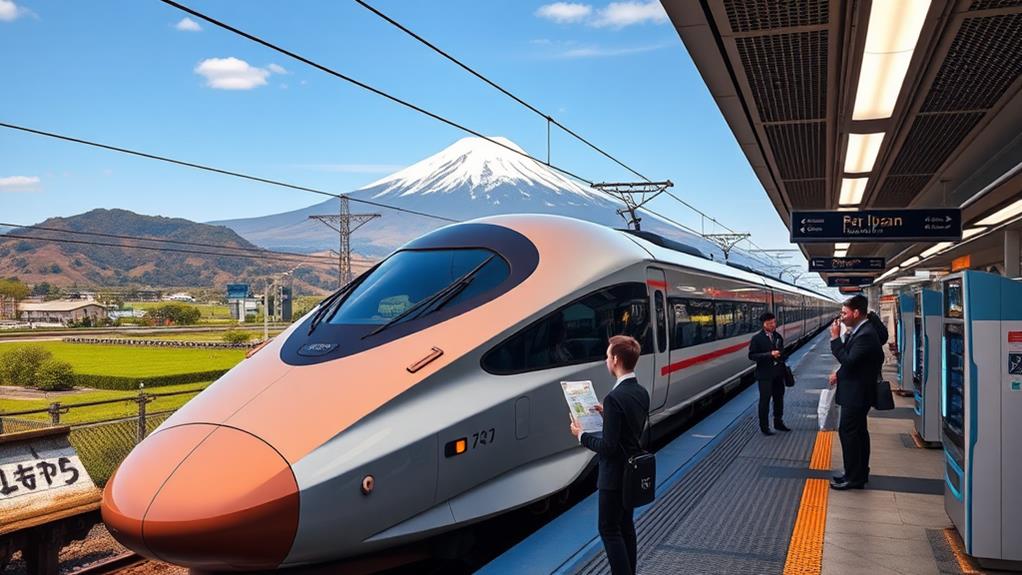
Pro Tip: On the Tokaido line, the Tokyo to Osaka direction has Mt Fuji on the right. Reserve seat E in an ordinary car for the view. Going the other way, take seat A.
Does the Japan Rail Pass pay off for Tokyo, Kyoto and Osaka?
For this route alone, usually not. The 7-day ordinary pass costs ¥50,000 since the October 2023 price increase.
A Tokyo to Kyoto to Osaka to Tokyo loop on reserved Nozomi seats costs roughly ¥28,000 to ¥29,000 at 2026 fares. That is well under the pass price.
A pass starts to make sense when you add a long leg, such as Tokyo to Hiroshima or Tokyo to Kanazawa, on top of the Kyoto loop. Run the numbers for your exact route before you buy.
Warning: Do not assume “unlimited Shinkansen” means every Shinkansen. Pass holders who board a Nozomi or Mizuho without paying the supplement can be charged the full fare on exit.
Check the pass rules at japanrailpass.net. Regional passes for Kyushu or Hokuriku can be cheaper than the national one.
How do you buy and reserve Shinkansen tickets as a visitor?
There are three practical routes. Pick one before you reach the station.
- SmartEX app: book Tokaido and Sanyo Shinkansen seats and tap through the gate with a registered IC card or QR code.
- JR ticket offices: staff speak some English and can issue reserved and non-reserved seats, including pass reservations.
- Ticket machines: they have English screens and take cash and major cards.
JR East lines, such as Tohoku and Hokuriku, use a different booking system. Check JR East’s own reservation channel if you are heading north.
Reserved seats cost more than non-reserved, and some peak dates add a seat surcharge. Book ahead for Golden Week, Obon and New Year.
What are the luggage rules for the Shinkansen?
This is the rule that catches visitors. Bags with total dimensions (length, width and height added together) between 160 and 250 cm need a reserved seat with an oversized-baggage area.
Without that reservation, JR charges a ¥1,000 handling fee. Bags over 250 cm are not allowed.
Standard suitcases under 160 cm go on the overhead rack or between seat rows. Large suitcases are best placed in the last row of a car.
Pro Tip: Send big bags ahead with a takkyubin luggage-forwarding service from your hotel. A suitcase can arrive at your next hotel a day later while you travel light.
Is there food on the Shinkansen?
Do not count on a trolley. JR Central ended in-car trolley sales on the Tokaido line in late 2023, and there is no dining car.
Buy an ekiben (station bento) before you board. Tokyo Station, Shinagawa and Shin-Osaka all have large ekiben shops.
Eating is allowed at your seat. Avoid strong-smelling foods and take your rubbish with you.
What is the etiquette on board?
Keep your voice low and take phone calls in the vestibule between cars. Set your phone to silent mode.
Check with the person behind you before reclining your seat. Do not block the aisle or doors with luggage.
Trains depart on the minute, so be on the platform early. Boarding lines are marked on the platform floor by car number.
Key Takeaway: Compare the pass with the point-to-point fares first, book the seat in the SmartEX app, send oversized bags ahead, and buy an ekiben before boarding.
Frequently Asked Questions
Can I use a Japan Rail Pass on the Nozomi?
Not without paying a supplement. Pass holders normally use Hikari or Kodama on the Tokaido-Sanyo line. Check the current pass conditions before travelling.
How far ahead should I book?
Seats are available on the day for most departures. Book ahead for Golden Week, Obon and New Year, and when you need an oversized-baggage seat.
Is there Wi-Fi on the Shinkansen?
Free Wi-Fi is available on many trains, but coverage and speed vary. Download offline maps and tickets before you board.
Do I need to speak Japanese?
No. Major stations have English signage and ticket machine menus. Announcements on board are made in Japanese and English.
Which side has the Mt Fuji view?
On Tokyo to Osaka trains, sit on the right in seat E. On the return, take seat A. Cloud and weather can hide the mountain.
Can I eat on the train?
Yes. Eating at your seat is normal. Buy your ekiben before boarding, because there is no dining car and trolley sales have ended on the Tokaido line.
Last updated: October 2026. Written by the East Asia Explorer Editorial Team.
More on Transportation:

Written by East Asia Explorer Editorial Team
Sam Konneh is an AI strategist and digital marketer based in Seoul, South Korea. With years spent living, working, and exploring across Korea, Japan, and China, he shares firsthand insights into East Asia's cultures, hidden gems, and everyday life. A graduate of Inha University and KDI Graduate School, Sam combines data-driven expertise with on-the-ground experience. His journey also includes studying in Malaysia and traveling through Southeast Asia. Through practical tips, local stories, and travel guides, he helps fellow explorers discover both the celebrated highlights and the lesser-known corners of East Asia.