Last Updated: July 7, 2026 | Originally Published: October 14, 2023
- Apply for MEXT Scholarship (¥117,000/month stipend + full tuition) through Japan’s embassy — or JASSO (¥48,000/month) through your university after admission.
- Tuition: national universities charge a standardized ¥535,800/year; private universities (Waseda, Keio, APU) range from ¥1,000,000–¥2,000,000/year.
- JLPT N2 is the floor for Japanese-medium programs; N1 is required at competitive grad schools like Waseda and Keio.
- Monthly living costs: ¥64,000–¥90,000 in Sapporo vs ¥130,000–¥170,000 in Tokyo. Add ¥1,500–¥3,000/month for National Health Insurance (NHI), mandatory for all students staying 3+ months.
Last updated: 2026-07-07
Japan hosts over 340,000 international students, according to the Japan Student Services Organization (JASSO). The country ranks among the top five study destinations in Asia-Pacific per the UNESCO Institute for Statistics.
Most guides recycle the same generic formula without naming the specific scholarships, tuition costs, banking realities, or city costs that actually shape your decision. This guide covers what they miss: real scholarship amounts, a national-vs-private tuition comparison, city-by-city costs with NHI included, and how to open a Japanese bank account on day one.
1. Choosing the Right Japanese University: Beyond Tokyo, Kyoto, and Osaka
Every guide mentions University of Tokyo (QS #28), Kyoto University (QS #46), and Osaka University (QS #86). These are legitimate targets. But they aren’t the whole picture for international students.
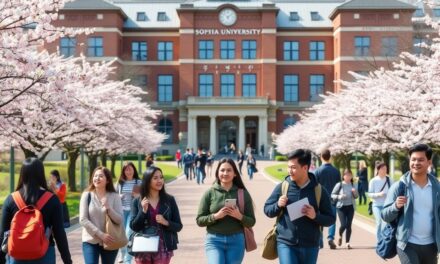
Waseda University in Shinjuku, Tokyo admits over 7,000 international students annually. Its School of International Liberal Studies (SILS) offers full English-medium undergraduate degrees. Strong reputation in humanities, journalism, and political science.
Keio University (established 1858) runs the Faculty of Policy Management at its Shonan Fujisawa Campus — a popular choice for English-medium instruction outside central Tokyo.
Ritsumeikan Asia Pacific University (APU) in Beppu, Oita Prefecture, conducts all instruction in both English and Japanese. Roughly half the student body is international. On-campus housing costs ¥26,500–¥33,500/month — the most affordable campus accommodation in this guide.
Tohoku University in Sendai (QS #116) is Japan’s top pick for graduate research in engineering and science. Living costs in Sendai are among the lowest of any major Japanese university city.
2. Tuition Fees: National vs. Private University in Japan
This is the number most study-abroad guides omit entirely. Tuition is one of the largest costs you’ll face — and the gap between national and private universities is substantial.
National universities (国立大学) are funded by the Japanese government. The Ministry of Education sets a standardized tuition of ¥535,800 per year for undergraduate and most graduate programs. Admission fees add approximately ¥282,000 once. The University of Tokyo, Tohoku University, Osaka University, and Kyoto University all charge this rate.
Private universities set their own fees. Expect ¥1,000,000–¥2,000,000 per year depending on the faculty. Science and medical programs cost more than humanities. Waseda’s international programs run approximately ¥1,200,000/year; Keio’s SFC campus is similar.
| University Type | Annual Tuition | One-Time Admission Fee | MEXT Covers? |
|---|---|---|---|
| National university (Tokyo, Tohoku, Osaka) | ¥535,800/year | ¥282,000 | Yes — full waiver |
| Private university (Waseda, Keio, APU) | ¥1,000,000–¥2,000,000/year | ¥200,000–¥400,000 | Partial — varies by school |
| Public (municipal/prefectural) | ¥500,000–¥600,000/year | ¥280,000 | Yes — full waiver |
3. JLPT Requirements: Which Score Gets You Into Which Program
The Japanese Language Proficiency Test (JLPT) has five levels — N5 (beginner) to N1 (near-native). Most guides say “prepare for Japanese proficiency” without specifying which level you actually need.
| Program Type | JLPT Level Required | Alternative Accepted |
|---|---|---|
| Japanese-medium undergraduate | N2 minimum | EJU Japanese 200+ |
| Competitive graduate (Waseda, Keio) | N1 required | EJU 280+ |
| English-medium programs | No JLPT required | TOEFL iBT 79+ / IELTS 6.0+ |
| MEXT Scholarship applicants | N2 or above | Government screening exam |
The Examination for Japanese University Admission for International Students (EJU) is Japan’s own standardized entry test. Some universities prefer EJU scores over JLPT because it tests academic Japanese, not conversational skill.
The EJU is offered twice a year — June and November — at test centers across Japan and in select countries overseas. Results arrive 6–8 weeks after the test date. If your target program prefers EJU and has an April enrollment, you must sit the November test at the latest. Factor this into your 18-month preparation timeline.
4. MEXT vs. JASSO: Japan’s Two Government Scholarships Explained
Most guides say “apply for government scholarships.” Here are the two you actually need to know.
MEXT Scholarship (Monbukagakusho) — Administered by Japan’s Ministry of Education, Culture, Sports, Science and Technology. The undergraduate track provides ¥117,000/month as a living stipend plus a full tuition waiver and round-trip airfare. The graduate research track pays ¥143,000–¥145,000/month.
MEXT has three distinct application tracks — most guides only describe one:
| Track | Who It’s For | Deadline | How to Apply |
|---|---|---|---|
| Embassy-Recommended | Students outside Japan | April–June (18 months before enrollment) | Through Japan’s embassy in your home country |
| University-Recommended | Students nominated by a Japanese university | September–November (varies by university) | Directly through your target Japanese university’s international office |
| Japan-Located Students | Already in Japan on cultural/exchange visa | Varies by university (typically December–January) | Through the Japanese university where you’re currently enrolled |
The University-Recommended track is less competitive than the Embassy track and lets you target specific professors and labs directly. If you already have a relationship with a Japanese university or a faculty sponsor, this route can give you a meaningful edge.
JASSO Scholarship for Privately Financed International Students — Administered by the Japan Student Services Organization. The standard amount is ¥48,000/month, awarded for up to 12 months. You apply through your enrolled Japanese university — not an embassy — so you’re eligible only after admission.
“MEXT remains Japan’s most comprehensive scholarship for international students — covering tuition, living expenses, and airfare in a single package.” — Japan National Tourism Organization (JNTO) Study in Japan Portal
Beyond these two, notable private options include the Panasonic Scholarship (graduate students in science/engineering, ¥180,000/month) and the Fujitsu Scholarship for MBA candidates in Asia-Pacific. Both require applications through partner universities.
5. The Real Cost of Living: City-by-City Breakdown for 2026 (NHI Included)
The commonly cited “¥80,000–¥120,000 per month” range is too narrow for Tokyo and too wide for Sendai. Here’s an accurate breakdown based on JASSO’s International Student Living Survey and Numbeo cost-of-living data for 2026.
| City | Rent (shared room) | Food + Transport | Total/Month |
|---|---|---|---|
| Tokyo | ¥60,000–¥90,000 | ¥60,000–¥80,000 | ¥130,000–¥170,000 |
| Osaka | ¥45,000–¥65,000 | ¥50,000–¥65,000 | ¥95,000–¥130,000 |
| Kyoto | ¥40,000–¥60,000 | ¥48,000–¥60,000 | ¥88,000–¥120,000 |
| Fukuoka | ¥35,000–¥50,000 | ¥40,000–¥55,000 | ¥75,000–¥105,000 |
| Sendai | ¥30,000–¥45,000 | ¥38,000–¥50,000 | ¥68,000–¥95,000 |
| Sapporo | ¥28,000–¥42,000 | ¥36,000–¥48,000 | ¥64,000–¥90,000 |
Fukuoka consistently ranks as the best value for international students. It has direct flights to Seoul, Shanghai, and Taipei. Its subway connects the entire city in under 30 minutes.
Sapporo winter caveat: The ¥64,000–¥90,000 figure applies to mild months. From December through March, heating costs in Hokkaido add ¥5,000–¥15,000/month to your budget. Gas central heating in older share houses can push the upper end. Budget at least ¥100,000/month for Sapporo in winter — still below Tokyo, but closer to Sendai than the annual average suggests.
Add ¥1,500–¥3,000/month for National Health Insurance (NHI). Every international student staying 3+ months must enroll in Japan’s National Health Insurance (国民健康保険, Kokumin Kenko Hoken). The student premium is income-tested — most international students pay ¥1,500–¥3,000/month. NHI covers 70% of most medical costs, which is far cheaper than private travel insurance for a multi-year stay. Enroll at your local ward office (市役所) within 14 days of registering your address. Failing to enroll triggers retroactive billing — don’t skip this step.
6. Housing Options: University Dorms vs. Share Houses vs. Monthly Apartments
Most guides say “arrange accommodation.” Here are the actual options international students use.
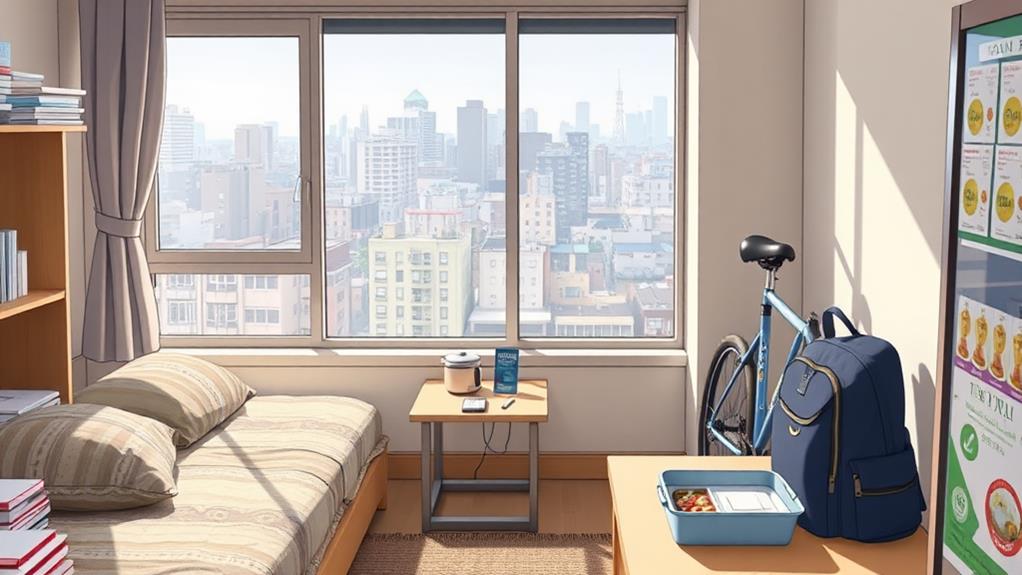
University dormitories are the cheapest option: typically ¥25,000–¥45,000/month including utilities. At Ritsumeikan APU’s Beppu campus, dorm costs are ¥26,500–¥33,500/month. Apply immediately after receiving your acceptance letter — waitlists fill fast.
Sakura House is Japan’s largest foreigner-friendly share house network, with locations across Tokyo, Osaka, and Kyoto. Prices range from ¥47,000/month (shared room in suburban Tokyo) to ¥80,000+ in Shinjuku or Shibuya. No Japanese guarantor required — a critical detail for international students.
Leo Palace 21 offers furnished monthly apartments with leases starting at one month. Rates begin around ¥60,000/month in regional cities and ¥90,000+ in Tokyo. The furnished setup reduces your initial move-in costs significantly.
7. Applying for Admission: Deadlines and Documents
Japanese universities have two primary intake periods: April (spring) and October (autumn, fewer institutions). Application deadlines for April intake are typically September to November of the prior year — earlier than most Western universities.
Standard documents required:
- Completed application form (download from university website)
- Academic transcripts (certified translation if not in Japanese or English)
- JLPT certificate or EJU result slip (if applicable)
- TOEFL iBT or IELTS score report (for English-medium programs)
- Personal statement (typically 600–1,000 words)
- Two recommendation letters from professors
- Passport copy + passport-sized photos (4.5×4.5cm, white background)
- Application fee (¥30,000–¥50,000 at national universities)
Late-submitted documents are the single most common reason for delayed processing. Use trackable international mail for physical documents and confirm receipt with the admissions office.
8. Obtaining Your Student Visa: Certificate of Eligibility Timeline
Japan’s student visa process works through a Certificate of Eligibility (CoE). Your Japanese university applies for it on your behalf after you’re admitted — you cannot apply for it yourself.
The CoE takes 1–3 months to process at the Japan Immigration Services Agency. Once you receive it, submit it to your nearest Japanese embassy or consulate. Visa processing then takes approximately 5–7 business days.
Work backward: for April 1 enrollment, your university should begin the CoE application in November or December. Most universities issue CoE instructions alongside the admission offer letter.
Important: your student visa is valid for 3 months from the issue date. If you receive it too early, you must enter Japan before it expires even if classes haven’t started. Coordinate your visa pickup timing carefully with your enrollment date.
9. Working Part-Time: The 28-Hour Rule and the Permission Stamp
International students can work up to 28 hours per week during term time and full-time during official university vacation periods.
You need a Permission to Engage in Activity Other Than That Permitted Under the Status of Residence Previously Granted — the immigration work permission stamp. Apply at the immigration office nearest to your university (or online via the Immigration Services Agency portal). Processing takes 2–4 weeks.
Popular part-time jobs: convenience store staff (コンビニ), restaurant work, English tutoring, and campus research assistant roles. Base hourly wages in Tokyo start around ¥1,163/hour (Tokyo minimum wage from October 2026). Regional rates are ¥950–¥1,050/hour — Osaka reached ¥1,114/hour in the same revision cycle.
To find listings, use バイトル (Baitoru), Indeed Japan, or FromA — the three job platforms most used by international students. On-campus notice boards at the international student office also post lab assistant and language-exchange tutor roles not listed publicly.
10. Planning Your Arrival: Airports, IC Cards, SIM Cards & Banking
Most long-haul international flights into Tokyo land at Narita Airport (NRT), 60–80 minutes from central Tokyo. The N’EX (Narita Express) costs ¥3,000–¥4,000 one-way. Budget alternative: the Keisei Skyliner to Nippori Station (¥2,520) or the slower Keisei Limited Express (¥1,050).
Haneda Airport (HND) is only 20–30 minutes from central Tokyo by monorail or Keikyu Line (¥500–¥600). If your flights are flexible, Haneda saves significant time and transport cost.
Get a Suica card (or PASMO) on arrival — it works on virtually every train, subway, and bus in the Tokyo metro area. You can now load a mobile Suica through Apple Wallet before you land.
For SIM cards, IIJmio and Mineo are the most popular budget options among long-term residents: plans from ¥1,100–¥2,200/month for 3–20GB. Avoid airport SIM kiosks — they charge 2–3× more for equivalent data.
Opening a Japanese bank account — the step most guides skip. Standard Japanese banks (Mitsubishi UFJ, Mizuho, SMBC) typically require 6+ months of residence before accepting new international accounts. Two alternatives work on arrival:
- Japan Post Bank (ゆうちょ銀行) — Available at every post office in Japan. Opens with a residence card (在留カード) and passport only. No employment proof, no minimum balance. Free cash withdrawals at all post offices and 7-Eleven ATMs. Widely accepted for rent, tuition, and utilities auto-pay. Your university will need a Japanese bank account for scholarship disbursements — this is your fastest option.
- SMBC Prestia — Designed for foreign nationals. English-language service, international wire transfers, and a Visa debit card. A minimum balance of ¥1,000,000 waives fees; below that, a ¥2,200/month maintenance fee applies.
For international transfers before your local account clears, Wise (formerly TransferWise) lets you receive money in JPY without a full Japanese bank account — useful in the first 2–4 weeks on arrival.
11. My Number Card (マイナンバーカード): The Administrative Step Most Students Miss
Within 2–3 weeks of registering your address at the ward office, Japan’s government mails you a My Number notification letter (個人番号通知書). This contains your 12-digit Individual Number — used for taxes, health insurance verification, and government systems.
The notification letter is not the My Number Card. The physical card (マイナンバーカード) must be applied for separately, at your ward office. Processing takes 4–8 weeks. Apply immediately after arrival.
Why it matters for students:
- NHI clinic verification — Since 2026, pharmacies and many clinics verify insurance electronically via My Number Card instead of your paper NHI card. Without the card, some pharmacies will ask for your paper NHI booklet (which you’ll receive from the ward office separately).
- Tax refunds on part-time income — If you work more than ¥1,030,000/year, you must file an e-Tax return. The My Number Card is required to file online via the National Tax Agency (NTA) portal. Without it, you file in person at the tax office — slower, requires appointment.
- JASSO scholarship reporting — JASSO requires your My Number on scholarship renewal forms from the second year onward.
- University payment systems — Some national universities (including Tohoku and Kyushu) now use My Number Card as a student ID alternative for administrative portals.
- Tuition reality: National universities (¥535,800/year) are far cheaper than private ones (¥1M–¥2M/year) — MEXT covers the national rate in full.
- Apply for MEXT through Japan’s embassy (April–June deadline) and JASSO through your university after admission — they target different stages and can’t usually be combined.
- Living in Fukuoka or Sendai saves ¥50,000–¥80,000/month vs. Tokyo; add ¥1,500–¥3,000 for NHI, which is mandatory for all students staying 3+ months.
- Open a Japan Post Bank account within 72 hours of arrival — it’s the only bank accessible to international students with just a residence card, and your university needs it for scholarship payments.
Frequently Asked Questions
What is the MEXT Scholarship and how much does it pay?
The MEXT Scholarship (Monbukagakusho) is Japan’s primary government scholarship for international students. The undergraduate track pays ¥117,000/month plus full tuition and round-trip airfare. The graduate research track pays ¥143,000–¥145,000/month. Applications go through Japan’s embassy in your home country, with deadlines typically April–June.
How much does tuition cost at a Japanese university?
National universities (University of Tokyo, Tohoku, Osaka) charge a standardized ¥535,800 per year across all faculties, plus a ¥282,000 admission fee once. Private universities (Waseda, Keio, Ritsumeikan APU) set their own fees and typically charge ¥1,000,000–¥2,000,000 per year. MEXT covers the full national university rate; private university waivers vary significantly by school.
Do I need JLPT to study in Japan?
Only for Japanese-medium programs. N2 is the minimum for most undergraduate programs taught in Japanese. N1 is required at competitive graduate schools like Waseda and Keio. English-medium programs require TOEFL iBT 79+ or IELTS 6.0+ — no JLPT needed.
Which Japanese city is cheapest for students?
Sapporo and Sendai have the lowest monthly costs: ¥64,000–¥95,000 all-in including rent, food, and transport. Fukuoka is slightly higher but offers better international connectivity. Tokyo is the most expensive at ¥130,000–¥170,000/month. All cities add ¥1,500–¥3,000/month for National Health Insurance, which is mandatory for students staying 3+ months.
How long does the Certificate of Eligibility take?
The CoE takes 1–3 months for Japan’s Immigration Services Agency to process. Your university applies on your behalf after you receive an admission offer. For April enrollment, your university should begin the CoE process in November or December. Visa processing at your embassy then takes approximately 5–7 business days.
Can I work part-time while studying in Japan?
Yes — up to 28 hours per week during term time, full-time during university vacation periods. You must obtain a work permission stamp from the immigration office (2–4 weeks processing). Tokyo minimum wage is approximately ¥1,100–¥1,200/hour. Use バイトル (Baitoru), Indeed Japan, or FromA to find listings.
What housing doesn’t require a Japanese guarantor?
University dormitories (¥25,000–¥45,000/month), Sakura House share houses (from ¥47,000/month in Tokyo), and Leo Palace 21 furnished monthly apartments (from ¥60,000/month in regional cities) all accept international students without a local guarantor. Standard private Japanese leases require ¥200,000–¥500,000 in upfront deposits that international students typically cannot arrange.
How do I open a Japanese bank account as an international student?
Go to any post office and open a Japan Post Bank (ゆうちょ銀行) account within 72 hours of registering your address. You need only your residence card and passport — no employment history or minimum balance required. This account handles scholarship disbursements, rent auto-pay, and NHI enrollment. SMBC Prestia is the English-friendly alternative with a Visa debit card, though it charges ¥2,200/month unless you hold ¥1,000,000 in the account.
What is National Health Insurance (NHI) and do I need it?
Yes — it’s mandatory. Every international student staying 3+ months in Japan must enroll in the National Health Insurance (国民健康保険) within 14 days of registering their address at the ward office. The monthly premium for students is typically ¥1,500–¥3,000 depending on declared income. NHI covers 70% of most medical costs. Skipping enrollment triggers retroactive billing for all finded months — it’s not optional.
Is Ritsumeikan APU worth considering?
Yes — Ritsumeikan Asia Pacific University in Beppu, Oita conducts all instruction in both English and Japanese, and roughly half its student body is international. On-campus dorm costs ¥26,500–¥33,500/month — the most affordable campus housing in this guide. It’s a strong option for students who want an internationally-focused environment at a lower cost than urban universities.
What SIM card should I get as an international student?
IIJmio and Mineo are the most popular budget options among long-term residents, with plans from ¥1,100–¥2,200/month for 3–20GB. Avoid airport SIM kiosks — they charge 2–3× more for equivalent data. Load a mobile Suica through Apple Wallet before you arrive for smooth airport-to-city travel without queuing at a ticket machine.
More on Study in Japan:

Written by Sam Konneh
Sam Konneh is an AI strategist and digital marketer based in Seoul, South Korea. With years spent living, working, and exploring across Korea, Japan, and China, he shares firsthand insights into East Asia's cultures, hidden gems, and everyday life. A graduate of Inha University and KDI Graduate School, Sam combines data-driven expertise with on-the-ground experience. His journey also includes studying in Malaysia and traveling through Southeast Asia. Through practical tips, local stories, and travel guides, he helps fellow explorers discover both the celebrated highlights and the lesser-known corners of East Asia.