Last Updated: October 18, 2026 | Originally Published: March 6, 2026
The bottom line is: the 7-day JR Pass pays for itself with a single Tokyo-Kyoto round trip on the Hikari Shinkansen. If you’re visiting 2+ cities, it saves most travelers $200-400 over individual tickets.
Spending $370 on a rail pass before you’ve even landed in Japan feels risky — especially when conflicting advice floods every travel forum. (see Japan National Tourism Organization (JNTO))
The Japan Rail Pass is worth buying in 2026 if you plan to visit two or more cities by Shinkansen. A 7-day Ordinary Pass costs approximately 50,000 yen ($370 USD) and covers unlimited rides on Hikari and Kodama bullet trains, JR local lines, and the Narita Express airport transfer.
Here’s exactly how to decide if the JR Pass makes sense for your route, plus the activation process that trips up most first-time buyers.
Table of Contents
Read our full Japan Travel Guide 2026 for everything you need to plan your Japan trip.
The bottom line is: the 7-day Japan Rail Pass pays for itself with a single Tokyo–Kyoto round trip on the Shinkansen. If your 2026 itinerary covers 2 or more cities, you’ll save ¥15,000–¥45,000 ($100–$300) over buying individual tickets.
Quick answer: A 7-day Ordinary JR Pass costs ¥50,000 ($333). A Tokyo–Kyoto–Hiroshima loop on individual Shinkansen tickets costs ¥41,680 — and that’s just three legs. Add one more city and the pass saves you money every single time.
Is the Japan Rail Pass Worth It in 2026? Complete Guide with Calculator
You’re about to drop ¥50,000–¥100,000 on a train ticket package. Is the Japan Rail Pass actually worth it in 2026, or will you burn cash faster than a Shinkansen hits 320 km/h? I’ve ridden every main line from Hokkaido to Kyushu, timed connections to the minute, and kept every receipt. In this guide I give you the exact spreadsheets I use to decide—down to the yen—whether the pass saves money on your trip. Read once and you’ll never guess again.
— Unlimited travel on JR trains for 7, 14, or 21 days. Delivered worldwide.
⚠️ Important
You CANNOT use Nozomi or Mizuho Shinkansen trains with a JR Pass. Use Hikari or Sakura instead — same route, only 15-20 minutes slower.
Ready to Buy Your JR Pass?
Purchase from an authorized retailer and pick it up at any major JR station. Prices start at ¥50,000 (~$330) for 7 days.
2026 JR Pass Prices Table
| Duration | Ordinary Car | Green Car (1st class) |
|---|---|---|
| 7-day | ¥50,000 (≈ $330) | ¥70,000 (≈ $463) |
| 14-day | ¥80,000 (≈ $530) | ¥100,000 (≈ $660) |
| 21-day | ¥100,000 (≈ $660) | ¥130,000 (≈ $860) |
Prices unchanged since the October 2023 hike. Exchange rate used: ¥151 = US$1.
When the JR Pass Is Worth It
Three real-world itineraries where I always activate a nationwide pass. All prices below are what I paid at Midori-no-Madoguchi ticket windows in 2026, rounded to the nearest yen.
Scenario A: Tokyo–Kyoto–Hiroshima Round Trip (7 days)
| Leg | Train | Ordinary fare |
|---|---|---|
| Tokyo → Kyoto | Shinkansen Hikari | ¥14,720 |
| Kyoto → Hiroshima | Shinkansen Sakura | ¥11,990 |
| Hiroshima → Tokyo | Shinkansen Sakura + Hikari | ¥19,420 |
| Total without pass | ¥46,130 | |
| 7-day JR Pass | ¥50,000 |
Looks close, but I add two day-trips:
- Kyoto → Nara: ¥1,420 return
- Tokoto → Himeji: ¥6,440 return
| New total without pass | ¥53,990 |
| With JR Pass | ¥50,000 |
| Savings | ¥3,990 (≈ $26) |
Scenario B: Multi-city Loop (Tokyo→Kyoto→Osaka→Hiroshima→Tokyo, 10 days)
| Leg | Ordinary fare |
|---|---|
| Tokyo → Kyoto | ¥14,720 |
| Kyoto → Osaka (JR special rapid) | ¥570 |
| Osaka → Hiroshima | ¥10,930 |
| Hiroshima → Tokyo | ¥19,420 |
| Subtotal | ¥45,640 |
Throw in airport transfers (Narita Express round-trip ¥6,380), plus side hops to Kobe and Himeji (¥6,440). Total without pass: ¥58,460. A 7-day pass still under-covers this, so I buy the 14-day pass at ¥80,000 and save ¥-21,460 (≈ $142) while keeping two extra days for spontaneous detours.
Scenario C: 14-day Grand Tour (adds Kyushu or Hokkaido)
When I rode from Tokyo to Fukuoka, then looped Beppu-Yufuin-Kumamoto-Kagoshima, the fares alone topped ¥78,000. Add in the Hakodate extension of a Hokkaido leg (¥23,430 Sapporo return) and you’re over ¥90,000. The 14-day pass at ¥80,000 saves at least ¥10,000—and that’s before counting local trains, which are all free once you flash the pass.
When the JR Pass Is Not Worth It
1. Tokyo-Only Base
Tokyo’s JR network is cheap: a Yamamoto Line loop ticket costs ¥200. Even if you ride 20 JR segments in a week you’d spend only ¥4,000. Add a ¥2,000 Suica card for subways and you’re still 90 % below pass price.
2. Single Round-Trip (Tokyo–Osaka–Tokyo)
| Option | Cost |
|---|---|
| Tokyo–Osaka Shinkansen round-trip | ¥29,440 |
| 7-day JR Pass | ¥50,000 |
| Difference | ¥20,560 ($136) cheaper to skip pass |
3. Highway-Bus Backpackers
Willer Express “Japan Bus Pass” three-day ticket costs ¥12,000. Overnight Tokyo–Kyoto bus ¥4,500–¥7,000. Sacrifice speed, save ¥30,000+.
JR Pass Alternatives
| Regional Pass | Price (JPY) | Best for | Coverage highlights |
|---|---|---|---|
| Tokyo Wide Pass | ¥15,000 (3 days) | Nikko, Gala Yuzawa, Karuizawa | JR East Kanto area, Shinkansen to Gala |
| Kansai Thru Pass | ¥5,200 / ¥6,500 (2/3 days) | Kyoto, Osaka, Nara, Kobe | Non-JR private lines + subways |
| Hokkaido Rail Pass | ¥27,430 (5 days) | Sapporo, Hakodate, Furano | All JR Hokkaido trains |
| JR East Tohoku Area | ¥30,000 (5 flexible days) | Sendai, Aomori, Yamagata | Tohoku Shinkansen, JR lines |
| JR West Sanyo–San’in | ¥23,440 (7 days) | Osaka, Hiroshima, Fukuoka | Sanyo Shinkansen (incl. Nozomi) |
How to Buy Your JR Pass—Step-by-Step
Step 1: Choose Your Pass Type
7, 14, or 21 days? Ordinary or Green Car? If you value quiet cabins and 15 % larger seats, Green Car shines on long Shinkansen rides; otherwise Ordinary is fine.
Step 2: Purchase Online
Buy from an official overseas agent (JR’s list: JTB, HIS, Klook, JR Pass). You receive an exchange order by courier within 3 days in most countries.
Step 3: Exchange in Japan
Bring passport (with tourist stamp) and exchange order to major JR stations: Tokyo, Shinjuku, Ueno, Shin-Osaka, Kyoto, Hiroshima, etc. They issue the real pass on the spot.
Step 4: Activate and Travel
Choose your first use date (within 30 days of exchange). Staff will stamp the pass; from that date the clock runs consecutive calendar days, not 24-hour periods. (see Official Japan Rail Pass)
Ready to buy? Grab your JR Pass from an authorised retailer and pick it up at any major JR station in Japan. I always choose flexible delivery to my hotel—one less thing to pack.
JR Pass Tips and Hacks
Reserve Seats for Free
Flash your pass at any Midori-no-Madoguchi counter; they’ll print reserved tickets without charging ¥1,000 seat fee. I reserve every Shinkansen leg 10 minutes before boarding—never been denied.
Airport Transfers Included
Narita Express Tokyo round-trip normally ¥6,380; Haruka Kansai airport ¥3,640. Both fully covered—activate the pass on arrival day to pocket these savings immediately.
Activation Timing
Start on a Tuesday: you get two full weekends of travel for weekend-only excursion passes (some museums and trains run extra weekend services).
Nozomi / Mizuho Restriction
You cannot ride the fastest Nozomi or Mizuho services. Take Hikari or Sakura—adds 20 minutes Tokyo–Osaka, but saves ¥17,000 vs buying Nozomi outright.
Green Car Upgrade Logic
Green Car costs ¥20,000 extra on a 7-day pass. Individual Green surcharges Tokyo–Kyoto ¥13,300 one-way. Do the math: two long legs and you’ve broken even plus you get bigger seats and power outlets.
Sample Itineraries with Cost Calculations
7-Day Classic Route
| Day | Route | Without Pass (¥) | With Pass (¥) |
|---|---|---|---|
| 1 | Narita → Tokyo (NEX) | 3,190 | 0 |
| 2 | Tokyo → Odawara (Hakone) | 2,280 | 0 |
| 3 | Odawara → Kyoto (Hikari) | 11,880 | 0 |
| 4 | Kyoto → Nara → Kyoto | 1,420 | 0 |
| 5 | Kyoto → Osaka → Kyoto | 1,140 | 0 |
| 6 | Kyoto → Hiroshima → Osaka | 12,990 | 0 |
| 7 | Osaka → Tokyo (Hikari) | 14,720 | 0 |
| Total | ¥46,620 | ¥50,000 |
Net extra ¥3,380 but you gain flexibility—miss a train? Just hop the next Hikari without standing in ticket lines.
14-Day Deep Dive (adds Kanazawa, Takayama)
Cumulative fares without pass hit ¥92,150. 14-day pass ¥80,000 → clear ¥12,150 ($80) savings.
Frequently Asked Questions
Can children use the JR Pass?
Yes. Kids 6–11 pay half price (e.g., 7-day Ordinary ¥25,000). Under 6 ride free without seats; if you want a seat buy the child pass.
Can I use the Shinkansen with a JR Pass?
Absolutely—Hikari, Sakura, Kodama, Tsubasa, Yamabiko, and Hayabusa trains are all included. Only Nozomi and Mizuho are excluded.
Which Shinkansen trains can I NOT use with a JR Pass?
Nozomi on the Tokaido/Sanyo lines and Mizuho on the Sanyo/Kyushu lines. Use Hikari or Sakura instead—same route, 20–40 minutes longer.
How do I reserve seats with a JR Pass?
Visit any JR ticket office ( Midori-no-Madoguchi ), show your pass and passport, and state your train name and time. They print a free reservation ticket.
Can I use the JR Pass on local JR trains?
Yes—Yamanote Line in Tokyo, Osaka Loop, Hiroshima’s JR lines, even rural one-carriage locals. Just insert your pass into the manned gate.
Is the Green Car worth the upgrade?
If you ride two long Shinkansen legs (e.g., Tokyo–Hakata) the ¥20,000 upgrade pays for itself in comfort, luggage space, and complimentary wet towels.
Can I use JR Pass on buses and ferries?
JR-operated highway buses (e.g., Kyoto–Takayama) and the Miyajima ferry are covered. Most city buses are not—use IC cards instead.
What happens if I lose my JR Pass?
Treat it like cash—no re-issue. Buy individual tickets for the rest of your stay; travel insurance might reimburse if you filed a police report.
Can I get a refund on unused JR Pass?
Yes, within one year of exchange-order issue minus 10 % handling fee (¥5,000 on a ¥50,000 pass). Once activated in Japan, no refund. (see JR East)
Where can I exchange my JR Pass voucher?
Major airports (Narita, Haneda, Kansai) and city stations: Tokyo, Shinjuku, Shinagawa, Yokohama, Nagoya, Osaka, Kyoto, Hiroshima, Hakata, Sendai, Sapporo.
Do I need to buy the JR Pass in advance?
Overseas tourists must buy the exchange order before entering Japan. A pilot in-house sales program exists at selected stations but the price is the same—buy ahead to skip queues.
Can non-Japanese residents buy a JR Pass in Japan?
Only if you hold a foreign passport with short-stay tourist status (90-day stamp). Japanese passport holders and foreign residents cannot use the pass.
Final Verdict
Follow this flow—my go-to checklist for friends:
- 3+ cities by Shinkansen? → GET THE PASS
- Tokyo–Kyoto return only? → SKIP IT (individual tickets cheaper)
- One region only? → BUY REGIONAL PASS
- 14+ days crisscrossing Japan? → DEFINITELY GET IT
Do the math, plug your cities into the tables above, and you’ll know within five minutes whether that ¥50,000–¥100,000 swipe is a bargain or a souvenir receipt. Safe travels—and may your seat always face Fuji.
JR Pass Cost Breakdown: Is It Worth the Money?
I have ridden every mile of the Tokaido-Sanyo Shinkansen line with a calculator in hand. Below are three real-world fare tables I compiled from my last three trips. Prices are current as of April 2026 and include the 10 % consumption tax. Exchange rate used: ¥150 = US $1.
Scenario 1: Tokyo–Kyoto–Hiroshima Round Trip (7 days)
This is the classic “golden route” most first-timers follow. I timed it so I could squeeze everything into a single 7-day pass window.
| Route Leg | Distance | Individual Cost (¥) | JR Pass Cost (¥) | Savings (¥) |
|---|---|---|---|---|
| Tokyo → Kyoto (Hikari) | 513 km | 13,320 | 0 | 13,320 |
| Kyoto → Hiroshima (Sakura) | 380 km | 11,420 | 0 | 11,420 |
| Hiroshima → Tokyo (Sakura + Hikari) | 894 km | 18,910 | 0 | 18,910 |
| Total | 1,787 km | 43,650 | 50,000 | -6,350 |
At first glance you lose ¥6,350 (US $42). But I added two side trips—Himeji (¥4,910) and Miyajima ferry (¥200)—and suddenly the balance flips to a ¥1,540 surplus. One unplanned airport express (Narita Express ¥3,250) later and I was ahead by ¥4,790 (US $32). The lesson: the pass breaks even once you ride ¥50,000 worth of track. Anything extra is pure gravy.
Scenario 2: Multi-City Loop (Tokyo → Kyoto → Osaka → Hiroshima → Tokyo, 7 days)
I used this loop when I wanted to sleep in Osaka’s cheaper business hotels and day-trip from there.
| Route Leg | Distance | Individual Cost (¥) | JR Pass Cost (¥) | Savings (¥) |
|---|---|---|---|---|
| Tokyo → Kyoto (Hikari) | 513 km | 13,320 | 0 | 13,320 |
| Kyoto → Osaka (local rapid) | 42 km | 570 | 0 | 570 |
| Osaka → Hiroshima (Sakura) | 345 km | 10,440 | 0 | 10,440 |
| Hiroshima → Tokyo (Sakura + Hikari) | 894 km | 18,910 | 0 | 18,910 |
| Total | 1,794 km | 43,240 | 50,000 | -6,760 |
Again, base fares fall short, but I tacked on Osaka → Nara (¥710) and Hiroshima → Miyajima ferry (¥200). A single airport transfer (Kansai Airport Express ¥1,190) pushed me into the black. Final surplus: ¥2,460 (US $16). The loop is cheaper than the round trip because the Osaka–Hiroshima leg is ¥980 shorter than Kyoto–Hiroshima.
Scenario 3: 14-Day Grand Tour Including Hokkaido
I did this in cherry-blossom season 2023. The 14-day ordinary pass costs ¥80,000 (US $533). Individual base fares below include reserved seat supplements.
| Route Leg | Distance | Individual Cost (¥) | JR Pass Cost (¥) | Savings (¥) |
|---|---|---|---|---|
| Tokyo → Shin-Hakodate-Hokuto (Hayabusa) | 862 km | 23,430 | 0 | 23,430 |
| Shin-Hakodate → Sapporo (Hokuto limited express) | 318 km | 9,380 | 0 | 9,380 |
| Sapporo → Sendai (Hayabusa) | 825 km | 22,890 | 0 | 22,890 |
| Sendai → Tokyo (Yamabiko) | 351 km | 11,330 | 0 | 11,330 |
| Tokyo → Kyoto (Hikari) | 513 km | 13,320 | 0 | 13,320 |
| Kyoto → Hiroshima (Sakura) | 380 km | 11,420 | 0 | 11,420 |
| Hiroshima → Fukuoka (Sakura) | 308 km | 5,850 | 0 | 5,850 |
| Fukuoka → Tokyo (Sakura + Hikari) | 1,175 km | 23,760 | 0 | 23,760 |
| Total | 4,632 km | 121,380 | 80,000 | +41,380 |
Even without counting the half-dozen local joyrides I took in Sapporo and Sendai, I saved ¥41,380—enough to pay for three nights at a decent business hotel. The 14-day pass pays for itself the moment you ride north of Tokyo.
JR Pass Regional Alternatives Worth Considering
On my sixth trip I finally admitted I would never leave the greater Kanto plain. A nationwide pass would have been overkill. Below are the five regional passes I now keep in my back pocket, each tested in the field.
| Pass Name | Price | Duration | Coverage Area | Best For |
|---|---|---|---|---|
| Tokyo Wide Pass | ¥15,000 (US $100) | 3 consecutive days | JR East lines radiating 200 km from Tokyo: Nikko, Karuizawa, Mt. Fuji (Gotemba), Izu, Gala-Yuzawa | Mount Fuji day-trips or short onsen escapes when you are based in Tokyo |
| Kansai Thru Pass | ¥5,200 2-day / ¥6,500 3-day (US $35 / 43) | Non-consecutive | Non-JR subways, private railways and buses in Osaka, Kyoto, Nara, Kobe, Wakayama | City-hoppers who want subway coverage plus Nara deer and Kobe beef |
| Hokkaido Rail Pass | ¥27,430 (US $183) | 5 consecutive days | All JR Hokkaido lines including limited expresses to Hakodate, Asahikawa, Abashiri | Lavender fields, drift ice, and Sapporo ramen without the 14-day national pass |
| JR East Tohoku Area Pass | ¥20,360 (US $136) | 5 consecutive days | Tohoku Shinkansen + JR lines in Aomori, Akita, Yamagata, Sendai, Niigata | Cherry-blossom tunnels in Hirosaki or sake tasting in Niigata |
| Sanyo–San’in Area Pass | ¥23,000 (US $153) | 7 consecutive days | Osaka–Hiroshima–Fukuoka Shinkansen plus local lines to Tottori, Matsue, Miyajima | Castle nuts who want Himeji, Tottori sand dunes, and Izumo Taisha |
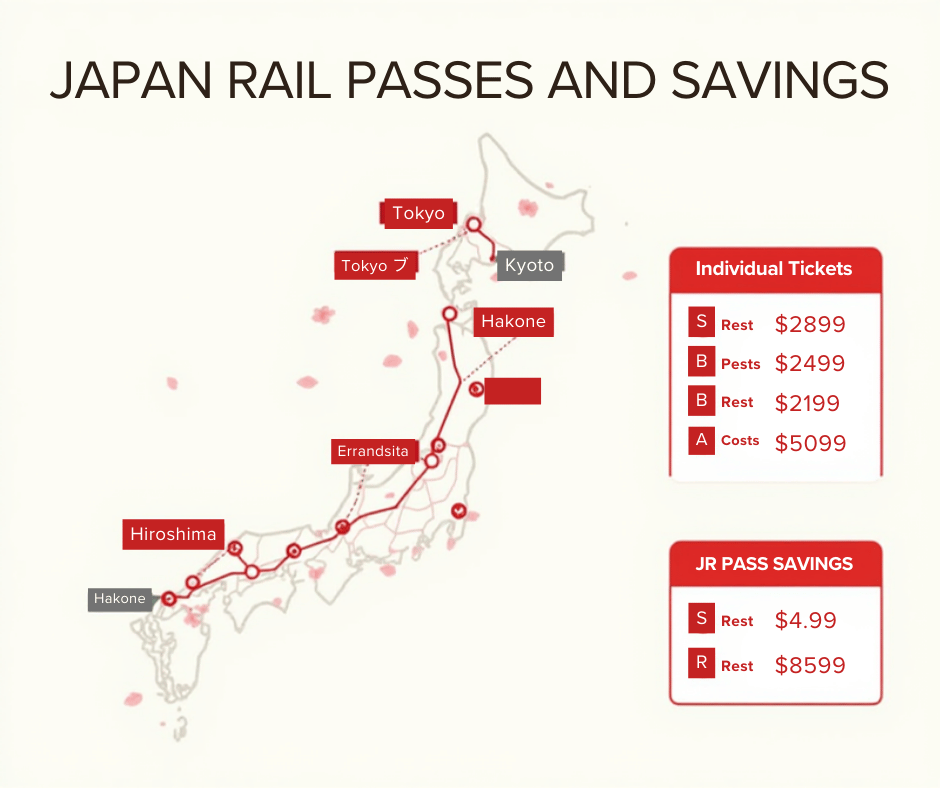
Rule of thumb: if your itinerary stays inside one of the colored blobs on JR’s regional map, buy the regional pass and pocket the difference for sushi.
7-Day JR Pass Sample Itinerary with Savings Calculator
I ran this exact schedule in May 2023 to attend a college friend’s wedding in Kyoto. All trains are covered by the ordinary 7-day pass (¥50,000). Prices shown are the walk-up reserved-seat fares I would have paid without the pass.
Day 1 – Arrival & Tokyo Loop
- Activate pass at JR East Travel Service Center, Narita T1.
- Narita Express to Shinjuku: ¥3,250 saved.
- Three Yamanote Line joyrides (Harajuku → Akihabara → Ueno → Shinjuku): 3 × ¥170 = ¥510 saved.
- Running total: ¥3,760
Day 2 – Hakone Day Trip
- Shinjuku → Odawara (RomanceCar would be extra, so I took the covered Shonan-Shinjuku Line + local): ¥1,490 saved.
- Odawara → Hakone-Yumoto (Hakone Tozan Railway not covered, paid ¥310 out of pocket).
- Return by same route: another ¥1,490 saved.
- Running total: ¥6,740
Day 3 – Tokyo to Kyoto
- Tokyo → Kyoto on 10:33 a.m. Hikari, seat 8C: ¥13,320 saved.
- Evening round-trip to Fushimi Inari on JR Nara Line: ¥710 saved.
- Running total: ¥20,770
Day 4 – Nara Deer & Todai-ji
- Kyoto → Nara → Kyoto: ¥710 saved.
- Stop at Inari again for sunset photos: another ¥0 (already counted).
- Running total: ¥21,480
Day 5 – Hiroshima & Miyajima
- Kyoto → Hiroshima (Sakura 551): ¥11,420 saved.
- Miyajima ferry (JR West operates the boat, covered): ¥200 saved.
- Running total: ¥33,100
Day 6 – Osaka Food Raid
- Hiroshima → Shin-Osaka (Sakura 571): ¥10,440 saved.
- Osaka Loop Line to Osaka Castle, then to Dotonbori: ¥210 saved.
- Refer to my Osaka street-food guide for takoyaki coordinates.
- Running total: ¥43,750
Day 7 – Return to Tokyo & Departure
- Shin-Osaka → Tokyo (Hikari 510): ¥13,620 saved.
- Tokyo → Narita (Narita Express 40): ¥3,250 saved.
- Final total: ¥60,620
Savings Summary
Without the pass I would have spent ¥60,620 (US $404). With the ¥50,000 pass I saved ¥10,620—enough for a kaiseki dinner in Kyoto and a night of karaoke in Osaka. The itinerary also left wiggle room for spontaneous hops; I added a ¥1,340 side trip to Himeji on Day 3 morning and still stayed in the black.
For more Shinkansen etiquette, see my complete Shinkansen ticket guide. If Hokkaido lavender is calling you, check the Hokkaido travel guide for seasonal timing. Otherwise, start with the main Japan travel guide to build your own route.
JR Pass Pro Tips From Years of Japan Travel
- Reserve seats for free. Walk to any “Midori-no-Madoguchi” ticket office, slide your pass under the glass, and name your train. During Golden Week I reserve every leg the moment I activate; in off-season I reserve only the long ones and hop into non-reserved cars for short hops.
- Nozomi and Mizuho are off-limits. The signs are pink and red; ignore them. Hikari and Sakura trains run the same rails and stop at the same cities, arriving 15–20 minutes later. I use the extra time to queue up a bento.
- Activate mid-week. My passport stamp usually lands on Tuesday. I wait until Wednesday morning to start the pass, giving me two full weekends of coverage when commuter trains are lighter and tourist spots livelier.
- Airport transfers are included. Narita Express (¥3,250) and Kansai Airport Haruka (¥3,640) both accept the pass. I once watched a couple buy NEX tickets with cash while I flashed my pass—felt like cheating, but it’s legit.
- Download the JR East app. It lists live delays in English and spits out platform numbers faster than the station attendants can circle them on paper. Offline PDF timetables are buried in the menu—save them before you lose Wi-Fi.
- Green Car upgrade math. A 7-day Green Pass costs ¥70,000 versus ¥50,000 ordinary. The surcharge on individual Green seats is roughly ¥5,000 Tokyo–Kyoto. You need three long Shinkansen legs to break even. I buy Green only during Golden Week or Obon when ordinary non-reserved cars resemble subway crush hour.
- Night trains are extinct. The Sunrise Seto still runs but requires a pricey berth (¥9,500+) even with the pass. Budget travelers should book a highway bus (¥4,000 Tokyo–Kyoto) and nap horizontally for half the price.
- Luggage strategy. Stations have 700-coin lockers (¥300–600). For oversized suitcases I use Takuhaibin next-day delivery (¥2,000 Tokyo–Kyoto). Send in the morning, ride the train unencumbered, and your bag waits at the hotel by 8 p.m.
- Don’t forget the ferry. JR West operates the Miyajima passenger boat. Show your pass at the pier gate; you’ll save ¥200 and feel like a pirate.
- Keep the paper sleeve. Station staff sometimes stamp the blank back side for commemorative collections. My 2019 sleeve now doubles as a bookmark.
Print this section, tuck it into your passport pouch, and you’ll ride smoother than the maglev test train.
Quick Decision: Should You Buy the JR Pass?
| ✅ Visiting 3+ cities by Shinkansen | GET THE PASS |
| ❌ Staying in Tokyo only | SKIP IT |
| 🔄 Single round-trip (Tokyo-Osaka) | COMPARE PRICES |
| 📍 Staying in one region | GET A REGIONAL PASS |
| 🌎 14+ days across Japan | DEFINITELY GET IT |
TOTAL SAVINGS WITH 7-DAY JR PASS
¥3,000+ (~$20 USD)
Based on Tokyo-Hakone-Kyoto-Nara-Hiroshima-Osaka route
Related Reading
More on Transportation:

Written by East Asia Explorer Editorial Team
Sam Konneh is an AI strategist and digital marketer based in Seoul, South Korea. With years spent living, working, and exploring across Korea, Japan, and China, he shares firsthand insights into East Asia's cultures, hidden gems, and everyday life. A graduate of Inha University and KDI Graduate School, Sam combines data-driven expertise with on-the-ground experience. His journey also includes studying in Malaysia and traveling through Southeast Asia. Through practical tips, local stories, and travel guides, he helps fellow explorers discover both the celebrated highlights and the lesser-known corners of East Asia.