
Last Updated: October 9, 2026 | Originally Published: May 31, 2026
Quick answer: paying in China as a tourist
- Best all-rounder: Alipay (支付宝) — link a Visa or Mastercard, scan to pay almost anywhere.
- Strong backup: WeChat Pay (微信支付) — same card-linking, plus messaging and Didi rides in one app.
- Fees: transactions under ¥200 are generally free; above ¥200 expect a service fee of around 3% on a foreign card (verify in-app).
- Always carry: ¥300–500 in cash. The People’s Bank of China requires merchants to accept yuan, and a few stalls still prefer it.
I landed in Shanghai with a wallet full of euros and learned within an hour that almost nobody wanted them. A noodle shop near Nanjing Road waved my cash away and pointed at a QR code taped to the counter.
China runs on two super-apps: Alipay and WeChat Pay. Since both opened up to foreign cards, paying here got far easier than the old “prepaid Tour Pass” days. This guide compares them and tells you exactly what to set up before you fly.
Can foreign tourists actually use Alipay and WeChat Pay in 2026?
Yes. Both apps let overseas visitors link an international card — Visa, Mastercard, JCB, Diners Club and Discover are the common ones.
This changed in late 2023, when Ant Group (Alipay) and Tencent (WeChat Pay) added direct card binding for tourists. Before that, foreigners had to load a prepaid balance through Alipay’s “Tour Pass” mini-program.
You no longer need a Chinese bank account or a local phone number tied to a bank. You do need the app, your passport details, and a supported card.
One detail trips people up. Until you finish passport verification, your account is treated as unverified, and unverified accounts are capped at about ¥1,000 per day under China’s non-bank payment rules.
That ¥1,000 ceiling vanishes once your passport clears. On sourcing trips I’ve seen the difference firsthand: an unverified app handles a taxi and lunch fine, then chokes on a ¥1,400 hotel night until the verification finally lands.
Pro tip: Set up at least one app before you leave home, on hotel or home Wi-Fi. Verification can take a few hours, and you do not want to do it standing at a metro gate.
Alipay vs WeChat Pay: which should you install?
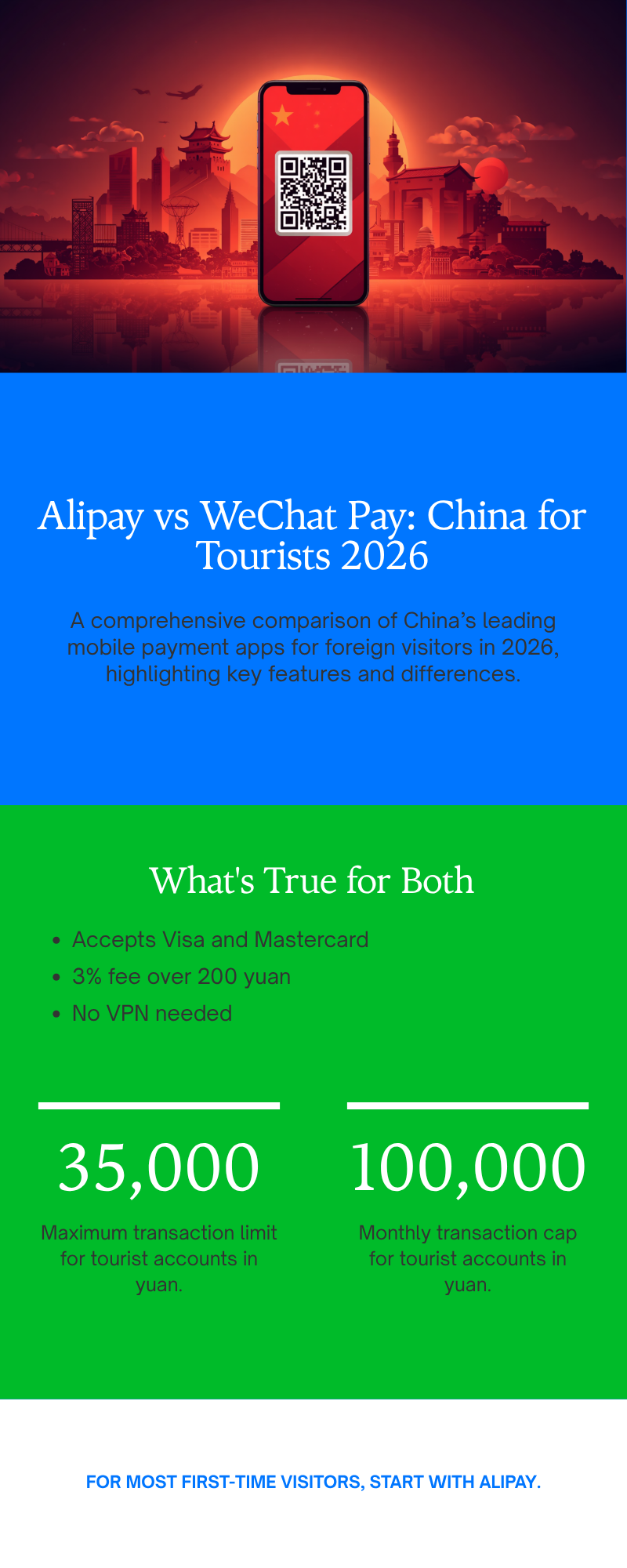
Install both if you can. They overlap heavily, but each has moments where the other struggles to verify a foreign card.
Alipay tends to be the smoother choice for first-time visitors. Its English interface is cleaner, and its built-in mini-programs cover metro QR tickets, Didi rides, and train bookings through Trip.com partners.
WeChat Pay shines if you also want to message people, join group chats, or split a bill with friends. Payment is one tab inside an app you may already be using to stay in touch.
| Feature | Alipay (支付宝) | WeChat Pay (微信支付) |
|---|---|---|
| Foreign card linking | Visa, Mastercard, JCB, Diners, Discover | Visa, Mastercard, JCB, Diners, Discover |
| Best for | First-timers, smooth English UI | Messaging + paying in one app |
| Fee under ¥200 | Generally free | Generally free |
| Fee over ¥200 | ~3% on foreign card | ~3% on foreign card |
| Metro / transit | Metro QR mini-programs in major cities | Metro QR mini-programs in major cities |
| Rides | Didi built in | Didi built in |
| Verified single-txn cap | ~¥35,000 (about US$5,000) | ~¥35,000 (about US$5,000) |
| Unverified daily cap | ~¥1,000/day until passport verified | ~¥1,000/day until passport verified |
| English UI | Cleaner, more consistent | Good, some menus stay Chinese |
| Sign-up promo | Periodic fee waivers (varies) | Fee waiver, daily spend up to ¥1,000, first 60 days |
| Ecosystem | Payments, transit, travel, shopping | Messaging, social, plus the same payments |
| Ease of setup | Slightly simpler for first-timers | Easy if you already use WeChat to chat |
One number on that table deserves a closer look: the WeChat sign-up promo. As of 2026, a new international-card user gets the 3% fee waived on daily transactions up to ¥1,000 for the first 60 days after their first payment.
That window covers a typical two-week trip outright. If you only install one app and your spend is modest, WeChat Pay’s intro waiver can quietly be the cheaper option for the duration of the visit.
What does it cost to pay with a foreign card?
The headline rule is simple. As of early 2026, both apps waive fees on transactions under ¥200 and charge a service fee of roughly 3% above that threshold when you pay with a linked overseas card.
So a ¥35 bowl of noodles costs you ¥35. A ¥600 hotel charge may add about ¥18 in fees. Always glance at the in-app confirmation screen, which shows the fee before you approve.
Your card issuer may also add a foreign-transaction fee of 1–3% on top. A travel card with no foreign-transaction fee saves real money over a two-week trip.
One detail catches people out: the 3% is calculated on the whole amount, not just the slice above ¥200. A ¥1,000 purchase costs about ¥30 in service fee, not ¥24.
That math creates a popular tourist tactic. For a large bill split among friends, asking the merchant to ring it up as separate sub-¥200 charges keeps each one in the fee-free band.
Transaction and annual caps were raised for verified accounts, with single payments now allowed up to roughly ¥35,000 (about US$5,000) and monthly limits around ¥100,000. That covers nearly everything a tourist buys.
“The fee-free ¥200 threshold rewards small, frequent taps. Big-ticket buys — a hotel folio, a pricey dinner — are where the 3% bites, so that’s where cash or a split bill earns its keep.” — Frequent China travelers and fintech-savvy expats
Warning: Some small vendors and a handful of bank-account-only services still cannot accept foreign-card-linked payments. This is exactly why you keep cash and a backup app — do not rely on a single payment method.
Do you still need cash and a bank card in China?

Yes, a little. Cash is still legal tender, and the People’s Bank of China has reminded merchants that refusing yuan is not allowed.
Carry ¥300–500 in small notes for taxis without QR readers, rural stalls, temple donation boxes, and the rare app glitch. Break large notes early, because change for a ¥100 bill can be awkward at tiny shops.
For cash withdrawals, Bank of China and ICBC ATMs reliably accept foreign Visa and Mastercard. A UnionPay card, if you have one, is also widely accepted at terminals across the country.
“Refusing cash payments is illegal. Yuan banknotes and coins must be accepted for retail transactions.” — guidance issued by the People’s Bank of China on cash acceptance.
How do you set up Alipay or WeChat Pay step by step?
The flow is similar in both apps. Do it on a stable connection before you travel.
First, download the app from your home App Store or Google Play and register with your real phone number. Second, open the payment or wallet section and choose to add an international bank card.
Third, enter your card details and complete passport-based identity verification. Fourth, make a tiny test payment once you arrive — buy a bottle of water — so you know it works before you actually need it.
Pro tip: Take a screenshot of your own “receive money” QR code and your passport photo page. If your phone loses signal in a basement food court, a saved QR still lets a vendor scan you.
Where Alipay and WeChat Pay setup differ
The broad steps match, but the friction points differ. Alipay funnels foreign users straight into a “TourCard / international card” flow, so the path to adding a Visa or Mastercard is short and signposted in English.
WeChat Pay buries the wallet one layer deeper, inside Me → Services → Wallet, and a few sub-menus stay in Chinese. If you already use WeChat to chat, though, the account itself is half set up.
Both rely on a real phone number to receive an SMS code, and a foreign number works for this. The number only needs to receive the verification text — it does not have to be Chinese.
Passport verification is the slow part. Both apps ask you to photograph your passport’s photo page; review is usually under a day but can run up to about 72 hours, so do it well before you fly.
Pro tip: Photograph your passport flat, in daylight, with no glare and all four corners showing. Most verification failures are a blurry or cropped photo, not a rejected identity. A clean shot usually clears the automated check in minutes.
Paying in the real world: metro, taxis, trains and street stalls

The apps are only as good as the situations they handle. Here is how each common payment moment actually plays out for a foreign cardholder in 2026.
Metro and subway. Open the city’s transit QR inside Alipay’s “Transport” tab or WeChat’s equivalent, set it up once per city, then scan at the turnstile to enter and exit.
Beijing and Shanghai also let you tap in with a foreign contactless card, though that route usually costs a touch more than the QR.
Ride-hailing. Didi runs as a mini-program inside both apps — no separate download, no Chinese number. Link your foreign card, and the interface shows in English with driver messages auto-translated both ways.
High-speed rail. Buy through the Trip.com partner mini-program inside Alipay or the official Railway 12306 app. A warning here: on 12306 directly, foreign cards do not always go through, so the Trip.com route is the more reliable payment path. You collect at the station with your passport.
Street vendors and wet markets. Almost every stall tapes up a static QR you scan, or the vendor scans your code. This is where the sub-¥200 fee-free band shines — most market buys never come close to the threshold.
Taxis and vending machines. Modern taxis show a QR on the dashboard; older ones may want cash. Vending machines, lockers and self-service kiosks almost all read the apps. Tipping is not customary, so there is no awkward in-app gratuity step.
When a foreign card fails: the real failure modes
Payments in China work the vast majority of the time. The failures cluster into a handful of patterns worth recognising before they strand you.
Card simply rejected. Often the issuer flags the charge as suspicious foreign e-commerce. A quick travel-notice to your bank, or raising your online spending limit, clears most of these.
Verification loop. The app keeps asking for the passport photo. Usually a glare-free reshoot fixes it; if not, wait out the 72-hour review rather than resubmitting on repeat, which can reset the queue.
SMS never arrives. The registration code needs a reachable number. If roaming is patchy, set the app up on home Wi-Fi with your normal SIM before departure, not at the airport.
Scan confusion. Two modes exist — you scan the merchant, or the merchant scans your code. If one screen stalls, switch to the other; vendors are used to flipping between them.
Refunds. A reversed charge returns to the linked card, not an in-app balance, and can take a few business days. Keep the in-app transaction record until it lands.
Will the Great Firewall block these payment apps?
No. Alipay and WeChat both operate inside China and work normally on local networks without a VPN.
The catch is everything around them. Google Maps, Gmail, and many Western apps are blocked, so set up an eSIM or VPN for those before arrival. Your payment apps will work; your map app might not.
Key takeaway
Link a no-foreign-fee Visa or Mastercard to both Alipay and WeChat Pay before you fly, keep ¥300–500 cash for the gaps, and you can travel China for two weeks barely touching a physical wallet.
When does Alipay’s prepaid Tour Pass still make sense?
Direct card linking has mostly replaced the old Tour Pass mini-program. It still has a niche use, though.
Tour Pass lets you preload a balance — top-ups run from ¥100 to ¥2,000 — onto a virtual prepaid card inside Alipay. The balance stays valid for 90 days, and any unused amount is refunded after it expires.
Reach for it if your bank repeatedly blocks the recurring foreign charges that direct linking creates, or if you want a hard ceiling on your daily spend. For most travellers, plain card linking is simpler and avoids the small top-up surcharge.
Tour Pass also helps if your card keeps tripping the unverified ¥1,000 daily cap and you cannot wait out passport verification. Preloading a balance lets you spend against the loaded amount rather than per-transaction card approvals.
The trade-off is the top-up service fee on each reload and the 90-day expiry clock. If you are staying a fortnight and your card binds cleanly, direct linking still wins on simplicity.
City by city: where paying is effortless and where it is not
In tier-one cities, cashless travel is close to total. Shanghai, Beijing, Shenzhen and Guangzhou run on QR codes from breakfast stalls to luxury malls.
Metro QR ticketing now works in more than 40 Chinese cities through Alipay and WeChat mini-programs, so you rarely buy a paper ticket. Didi inside either app handles taxis and ride-hailing without cash.
Smaller and rural areas are where I still reach for notes. Village stalls around Guilin’s rice terraces, some Yunnan guesthouses, and the occasional older taxi driver prefer cash or struggle with foreign-card QR scans.
Pro tip: Long-distance train tickets are easiest through the Trip.com partner mini-program inside Alipay, or the official Railway 12306 app. Both let you pay with a linked foreign card and collect at the station with your passport.
Across all regions, the pattern is consistent. Apps handle the vast majority of spending, and a small cash float covers the handful of places technology has not yet reached.
What are the most common payment mistakes tourists make?
The biggest one is arriving with only euros or dollars and no app installed. Currency exchange counters give poor rates, and most shops cannot take foreign notes at all.
The second is relying on a single app. Verification engines differ, so a card that fails in WeChat Pay often sails through Alipay, and the other way around.
A third trap is the foreign-transaction fee your own bank adds. That fee is separate from the in-app service fee, so a debit card from a fee-heavy bank quietly taxes every purchase.
Travellers also forget to raise their card’s online spending limit before the trip. A linked card behaves like an e-commerce charge, and a low default limit can block a hotel payment at the worst moment.
Finally, people drain their phone battery on map and translation apps and then cannot pay. A small power bank is as essential as the apps themselves in a cashless country.
Which payment method wins for most China trips?
For a typical two-week visit, Alipay with a linked no-foreign-fee Visa or Mastercard is the single best setup. It covers shops, metro, taxis, and trains with the cleanest English flow.
Add WeChat Pay as your backup and social layer, then keep ¥300–500 in cash for the gaps. That combination has handled everything from a Beijing hutong breakfast to a Shanghai Maglev ticket for me without a hitch.
Set all of it up at home, test each app on day one, and China becomes one of the easier places in Asia to pay — despite its reputation among first-time visitors.
Frequently asked questions
Can I use Apple Pay or Google Pay in China?
Rarely. Most merchants only take Alipay and WeChat Pay QR codes. Apple Pay works at a small number of chains, so treat it as a bonus, not a plan.
Do I need a Chinese SIM card to register?
No. You can register Alipay and WeChat Pay with your foreign phone number. A working number for the SMS verification code is the only requirement.
Is there a spending limit on a tourist account?
There are caps, but they are generous after the 2026 increases — single transactions up to roughly US$5,000, with annual limits well above typical tourist spending.
What if my foreign card keeps getting rejected?
Try the other app first, since verification engines differ. If both fail, fall back to Alipay’s prepaid Tour Pass mini-program or withdraw cash at a Bank of China ATM.
Should I tip using these apps?
Tipping is not customary in mainland China and is not expected at restaurants or taxis. Pay the displayed amount and you are done.
How do I avoid the 3% foreign-card fee?
Keep single payments under ¥200, where transactions are generally fee-free. For larger bills, ask the merchant to split the charge, pay with cash, or use WeChat Pay’s first-60-days waiver on daily spend up to ¥1,000.
Do I need a VPN to use Alipay or WeChat Pay?
No. Both run on Chinese networks without a VPN. You may want an eSIM or VPN for blocked Western apps like Google Maps and Gmail, but the payment apps themselves work fine on a local connection.
Last updated: 2026-05-31. Fees and limits for foreign-card payments change often; confirm current rates inside each app before you rely on them.
More on Travel Essentials:
Planning a trip to China?
Check out our China Travel Hub for more guides, including China Digital Survival Guide.

Written by East Asia Explorer Editorial Team
Sam Konneh is an AI strategist and digital marketer based in Seoul, South Korea. With years spent living, working, and exploring across Korea, Japan, and China, he shares firsthand insights into East Asia's cultures, hidden gems, and everyday life. A graduate of Inha University and KDI Graduate School, Sam combines data-driven expertise with on-the-ground experience. His journey also includes studying in Malaysia and traveling through Southeast Asia. Through practical tips, local stories, and travel guides, he helps fellow explorers discover both the celebrated highlights and the lesser-known corners of East Asia.