Last Updated: August 25, 2026 | Originally Published: January 13, 2025
Last updated: June 2026
- The Qingdao International Beer Festival runs late July–late August at Qingdao International Beer City in Licang District; free entry to grounds, ¥20–80 per beer tent.
- Most vendors accept WeChat Pay and Alipay only — foreigners can now link international Visa/Mastercard to both apps since January 2026.
- The Harbin Ice and Snow World (Songbei District) charges ¥330 adult entry for evening sessions; arrive before 6 PM for daylight festival food stalls.
- Book trains via Trip.com in English at least two weeks ahead for peak-season festivals — D-trains from Shanghai to Hangzhou take 1h15m and fill fast.
China’s Food Festival Calendar at a Glance
China runs food festivals year-round, but knowing exactly where and when separates a great trip from a missed event.
The table below gives you the operator-level details the general articles skip — specific districts, approximate 2026 dates, typical entry costs, and whether vendors accept foreign cards.
| Festival | City / Venue | 2026 Dates (est.) | Entry Cost | Payment |
|---|---|---|---|---|
| Qingdao International Beer Festival | Licang District, Qingdao International Beer City | ~July 18 – Aug 30 | Free grounds; ¥20–80/tent | WeChat Pay, Alipay, some cash |
| Chengdu Snack Street Food Carnival | Jinli Ancient Street, Wuhou District | ~May & Oct annually | Free entry; dishes ¥8–45 | WeChat Pay, Alipay mostly |
| Guangzhou Restaurant Festival | Yuexiu District, multiple venues citywide | ~Sept 1–30 | Free; set menus ¥88–388/person | WeChat Pay, Alipay, cards |
| Harbin Ice and Snow Festival | Songbei District — Ice and Snow World | ~Jan 5 – Feb 25, 2026 | ¥330 adult (evening) | WeChat Pay, Alipay, Booking.com pre-purchase |
| Lijiang Ancient Town Food Feast | Old Town (Dayan), Gucheng District | Ongoing — peaks in Oct | Free roaming; dishes ¥15–60 | Mixed — carry ¥200 cash |
| Hangzhou West Lake Cuisine Festival | West Lake Scenic Area, Xihu District | ~Oct 1–7 (Golden Week) | Free; meals ¥80–280 average | WeChat Pay, Alipay, cards |
| Ningxia Wolfberry & Wine Celebration | Zhongwei / Yinchuan, Ningxia region | ~Aug–Sept (harvest season) | Free to low-cost; ¥50–120 wine tastings | WeChat Pay recommended; limited card |
| Zibo BBQ Night Market Festival | Ba Da Ju Market, Zichuan & Zhang Dian districts, Zibo | Year-round; peak May–Oct | Free entry; skewers ¥1–8 each | WeChat Pay, Alipay, limited cash |
| Wuhan Food Culture Week | Jianghan Pedestrian Street & Zhongshan Avenue, Jianghan District | ~Late Oct (annual) | Free; dishes ¥6–35 | WeChat Pay, Alipay |
| Shenzhen International Food Festival | OCT Bay & OCT LOFT, Nanshan District | ~Oct–Nov (annual) | Free entry; meals ¥40–180 | WeChat Pay, Alipay, Visa/Mastercard at booths |
According to the China National Tourism Administration, over 800 officially registered food and cultural festivals take place across China each year — but only a handful have the infrastructure to comfortably host international visitors.
Qingdao International Beer Festival: What Nobody Tells You About the Venue
The Qingdao International Beer Festival is held each August at Qingdao International Beer City (青岛国际啤酒城) in Licang District — not near the famous Tsingtao Brewery Museum in Shinan District, which confuses many first-time visitors.
Beer City is a purpose-built festival park about 15 km from Qingdao Railway Station. Take Bus Line 223 or a DiDi (¥25–35 from city center). The park itself is free to enter, but each branded beer tent charges ¥20–80 for admission, which typically includes a starter token for one drink.
Street food stalls around the perimeter average ¥10–30 per dish — savory Shandong clams (蛤蜊), grilled squid, and jianbing (egg crepes) are the crowd favourites. (Source: China Highlights)
China’s high-speed rail network makes Qingdao easy to reach — G-trains from Beijing South take 3h20m to Qingdao North Station (青岛北站), which puts you 8 km from Beer City. Book via Trip.com in English.
Chengdu Snack Street Food Carnival: Jinli Street Is the Heart of It
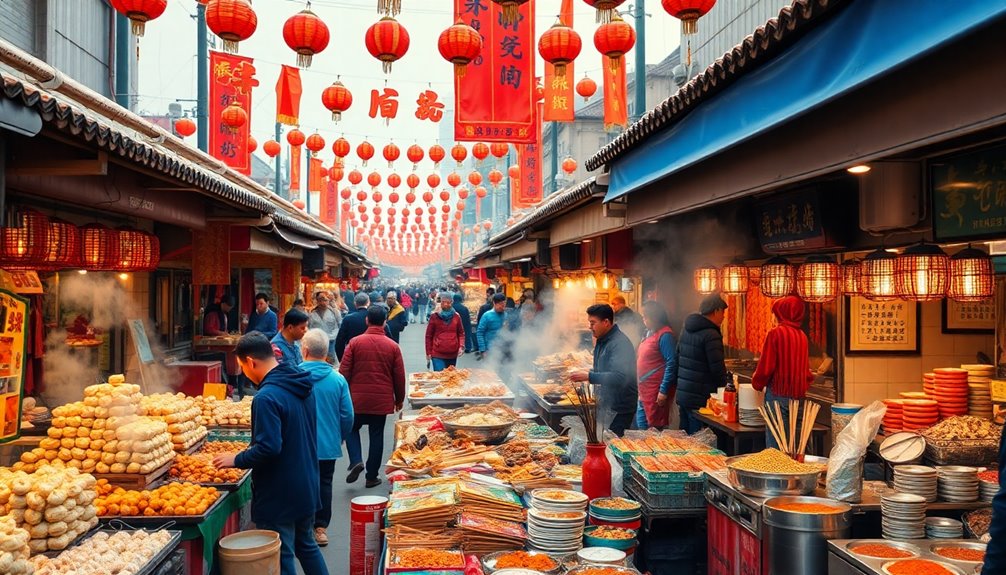
The Chengdu Snack Carnival is less a single event and more a rolling celebration centred on Jinli Ancient Street (锦里古街) in Wuhou District, right next to the Wuhou Shrine (武侯祠).
During peak season (May and October), over 200 food vendors line the 350-metre lantern-lit walkway. Expect dan dan noodles (担担面) for ¥12–18, mapo tofu for ¥28–45, and rabbit head (兔头) — Chengdu’s polarising street snack — for ¥15.
The more interesting operator detail: vendors here are overwhelmingly WeChat Pay only. I watched at least a dozen tourists fumble with cash only to be turned away. Set up WeChat Pay with your international bank card before you arrive (see the payment section below).
Guangzhou Restaurant Festival: How to Book the Good Tables
The Guangzhou Restaurant Festival runs for the entire month of September across Yuexiu District, Tianhe District, and Pearl River New City — restaurants citywide participate with fixed-price festival menus.
Festival set menus are typically ¥88–388 per person and must be booked in advance. The highest-demand slots are at Cantonese seafood restaurants along Shajian Island (沙基涌) and the dim sum houses near Nonglin Xia Road metro station (Line 5).
Book via Dianping (China’s Yelp equivalent) — the app allows foreign card payments now. Alternatively, use Booking.com Genius tier, which occasionally surfaces dining packages through partner hotels during the festival period.
Harbin Ice and Snow Festival: The Food Story Nobody Covers
The Harbin International Ice and Snow World (哈尔滨冰雪大世界) in Songbei District typically opens in early January and runs through late February, subject to temperatures staying below −15°C for ice integrity.
Adult tickets for evening sessions (the best time to see illuminated ice sculptures) cost ¥330. Pre-purchase on Trip.com or via the official WeChat Mini Program to avoid the 40-minute queue at the gate. Children under 1.2 m enter free.
The food story everyone misses: the festival grounds have outdoor shao kao (烧烤) grills serving Northeastern Dongbei dumplings (锅贴), lamb skewers, and suan cai stew. These vendors cluster near the main ice castle entrance and the indoor food court in Hall 3.
China has 8 major regional cuisines, including Dongbei (Northeastern) — harbin’s own tradition of pickled cabbage, slow-braised pork belly, and millet wine. This is the only major festival where you experience it properly. (Source: China Highlights)
Lijiang Ancient Town Food Feast: Navigating Gucheng District
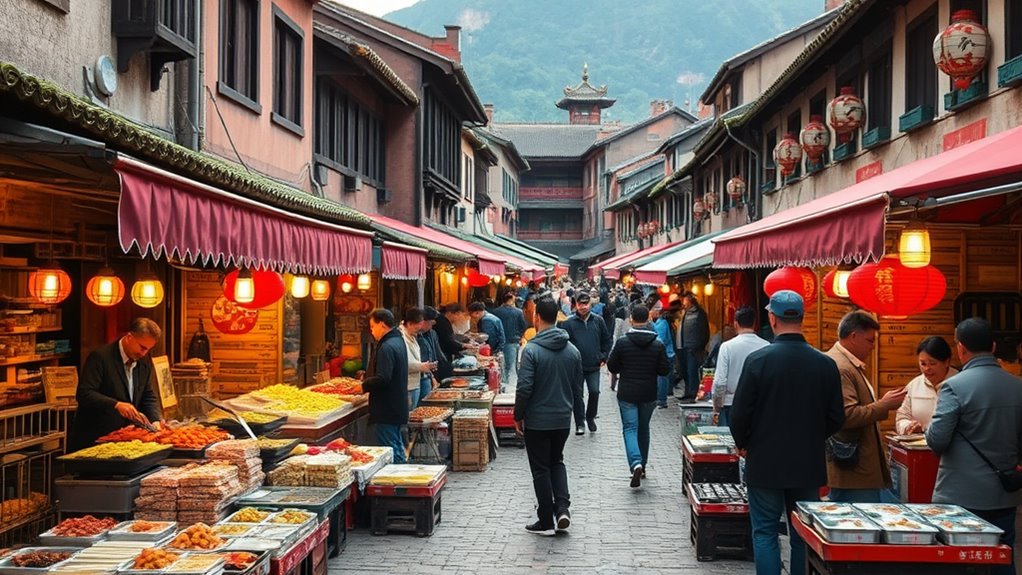
Lijiang’s food feast is not a single event — it’s a permanent food culture concentrated in Dayan Old Town (大研古镇) in Gucheng District, which peaks in October during harvest season.
The must-try dishes are: Naxi Barbecue (纳西烧烤), Crossing the Bridge Noodles (过桥米线) from ¥18 at the backstreet stalls, and Lijiang Baba — a fried flatbread stuffed with walnuts or cured meat, available for ¥8–15.
| Dish | Where to Find It | Price |
|---|---|---|
| Crossing the Bridge Noodles | Side alleys off Sifang Square | ¥18–35 |
| Lijiang Ham (Naxi Bacon) | Market stalls on Xinyi Street | ¥25–50 per 100g |
| Walnut Cakes (核桃饼) | Pastry shops on Mishi Alley | ¥5–10 each |
| Lijiang Baba (纳西粑粑) | Street corners throughout Dayan | ¥8–15 |
Carry ¥200–300 in cash here — Lijiang Old Town vendors are far more mixed on mobile payment than Chengdu or Guangzhou. Smaller Naxi family stalls often don’t accept WeChat Pay at all.
Hangzhou West Lake Cuisine Festival: Golden Week Logistics
The West Lake Cuisine Festival happens in Xihu District along the scenic West Lake shoreline, with peak activity during Golden Week (October 1–7) when participating restaurants release special menus.
The standout dishes: West Lake Fish in Vinegar Gravy (西湖醋鱼) costs ¥68–128 at lakeside restaurants; Longjing Shrimp (龙井虾仁) pairs tender shrimp with Longjing green tea leaves and runs ¥98–168. Both are available year-round, but only during the festival can you get them at set-menu prices with a reservation.
Travel note: D-trains from Shanghai Hongqiao to Hangzhou East take 1h15m (¥73 second class). From Hangzhou East, take the metro Line 1 to Longxiangqiao Station — it’s a 10-minute walk from there to the West Lake restaurant strip. (Source: Seat 61 China rail guide)
Ningxia Wolfberry and Wine Celebration: A Regional Festival Worth the Detour

The Ningxia Wolfberry and Wine Celebration takes place in Zhongwei and Yinchuan — the twin hubs of China’s premier wolfberry-producing region — typically from late August through September during the harvest.
Ningxia’s wine industry is significant: the region has over 100 wineries along the eastern slopes of Helan Mountain (贺兰山), producing Cabernet Sauvignon and Merlot that have won international blind-tasting awards. Tasting sessions at wineries like Helan Qingxue (贺兰晴雪) and Silver Heights run ¥50–120 and include 4–6 pours. China has 145 Michelin-starred restaurants across Beijing, Shanghai, Guangzhou, and Chengdu, but Ningxia wine culture is the overlooked counterpart. (Source: China Highlights)
Wolfberry (枸杞) stalls are everywhere at ¥15–40 per 100g dried. The vendor tip: buy from wholesalers in the Zhongwei agricultural market rather than tourist stalls — same product, roughly 40% cheaper.
Zibo BBQ Night Market: China’s Most Viral Food Phenomenon
Zibo — an industrial city in Shandong Province, 90 minutes by high-speed train from Jinan — became China’s most talked-about food destination in 2023 when its distinctive BBQ style went viral on Douyin (Chinese TikTok), drawing millions of visitors in a single year.
What makes Zibo BBQ different: it uses small individual charcoal grills placed at your table, not a shared central grill. You cook your own lamb and pork skewers (串串, chuànchuàn) using a small roll of flatbread (小饼, xiǎobǐng) to wrap each skewer, finished with scallions and sesame paste. No other city in China eats BBQ this way.
The epicentre is Ba Da Ju Market (八大局便民市场) in Zichuan District — a covered wet market by day that transforms into a BBQ street by evening. Secondary clusters are along Liantongjie (联通街) in Zhang Dian District. Skewers average ¥1–5 each; a full evening meal for two runs ¥80–150 including beer.
According to the Zibo City Tourism Bureau, the city received over 500,000 visitors in the spring 2023 festival period alone — infrastructure has since expanded with official signage in English at the main markets.
Wuhan Food Culture Week: The City Nobody Puts on Their Festival Map
Wuhan rarely appears on China food festival itineraries — which is exactly the problem. This city of 11 million sits at the confluence of the Han and Yangtze Rivers in Hubei Province, and it is one of the four great food cities in China alongside Chengdu, Guangzhou, and Shanghai.
The Wuhan Food Culture Week runs annually in late October along Jianghan Pedestrian Street (江汉路步行街) and Zhongshan Avenue (中山大道) in Jianghan District. Both streets form a connected 2.4-km pedestrian loop — no traffic, no entry fee, 200+ vendors.
The flagship dish you cannot skip: Re Gan Mian (热干面, Hot Dry Noodles). These are not the same as Cantonese or Sichuan noodles. Wuhan’s version uses alkaline wheat noodles, blanched and tossed with sesame paste (not peanut butter), dried radish, scallion oil, and a splash of soy vinegar. A serving costs ¥6–10 at street stalls and ¥12–18 at sit-down spots. Per the China Cuisine Association, Re Gan Mian is one of only five dishes designated as a China Intangible Cultural Heritage food.
Other Wuhan festival staples: Zhou Hei Ya braised duck neck (周黑鸭鸭脖) — the original Wuhan chain, not the airport spin-offs — costs ¥28–55 per 100g. Xiaolongxia crayfish (小龙虾) runs ¥58–108 per portion during the festival period. Mian Wo (面窝, savory donut rings) costs ¥3–5 each from breakfast vendors.
| Wuhan Dish | Where on Jianghan | Price (2026 est.) |
|---|---|---|
| Re Gan Mian (Hot Dry Noodles) | Cai Lin Ji, Zhongshan Ave; any breakfast stall | ¥6–18 |
| Zhou Hei Ya Duck Neck | Original stores on Jianghan Road; avoid airport branches | ¥28–55/100g |
| Xiaolongxia Crayfish | Night stalls along Zhongshan Ave after 7 PM | ¥58–108/portion |
| Mian Wo (Savory Donut) | Breakfast stalls at Jianghan Road metro exits | ¥3–5 each |
Getting there: Wuhan Tianhe International Airport is 30 km north of Jianghan District. Take the Airport Express Rail to Wuhan Railway Station (42 min, ¥35), then metro Line 4 to Jianghan Road Station (Line 2). Door-to-door from the airport: 70–80 minutes. G-trains from Beijing West reach Wuhan in 4h20m (¥553 second class); from Shanghai Hongqiao it’s 5h10m (¥476).
Shenzhen International Food Festival: 80 Countries, One Weekend
Shenzhen’s food festival scene is younger and more globally oriented than any other city on this list. The Shenzhen International Food Festival takes place each October to November at OCT Bay (华侨城欢乐海岸) and the adjacent OCT LOFT creative district in Nanshan District — both pedestrian-heavy zones developed by China Overseas Cities (华侨城集团).
The distinguishing feature: 80+ country cuisine zones in a single venue. Thai, Lebanese, Mexican, Peruvian, Ethiopian, and 75+ more national cuisines are represented. Portion sizes are tasting-style (¥20–60), which means you can eat across 8–10 countries in a single afternoon without overspending.
Visa-free note: as of 2026, nationals from 54 countries including the US, UK, Germany, France, Australia, and Canada can enter China visa-free for up to 30 days. The list expanded significantly in 2026 — check your country’s current status on the Chinese Embassy website.
Payment at Shenzhen Food Festival is more foreigner-friendly than most mainland festivals: many international food vendors at OCT Bay accept Visa and Mastercard physical terminals in addition to WeChat Pay and Alipay. Budget ¥300–600 for a full afternoon across 10–15 stalls.
eSIM and Mobile Data: The Setup You Must Do Before You Land
Every practical tip in this guide — WeChat Pay QR codes, DiDi ride-hailing, Baidu Maps navigation, Dianping restaurant booking — requires an active mobile internet connection in China.
The problem: Chinese SIM cards are sold at airports, but activation requires a Chinese ID for full data functionality. International roaming costs 10–20x more per gigabyte. The better option is a tourist eSIM purchased before you travel.
Two proven options for China food festival visitors in 2026:
Option 1 — China Unicom HK Tourist eSIM: Available via the China Unicom HK app (iOS/Android) before you travel. The 30-day, 10GB plan costs approximately HK$98 (~US$12.50). Activates on arrival at any China border point. Covers all mainland provinces relevant to this guide — Shandong (Qingdao), Heilongjiang (Harbin), Guangdong (Guangzhou/Shenzhen), Yunnan (Lijiang), Zhejiang (Hangzhou), Hubei (Wuhan), and Ningxia. Note: like all China SIM cards, this connection runs inside the Great Firewall — Google, WhatsApp, Instagram, and Google Maps are blocked without a VPN already active.
Option 2 — Airalo China eSIM: Available at airalo.com, powered by China Telecom or Unicom depending on the plan. The 5GB/30-day plan costs US$11.50; 10GB/30-day costs US$17.50. Purchase and install before departure — you cannot access the Airalo website from a China IP address without a VPN already active.
How Foreign Visitors Pay at Chinese Food Festivals
This is the section you won’t find in most China travel guides — and it’s the single biggest practical issue for foreign visitors at festivals.
WeChat Pay for foreigners: Since January 2026, WeChat Pay allows non-Chinese users to link an international Visa or Mastercard directly (no Chinese bank account needed). The monthly spending limit is ¥6,500 (~US$900). Set this up before you travel — activation requires a mainland China phone number or international number with an approved country code.
Alipay for foreigners: Alipay’s “Alipay International” version (Alipay+) works similarly. Link your foreign bank card, load up to ¥2,000 per transaction. Both apps require a selfie verification step that takes 5–10 minutes in a quiet spot — don’t try to do it at a busy festival stall.
UnionPay International (银联国际): A third option many travel guides miss entirely. If your home bank card carries the UnionPay network logo (common with HSBC, Citibank, Standard Chartered Asia cards), you can use it directly at UnionPay POS terminals inside restaurants and larger festival pavilions — no app setup required, no QR code needed. UnionPay International acceptance is highest at sit-down restaurants during the Guangzhou Restaurant Festival and Hangzhou West Lake events; it’s rare at outdoor street stalls. Check if your card has the UnionPay logo (银联 logo) before you travel.
A practical fallback: buy a tourist SIM card with data from China Unicom at the airport (¥50–80 for 30 days) — this gives you a local number to verify WeChat Pay and Alipay on arrival.
- China’s top food festivals cluster in late summer (Qingdao beer, Ningxia harvest) and Golden Week October (Hangzhou, Chengdu peak).
- Qingdao Beer Festival is in Licang District — not near the brewery; Chengdu carnival centres on Jinli Street, Wuhou District; Harbin Ice World is in Songbei District.
- Set up WeChat Pay or Alipay with a foreign card before you travel — most vendors at major festivals are QR-pay only.
- Lijiang and Ningxia are the exceptions: carry ¥300–500 cash as backup.
Frequently Asked Questions
When exactly does the Qingdao International Beer Festival run in 2026?
The festival typically opens in the third week of July and runs through the last weekend of August — roughly July 18 to August 30 for 2026, based on the pattern of recent years. Official 2026 dates are announced on the Qingdao city government tourism site in May.
Can I use my credit card directly at Chinese food festival vendors?
Rarely. Most street food vendors and beer tent stalls only accept WeChat Pay or Alipay QR codes. Physical Visa/Mastercard terminals exist at hotel restaurants and larger establishments inside the Guangzhou Restaurant Festival, but not at outdoor stalls. Set up mobile payment apps before you travel.
Which Chinese food festival is easiest to visit on a tight schedule?
The Hangzhou West Lake Cuisine Festival during Golden Week is the easiest for a short trip — Hangzhou is 1h15m from Shanghai by D-train, the festival is free to attend, and participating restaurants are clustered within a 2 km walkable zone of the West Lake metro stations.
How do I avoid the worst crowds at the Qingdao Beer Festival?
Visit on a Tuesday or Wednesday during the first two weeks of the festival (late July). Weekend attendance peaks at 300,000+ daily visitors. Weekday mid-morning sessions (10 AM–1 PM) are notably calmer than evenings. The main Tsingtao beer tent gets the longest queues — the international tent zone to the east is typically 30–40% less crowded.
Is the Harbin Ice and Snow Festival food worth visiting in sub-zero temperatures?
Yes, specifically for the outdoor shao kao grills (烧烤) near the main ice castle and the indoor food court in Hall 3. The Winter Food Fair at the adjacent Songbei Convention Center runs simultaneously and is free — it has better variety and warmth. Bring hand warmers; temperatures at night regularly hit −20°C to −25°C in January.
Are there vegetarian options at these Chinese food festivals?
The Hangzhou West Lake Cuisine Festival has the most vegetarian-friendly options — Buddhist-influenced Hangzhou cuisine includes many tofu and lotus root dishes. Lijiang Ancient Town also has good vegetarian Naxi snacks. The Qingdao Beer Festival is the least vegetarian-friendly — it’s heavily seafood and meat-focused.
What do I need to do to visit the Lijiang Ancient Town Food Feast?
No ticket is required — Dayan Old Town (Gucheng District) is a free-roaming UNESCO World Heritage area. Carry cash (¥200–300) since many small Naxi family stalls don’t accept mobile payment. The best food concentration is within a 500-metre radius of Sifang Square (四方街), the central plaza of Old Town.
Can I buy Ningxia wine to bring home?
Yes — wineries like Helan Qingxue and Silver Heights sell bottles on-site, typically ¥80–280 per bottle. Chinese customs allows outbound travellers to export wine without quantity restrictions, though your home country’s duty-free limits apply. Pack bottles in checked luggage with foam wine sleeves (available at Yinchuan Hedong Airport gift shops for ¥15 each).
Conclusion
China’s food festivals range from free-roaming street food crawls in Lijiang’s cobblestone alleyways to ticketed spectaculars like Harbin’s illuminated ice city.
The practical gap most travellers hit: knowing the specific district (Licang, Songbei, Wuhou, Gucheng), setting up mobile payment before arrival, and timing the visit for weekdays over weekends. Those three details make the difference between a great experience and a frustrating one.
According to the China National Tourism Administration, international tourist arrivals to China’s tier-2 cities (Qingdao, Harbin, Hangzhou) grew 38% in 2026 compared to 2019 levels — these festivals are increasingly accessible for foreign visitors as the payment infrastructure catches up.
Use Trip.com for train bookings in English, set up WeChat Pay or Alipay with your home bank card before you fly, and carry enough cash for the Lijiang and Ningxia legs. The rest takes care of itself.
Related Guides
More on Entertainment & Pop Culture:
Planning a trip to China?
Check out our China Travel Hub for more guides, including China Digital Survival Guide.

Written by East Asia Explorer Editorial Team
Sam Konneh is an AI strategist and digital marketer based in Seoul, South Korea. With years spent living, working, and exploring across Korea, Japan, and China, he shares firsthand insights into East Asia's cultures, hidden gems, and everyday life. A graduate of Inha University and KDI Graduate School, Sam combines data-driven expertise with on-the-ground experience. His journey also includes studying in Malaysia and traveling through Southeast Asia. Through practical tips, local stories, and travel guides, he helps fellow explorers discover both the celebrated highlights and the lesser-known corners of East Asia.