Last Updated: August 25, 2026 | Originally Published: July 29, 2026
Last updated: July 13, 2026
Quick Answer: Summer Palace (Yiheyuan) Beijing 2026
- Take Metro Line 4 to Beigongmen Station (Exit C) — 25–40 min from Tiananmen East, ¥3–4 fare
- Buy the through-ticket (联票, liántào): ¥30 peak (Apr–Oct) / ¥20 off-peak (Nov–Mar) — covers Longevity Hill’s main halls and the Long Corridor
- Allow 4–5 hours minimum: the park covers 2.9 km² with Kunming Lake filling three-quarters of the site
- Skip Sundays and Chinese Golden Weeks (May 1–7, Oct 1–7) — entry queues regularly exceed 90 minutes
The Summer Palace — Yíhéyuán in Mandarin, literally “Garden of Nurtured Harmony” — sits 12 km northwest of central Beijing. UNESCO inscribed it as a World Heritage Site in 1998, calling it “a masterpiece of Chinese field garden design.”
The park covers 2.9 km², and Kunming Lake accounts for roughly 75% of that area. The practical challenge isn’t finding the place — it’s arriving at the right entrance with the right ticket.
I arrived at the Beigongmen gate at 7:15am on a Tuesday in October and had Longevity Hill’s south-face stairs nearly to myself for the first 90 minutes. By 9:30am, the same path was a slow-moving column of visitors.
This guide covers the operational details that most travel articles bury: which metro exit, which ticket type, which gate, and which combinations of sights make sense for how much time you have.
For broader context on traveling in China, see our China Travel Hub.
How to Get to the Summer Palace from Central Beijing
The fastest route for independent travelers is Metro Line 4 directly to Beigongmen Station (北宫门站, Exit C). From Exit C, walk 200 meters west to the Beigongmen (North Palace Gate) entrance — the closest gate to Longevity Hill and the Long Corridor.
From Tiananmen East (Line 1), transfer at Xidan to Line 4 northbound. Journey time: approximately 35–40 minutes, fare ¥3–4. From Beijing South Railway Station, Line 4 runs direct in about 50 minutes.
Pro Tip: Beigongmen vs Dongmen (East Gate)
Tour buses drop passengers at the East Gate (Dongmen), which is fine for the 17-Arch Bridge area but puts Longevity Hill a 25-minute walk away. Metro Line 4 to Beigongmen saves that walk and puts you directly at the main sights. If someone insists the East Gate is more convenient, they mean convenient for their coach parking — not for you.
Bus options: Bus 331, 332, or 817 from Zhongguancun serves Beigongmen. Bus 690 from the Drum Tower area serves Dongmen. Both run ¥2 flat fare.
Didi/taxi: From Tiananmen Square area, expect ¥35–50 and 25–35 minutes in normal traffic. North 4th Ring Road congestion on weekday mornings adds 15–20 minutes. Didi works smoothly for foreign visitors using the English-language app with Visa/Mastercard linked.
Parking: The North Gate lot fills before 9am on summer and autumn weekends. The East Gate lot is larger but still congested by 8:30am during Golden Week.
Tickets: Through-Ticket vs Garden-Only
Two ticket types exist, and the distinction causes problems at the gate more than any other source of visitor confusion:
| Ticket Type | Peak (Apr–Oct) | Off-Peak (Nov–Mar) | What’s Included |
|---|---|---|---|
| Garden-only (花园票) | ¥20 | ¥10 | Park grounds, Kunming Lake shoreline, Long Corridor exterior walk |
| Through-ticket (联票) | ¥30 | ¥20 | All of the above + Tower of Buddhist Incense compound, Hall of Dispelling Clouds, Suzhou Street, Marble Boat area |
| Tower of Buddhist Incense add-on | ¥10 | ¥10 | Entry into the tower pavilion itself (through-ticket required first) |
The through-ticket (联票, liántào) is the right choice for almost everyone. At ¥10 extra over garden-only, it unlocks Longevity Hill’s main structures — the Hall of Dispelling Clouds and the approach to the Tower of Buddhist Incense — which are the primary reason most people make the trip.
Warning: Garden-Only Default at the Gate
Gate staff sell the cheaper garden-only ticket by default unless you explicitly say “联票” (liántào, pronounced “lyen-tao”). Many visitors buy the wrong ticket, walk 20 minutes to Longevity Hill’s hall compound, and are turned back. Ask specifically for the through-ticket — or buy in advance via the Summer Palace’s official WeChat mini-program.
Payment: Cash, Alipay, and WeChat Pay are accepted at the gate. Foreign visitors can link Visa or Mastercard to Alipay’s international wallet (updated 2023) — no domestic Chinese bank account required. Alipay International works at this venue based on verified visitor reports on Trip.com through early 2026.
Discounts: Children under 1.2m enter free. Students with valid ID pay half price. Mainland Chinese seniors over 60 enter free; international seniors over 60 pay full rate.
Opening Hours and the Best Seasons to Visit
| Period | Park Opens | Last Entry | Park Closes |
|---|---|---|---|
| Peak (Apr 1–Oct 31) | 6:30am | 7:00pm | 8:00pm |
| Off-peak (Nov 1–Mar 31) | 7:00am | 4:00pm | 5:00pm |
October (best overall): Autumn foliage peaks mid-October on Longevity Hill’s north slope. Crowds are moderate between Golden Weeks. Morning light after summer humidity clears makes for exceptional photography. A weekday in mid-October is the best single day to visit.
April: Peach and cherry trees along the Long Corridor bloom late March to mid-April. Visually stunning but weekends are crowded. Weekday mornings before 9am are manageable.
June–August: Lotus flowers cover parts of Kunming Lake’s western basin from late June through August, per the China National Tourism Administration‘s seasonal guides. Summer is the hottest and most congested period — arrive before 8am.
December–January: When temperatures drop below -5°C for sustained periods, Kunming Lake freezes and ice-skating is permitted in designated areas near the South Embankment. The park is nearly empty. Through-tickets drop to ¥20, and you often have Longevity Hill to yourself before 9am.
Pro Tip: The 6:30am Window
In peak season the park opens at 6:30am, but most tourists arrive after 9am. An early start gets you Longevity Hill essentially alone. Climbing the south face and descending to the Long Corridor takes about 90 minutes — by which point crowds are still arriving at the gate.
Longevity Hill: The Tower of Buddhist Incense and What’s Up There
Longevity Hill (Wànshòu Shān) rises 60 meters above the park’s north shoreline and is the Summer Palace’s defining vertical element. The Tower of Buddhist Incense (佛香阁, Fóxiāng Gé) occupies its summit — a four-story, octagonal pavilion originally constructed under Emperor Qianlong in the 18th century.
Reaching the tower from Beigongmen takes about 20 minutes on foot via the south-face path, which involves roughly 280–300 steps. There is no cable car or escalator. Paved stone paths wind up both the front and rear faces.
At the hill’s base, the Hall of Dispelling Clouds (排云殿, Páiyún Diàn) forms the formal ceremonial entrance. Empress Cixi held birthday celebrations here. Both the hall complex and the approach to the tower are included in the through-ticket; the tower pavilion interior itself costs an additional ¥10 (cash only at the pavilion gate).
From the summit, the view covers all of Kunming Lake, the 17-Arch Bridge to the southeast, and — on clear Beijing days in October and November — the Fragrant Hills (Xiangshan) range to the northwest.
North slope of Longevity Hill: The rear face sees a fraction of the traffic of the south face. The descent path through forested terrain leads to Suzhou Street and the Back Lake. Most visitors miss this entirely.
Pro Tip: Descend the North Face
The standard tourist circuit climbs Longevity Hill from the south and returns the same way. Instead, descend the north slope through the forest path to Suzhou Street — a completely different environment. From there, walk east along the Back Lake to the Garden of Harmonious Interest before looping south. Add 45–60 minutes but substantially change the experience.
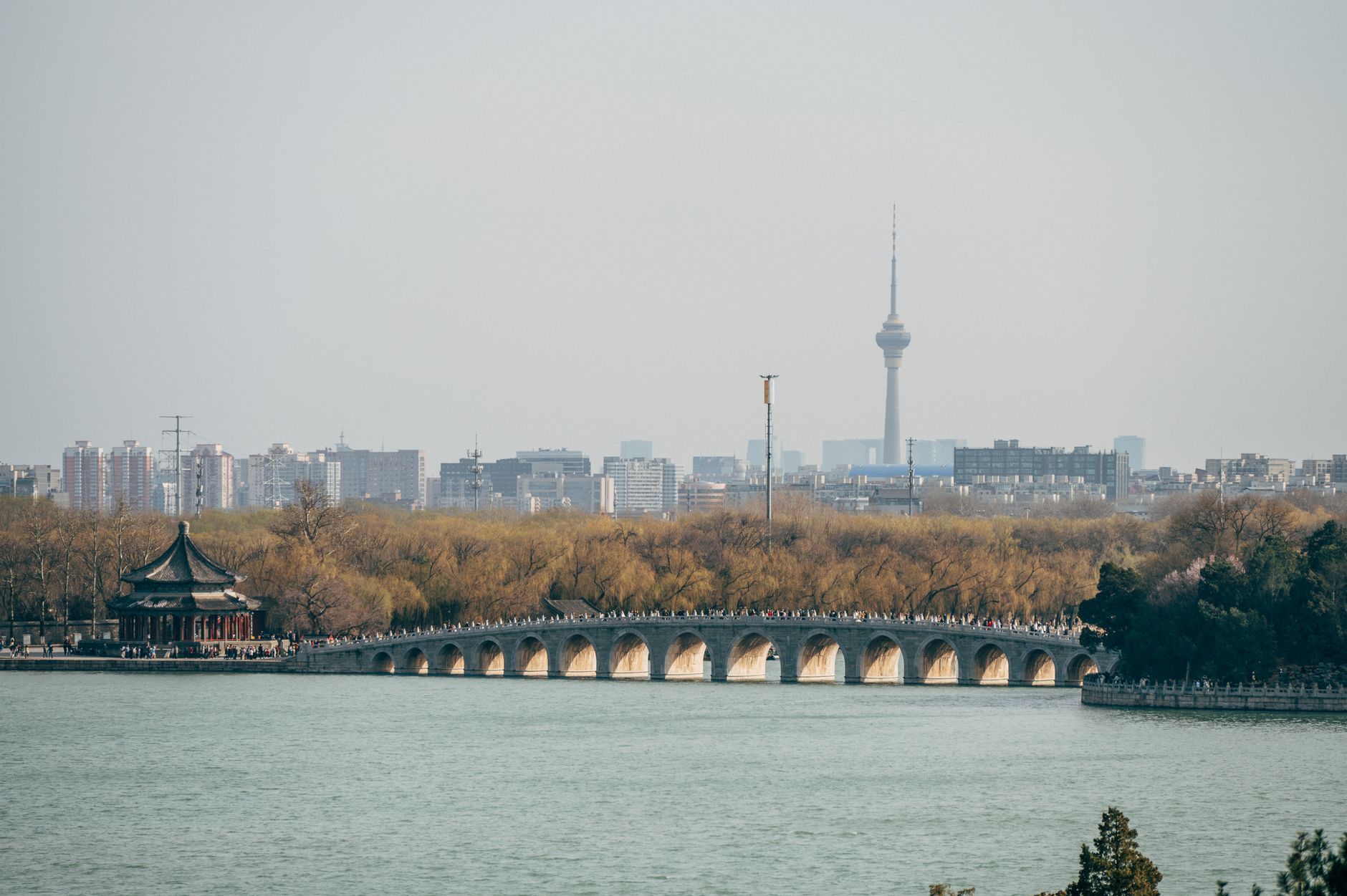
Kunming Lake: Boat Rentals, the 17-Arch Bridge and the Marble Boat
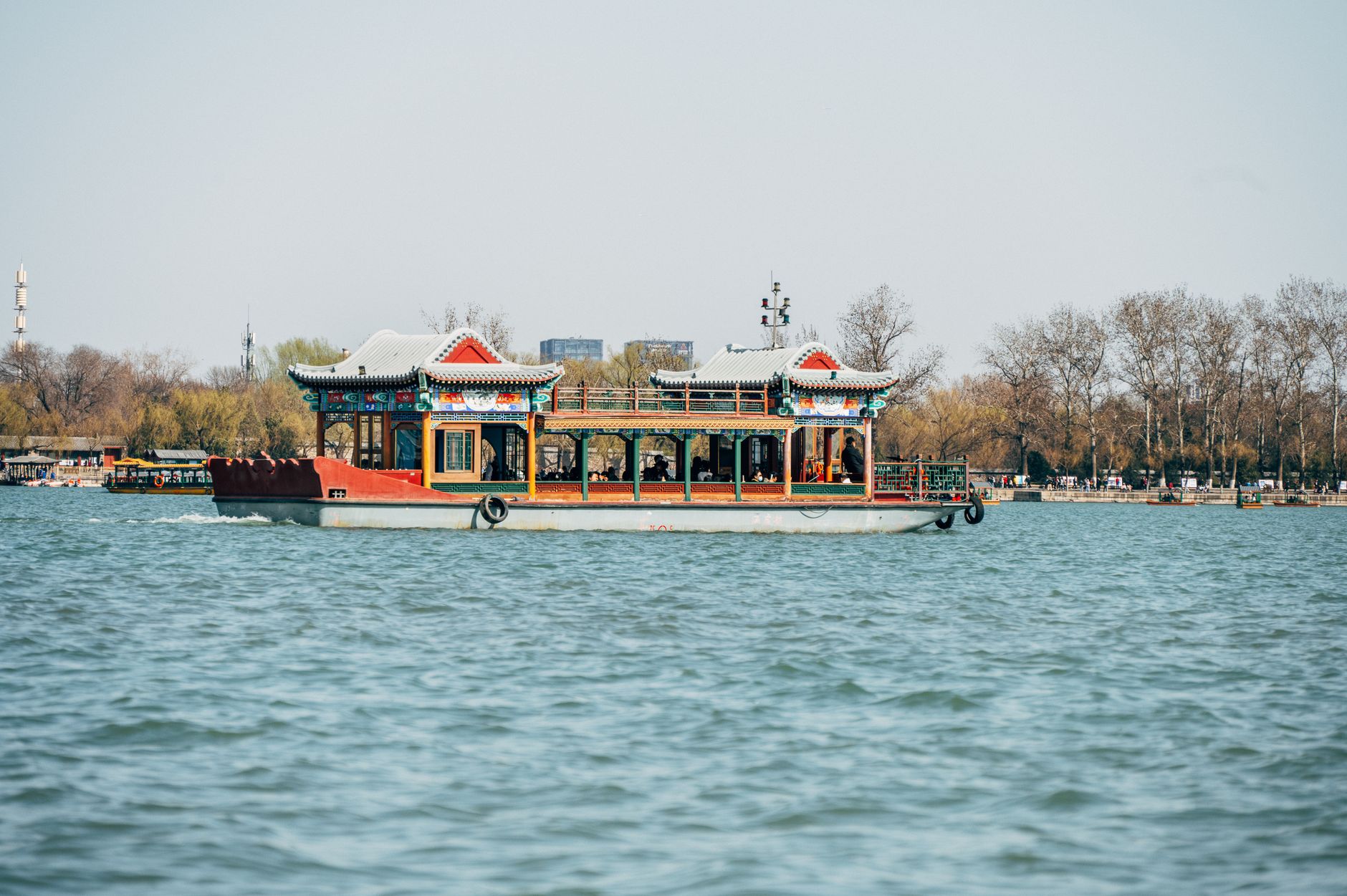
Kunming Lake (Kūnmíng Hú) covers approximately 2.2 km² of the Summer Palace’s 2.9 km² total footprint. Emperor Qianlong had it artificially expanded and partially modeled it on West Lake (西湖) in Hangzhou.
Boat rentals operate from docks near the East Gate and near the South Embankment (April–October only):
- Pedal boats: ¥60/hour (2-person), ¥100/hour (4-person)
- Electric cruise boat (龙船): ¥70 per person, ~45-minute circuit, departs every 30 minutes in peak season
- Traditional covered cruise: ¥90 one-way from East Gate dock to Marble Boat dock
Boat lines on summer weekends can run 30–45 minutes. Mid-week mornings have little to no wait.
The 17-Arch Bridge (十七孔桥, Shíqī Kǒng Qiáo) connects the southeast shoreline to South Lake Isle (南湖岛). Its 150 carved stone lions — each individually posed — make it one of Beijing’s most photographed structures. Afternoon light from the west bank works best for photography.
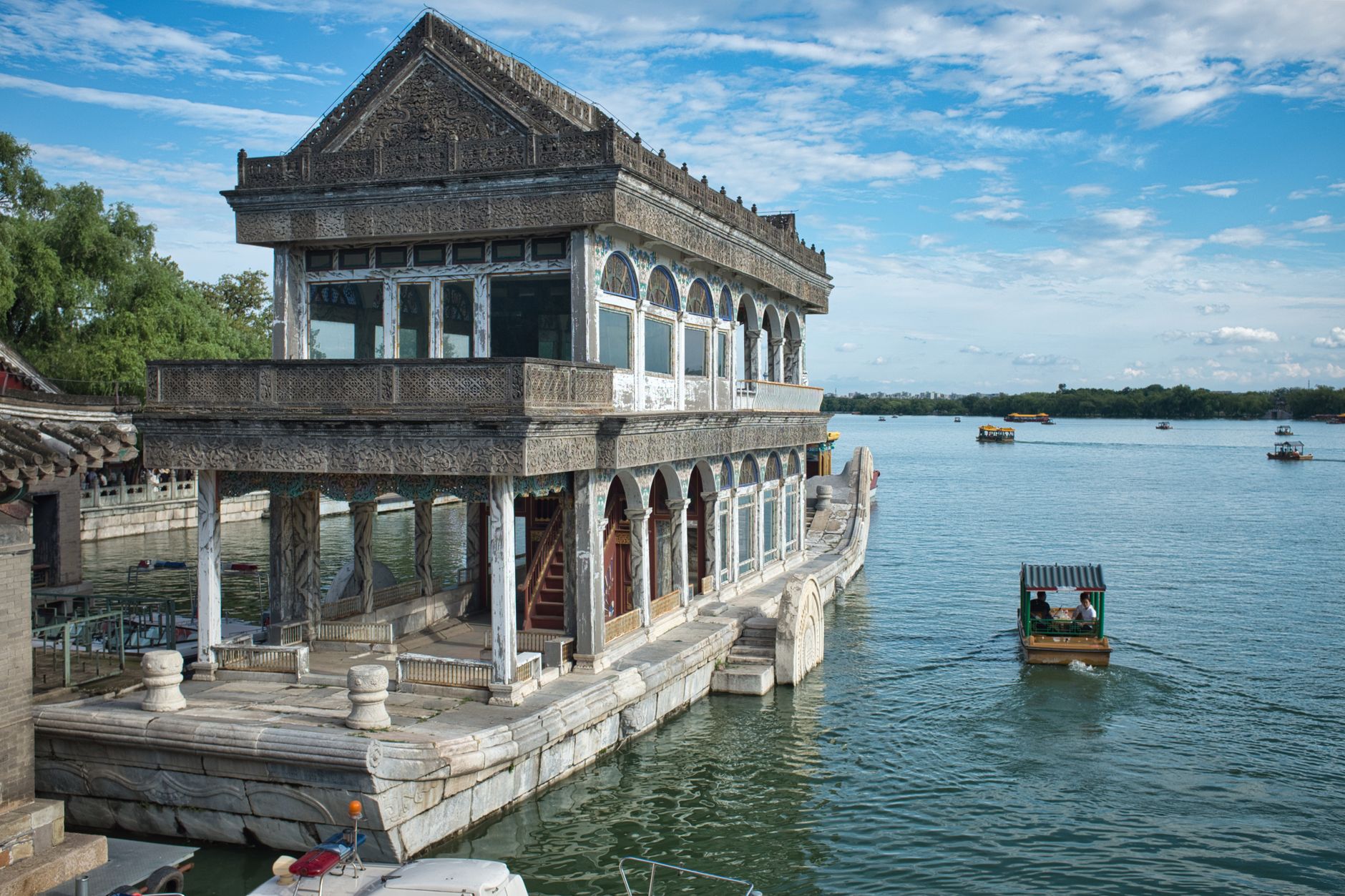
The Marble Boat (石舫, Shí Fǎng) sits at the lake’s northwest corner near the Beigongmen entrance. Built in the 18th century as a lakeside pavilion on a stone hull, it was burned by Anglo-French forces in 1860 and rebuilt in Western baroque style in 1893. Empress Cixi controversially used funds originally allocated for naval modernization to pay for the reconstruction — a historical footnote that appears in every Chinese middle-school textbook.
The Marble Boat does not float. It extends approximately 36 meters over the water on a fixed stone platform. Entry is included with the through-ticket; the interior structure is sometimes closed for conservation work.
The Long Corridor: Inside the 728-Meter Painted Gallery
The Long Corridor (Cháng Láng) runs 728 meters along Kunming Lake’s north shore, connecting the Marble Boat to the west with the Shouxin Hall at the east end of the hill complex. The Guinness Book of Records recognizes it as the world’s longest painted corridor.
Its 273 individual sections are covered by a continuous roof supported by crossbeams — totaling over 14,000 painted panels. Subjects range from Chinese field scenes and classical poetry to narrative episodes from Journey to the West, Romance of the Three Kingdoms, and Dream of the Red Chamber.
Walking the full length at a comfortable pace takes 20–30 minutes. The corridor faces Kunming Lake on its south side and the base of Longevity Hill on its north — providing shade in summer heat and shelter from north winds in autumn.
The corridor itself is free to walk with either ticket type (garden-only or through). But the Hall of Dispelling Clouds compound at the corridor’s midpoint, which you must pass through to ascend Longevity Hill, requires the through-ticket.
Suzhou Street and the Back Lake Area
Suzhou Street (Sūzhōu Jiē) runs along a canal at the foot of Longevity Hill’s north slope — a Qing-dynasty replica of the commercial waterways of Suzhou, built to allow Emperor Qianlong to experience southern market life without leaving Beijing.
The original was burned in 1860 and rebuilt in 1990. Today it operates with small shops selling snacks, tea, and handicrafts, with vendors in period costume during peak season. It’s included in the through-ticket and provides a dramatically different atmosphere from the formal south-facing imperial axis.
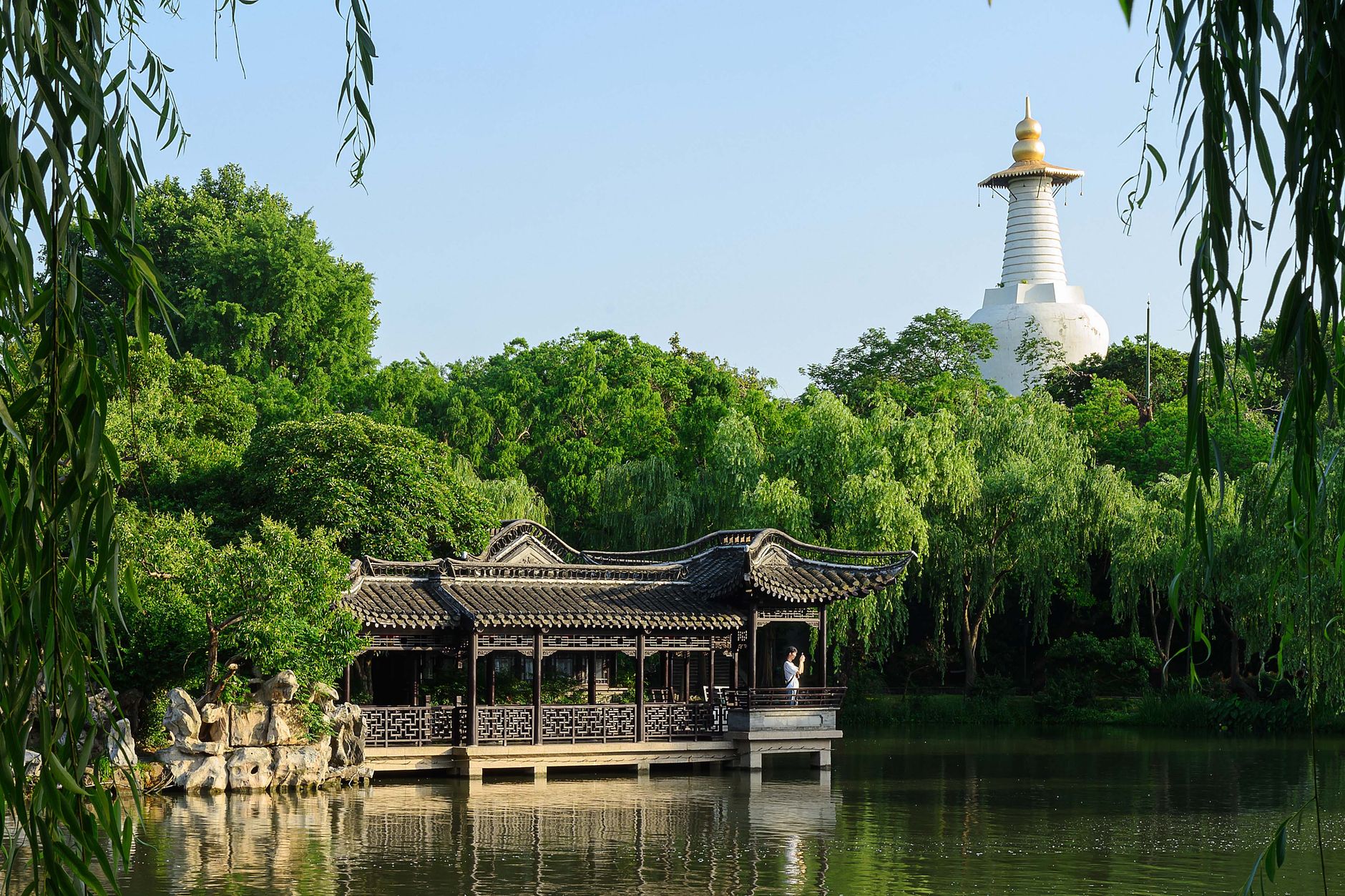
The Back Lake (后湖, Hòu Hú) stretches east from Suzhou Street behind the hill. It’s quieter than Kunming Lake and leads to the Garden of Harmonious Interest (谐趣园, Xiéqù Yuán) — a miniature Jiangnan-style garden at the hill’s northeast corner, built as a replica of the Jichang Garden in Wuxi. It has a small covered-walkway lotus pond and is genuinely beautiful in late June when the lotuses bloom.
“The Summer Palace represents the pinnacle of Chinese imperial garden design — the integration of natural landforms with architectural structures and water management at this scale is unparalleled in world heritage.”
— UNESCO World Heritage Committee, Nomination and Inscription Report, 1998
What to Eat Near the Summer Palace
Inside the park, food is limited and expensive. The Tingliguan Restaurant (听鹂馆) occupies a restored Qing pavilion near the Long Corridor’s east end. It serves Qing imperial cuisine in a genuinely atmospheric setting.
Reservations are essential and prices are high — ¥300–500 per person for a full meal. Appropriate for a special occasion; not practical for a quick refueling stop mid-visit.
Kiosks near Beigongmen: Vendors outside the gate sell grilled corn (¥5), ice cream (¥10–15), and jiānbǐng savory crepes (¥12–18) April–October. Cash or WeChat Pay only — Alipay international also accepted at most stalls.
Better value outside the park: The streets north of Beigongmen Station (a 5–8 minute walk on the Beigongmen Road) have northern Chinese restaurants with dishes running ¥20–45. Handmade noodles (shǒu gǎn miàn), lamb skewers, and braised pork are the regional staples worth ordering.
Warning: Bring Water
Summer temperatures in the park regularly exceed 35°C, and Longevity Hill’s south face has almost no shade on the stone stairs. In-park water costs ¥5–10 per bottle (roughly 3–5x outside prices). Bring at least 1L per person before entering in June–August. Dehydration on the 300-step climb is common and genuinely unpleasant.
Combining the Summer Palace with Nearby Attractions
The Summer Palace sits in Beijing’s northwest corridor alongside the city’s main academic institutions and several other major heritage sites. Efficient combinations depend on transit rather than distance estimates alone.
Old Summer Palace (Yuanmingyuan, 圆明园): The original imperial garden complex, burned by British and French forces in 1860 and left as fieldd ruins. It sits 2.5 km east of the Summer Palace. Meituan or Hellobike bikeshare (¥1.5 per 30 min, requires Chinese phone number) is the fastest link; walking takes about 30 minutes. Entry: ¥10 garden-only or ¥25 with exhibition areas.
Fragrant Hills (Xiangshan, 香山): National park 10 km northwest, famous for October red foliage (best weeks: October 15–30). Bus 331 from Beigongmen connects directly in about 20 minutes for ¥2. The park has marked hiking trails; the main cable car runs April–November.
Beijing Botanical Garden (北京植物园): 3 km south of Xiangshan, accessible via Bus 360 from the East Gate. Best in April (cherry and magnolia) and October (chrysanthemums).
The Forbidden City and Tiananmen: 12 km east via Metro Line 4 southbound to Tiananmen West or East. Frequently combined in a single day — Forbidden City morning, Summer Palace afternoon. Allow 3–4 hours per site minimum. The Forbidden City requires advance ticket booking via its official website (no walk-in tickets); the Summer Palace does not require advance booking.
For our detailed guide to Beijing’s most comparable attraction, see our Mutianyu vs Badaling Great Wall guide.
What First-Timers Get Wrong at the Summer Palace
The same mistakes appear repeatedly in Trip.com reviews and visitor reports:
1. Entering via the East Gate (Dongmen): Tour coaches use this entrance by default. It’s a 25-minute walk from Dongmen to Longevity Hill’s base. Metro Line 4 to Beigongmen solves this — the North Gate puts you 3 minutes from the Long Corridor’s western end.
2. Buying the wrong ticket: The garden-only default at the ticket window (see the tickets section) means many visitors discover their mistake only when they try to enter the Hall of Dispelling Clouds compound. Staff at the compound gate don’t sell upgrades — you walk back to the ticket office.
3. Underestimating distance: A full circuit — Long Corridor, Longevity Hill, 17-Arch Bridge, Marble Boat — covers 6–7 km on uneven stone paths. The Tower of Buddhist Incense stairs have no handrails in several sections. Comfortable walking shoes are not negotiable.
4. Skipping the north slope: The vast majority of visitors do the south face of Longevity Hill and the Long Corridor, then leave. Suzhou Street, the Back Lake, and the Garden of Harmonious Interest hold a quieter, genuinely different character — and in October, the north-slope forest path is arguably the most beautiful part of the park.
5. Arriving 10am on a weekend in October: This is peak crowds plus peak foliage. The north metro exit queues, the ticket window queues, and the Longevity Hill stairs all back up simultaneously. The same visit at 7am on a Tuesday in October is a completely different experience.
Key Takeaway: Summer Palace Planning Checklist
- Metro Line 4 → Beigongmen Station (Exit C) → North Gate — not the East Gate
- Buy the through-ticket (联票): ¥30 peak, ¥20 off-peak — specify it by name
- Arrive 6:30am–8am in peak season to avoid Longevity Hill queues
- Climb south face of Longevity Hill, descend north face to Suzhou Street
- Walk the full 728m Long Corridor; rent a boat if visiting April–October
- Best single days: weekday mornings in mid-October or early April
We earn a commission if you book through links on this page, at no extra cost to you. See our affiliate disclosure.
FAQ: Summer Palace Beijing 2026
How much do Summer Palace tickets cost in 2026?
The through-ticket (联票) costs ¥30 in peak season (April 1–October 31) and ¥20 off-peak (November 1–March 31). The garden-only ticket is ¥20 peak / ¥10 off-peak and excludes Longevity Hill’s main halls. The Tower of Buddhist Incense has an additional ¥10 entry fee, cash only at the pavilion gate.
Which metro station is closest to the Summer Palace?
Beigongmen Station on Metro Line 4 (Exit C) is the closest, 200 meters from the North Gate entrance. This is the best starting point for the Long Corridor and Longevity Hill. The East Gate (Dongmen) is served by several buses but requires a longer walk to the park’s main sights.
How long do you need at the Summer Palace?
A minimum of 4 hours covers the highlights: Long Corridor, Longevity Hill ascent and descent, and Kunming Lake shoreline. Budget 5–6 hours to add a boat rental, the Marble Boat, Suzhou Street, and the Garden of Harmonious Interest. A full day is possible if you combine it with the Back Lake circuit and Fragrant Hills.
Is the Summer Palace worth visiting in winter?
Yes — with adjusted expectations. Through-tickets drop to ¥20, crowds are thin, and when Kunming Lake freezes (typically December–January), designated ice-skating areas open on the lake’s south section. The Marble Boat and Tower of Buddhist Incense remain accessible. Boat rentals and most food vendors close November through March.
Can you visit the Summer Palace and the Forbidden City in one day?
Technically yes, but you’ll shortchange both. The Forbidden City requires advance online booking, and Tiananmen-area security queues add 30–60 minutes. Most visitors find one per day more satisfying. If combining: do the Forbidden City at 8:30am opening, then Metro Line 4 north to the Summer Palace by 1pm — you’ll have 3–4 hours before closing.
Are lockers available at the Summer Palace?
Yes. Coin-operated lockers (¥5–10) are available near both the Beigongmen and East Gate entrances. They accommodate carry-on-sized bags. Useful if you’re transiting through with luggage — though navigating 6+ km of stone paths with a rolling suitcase is not recommended.
What’s the best time of year to visit the Summer Palace?
Mid-October on a weekday combines the lowest crowd density with peak autumn foliage on Longevity Hill’s north slope. Late March to mid-April is second best for peach and cherry blossoms along the Long Corridor. Winter (December–January) offers the most solitude but fewer facilities. Summer gives you lotus flowers on Kunming Lake but demands early-morning arrival.
Can foreign visitors use Alipay at the Summer Palace?
Yes. Since Alipay updated its international wallet in 2023, foreign visitors can link Visa or Mastercard directly without a Chinese bank account. The Summer Palace ticket office and most in-park vendors accept Alipay international. WeChat Pay’s international version also works. Cash (RMB) remains universally accepted if digital payment fails.
For more on traveling in China, explore our Chengdu Panda Base Guide and The Bund Shanghai Guide.
Photos via Pexels.
More on Beijing:

Written by Sam Konneh
Sam Konneh is an AI strategist and digital marketer based in Seoul, South Korea. With years spent living, working, and exploring across Korea, Japan, and China, he shares firsthand insights into East Asia's cultures, hidden gems, and everyday life. A graduate of Inha University and KDI Graduate School, Sam combines data-driven expertise with on-the-ground experience. His journey also includes studying in Malaysia and traveling through Southeast Asia. Through practical tips, local stories, and travel guides, he helps fellow explorers discover both the celebrated highlights and the lesser-known corners of East Asia.