Last Updated: October 10, 2026 | Originally Published: March 8, 2025
- The best subjects are working markets and apothecaries, not staged displays: Bozhou, Beijing‘s Tong Ren Tang, Seoul‘s Gyeongdong Market and Hong Kong’s Ko Shing Street.
- Photograph herbs and shelves freely, but ask before framing a vendor’s face or a customer’s prescription.
- Shoot early, under window or open-door light, and set a custom white balance: market fluorescents turn yellow herbs green.
- Do not buy or carry home anything made from protected species. CITES rules apply at the border.
Where Can You Photograph Chinese Herbal Medicine in China, Korea and Japan?
Chinese herbal medicine is a trade, so the strongest photos come from places where it is still traded. Seven locations stand out for different reasons.
The table sorts them by what each frame offers and when the light and crowd work best. Opening hours change, so check each venue before travelling.
| City | Where to shoot | What you will frame | Best timing |
|---|---|---|---|
| Bozhou, Anhui | Bozhou Chinese herbal trading market | Bulk roots, barks and flowers stacked in sacks | Early morning, when trucks unload |
| Anguo, Hebei | Medicine King Temple (Yaowang Miao) and its herb market | Temple rituals beside the trade that grew around it | Temple fair days |
| Beijing | Tong Ren Tang flagship, Dashilan (founded 1669) | Wooden drawer cabinets, brass scales, labelled jars | Weekday mornings |
| Hong Kong | Ko Shing Street and Bonham Strand, Sheung Wan | Street-front dried herb and seafood stalls | Before noon |
| Seoul | Gyeongdong Market, Dongdaemun-gu | Korean herbal stalls: ginseng, jujube, licorice | Weekday mornings |
| Daegu | Yangnyeongsi herbal medicine district (est. 1658) | Old-street apothecaries and a medicine museum | Daytime, soft window light |
| Osaka | Doshomachi and Sukunahikona Shrine | Pharma-district history; Shinno festival in late November | Festival days, 22-23 Nov |
Which Herbs Make the Best Subjects?
Choose herbs with strong shape or colour. Dried goji berries (Lycium barbarum), jujube, chrysanthemum flowers, star anise and slices of Asian ginseng (Panax ginseng) all hold up under market light.
Ginseng roots are the classic Korean subject. Their forked, human-like shape is part of why the genus is named Panax, from the Greek for “all-healing”.
Cordyceps, a fungus that grows on insect larvae, photographs well in close-up and sells by weight. Vendors often guard the best grades, so ask before you shoot.
How Do You Read the Patterns in a Herbal Shop?
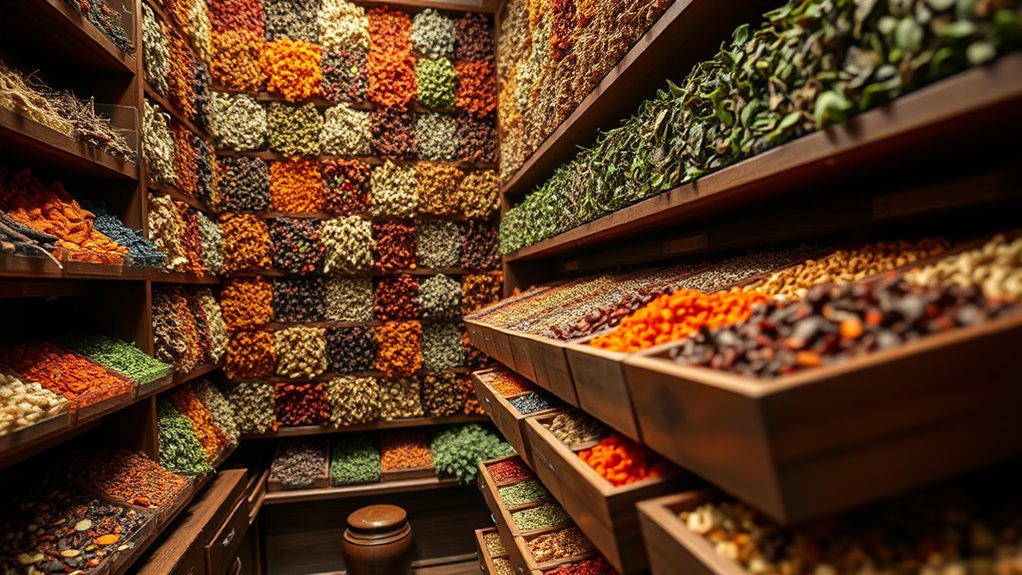
The wall of small drawers behind a counter is the visual signature of a Chinese pharmacy. Each drawer holds one ingredient, and the layout follows the pharmacist’s workflow rather than a decorative scheme.
Prescriptions are weighed out herb by herb, so a hand scale is the second key subject after the drawers. Shoot the drawer wall from a low angle, with the scale as a foreground anchor.
Symbolism enters through the Five Elements Theory (Wu Xing). Practitioners link flavours, organs and seasons to wood, fire, earth, metal and water, which is why displays often group herbs by colour.
What Camera Settings Work in a Crowded Herb Market?
Start with aperture priority at f/2.8 to f/4. That keeps one herb sharp while the stacked sacks behind it blur into colour.
Set ISO to auto with a ceiling of 3200, and use a minimum shutter speed of 1/125 s for hand-held close-ups. Shoot RAW, because mixed lighting needs correcting afterwards.
For wide shots of drawer walls, step back to f/5.6 and keep the camera level. Tilted frames make the grid of drawers look distorted.
A phone works too. Tap to focus on the herb, then drag the exposure slider down slightly so bright white sacks do not clip.
Plan 90 minutes for one market. Walk the whole lane first without shooting, note the three best stalls, then return and work them properly.
How Do Tea Houses and Temples Fit In?
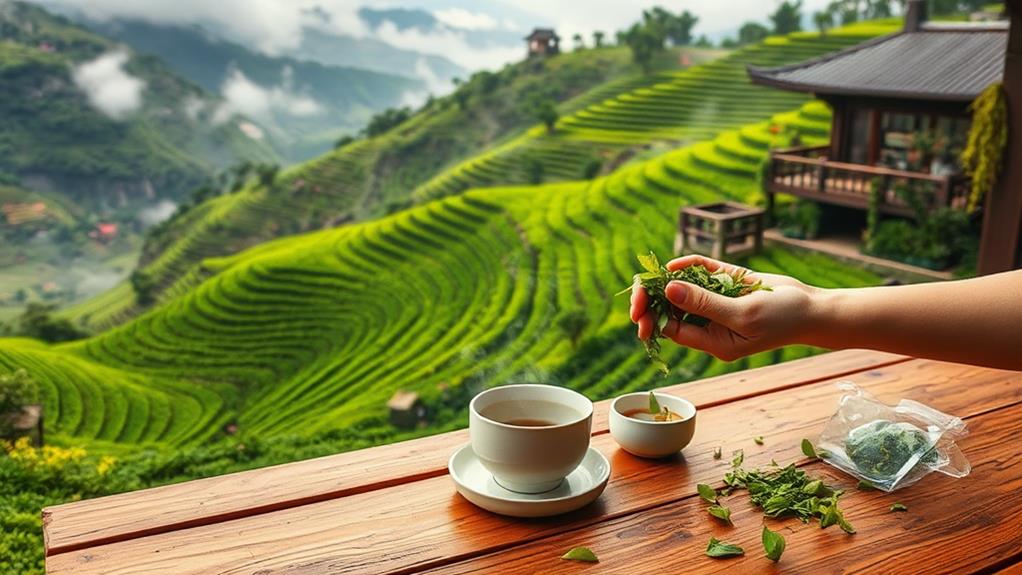
Herbal knowledge and tea culture overlap. Many traditional Chinese tea houses serve chrysanthemum, goji and jujube infusions alongside tea.
Temples add the ritual layer. Anguo’s Medicine King Temple draws herb traders for its temple fair. Osaka’s Sukunahikona Shrine in Doshomachi holds its Shinno festival on 22 and 23 November.
Peonies are another tie-in, since the root is used in decoctions. Their cultural weight is covered in our guide to the significance of peonies in China.
Frequently Asked Questions
Can you photograph people in Chinese herbal markets?
Ask first. Stalls and goods are usually fine. A smile and a gesture toward your camera is enough; if the answer is no, move on.
What is the best camera setup for a dim apothecary?
A fast prime lens (f/1.8 or wider) handles low light without a tripod, which most shops and crowded markets will not allow. Raise ISO before you slow the shutter below 1/60 s.
Which city is easiest for a first herbal-market shoot?
Seoul’s Gyeongdong Market and Hong Kong’s Ko Shing Street are compact and reachable by metro. Bozhou rewards the effort but sits in Anhui province, away from major tourist routes.
Are herbs allowed through customs?
Rules differ by country and by herb. Many dried herbs need declaring, and anything from a CITES-listed species needs permits. Check your own country’s customs list before buying.
When is the best time of day to shoot?
Early morning. Markets are busiest with deliveries then, and open-door light is softer than the overhead tubes used later in the day.
Last updated: October 2026. By the East Asia Explorer Editorial Team.
More on China:
Planning a trip to China?
Check out our China Travel Hub for more guides, including China Digital Survival Guide.

Written by East Asia Explorer Editorial Team
Sam Konneh is an AI strategist and digital marketer based in Seoul, South Korea. With years spent living, working, and exploring across Korea, Japan, and China, he shares firsthand insights into East Asia's cultures, hidden gems, and everyday life. A graduate of Inha University and KDI Graduate School, Sam combines data-driven expertise with on-the-ground experience. His journey also includes studying in Malaysia and traveling through Southeast Asia. Through practical tips, local stories, and travel guides, he helps fellow explorers discover both the celebrated highlights and the lesser-known corners of East Asia.