Last Updated: July 8, 2026 | Originally Published: October 15, 2023
- Go on a Sunday morning between 9–11 AM — the kitchen runs at full speed and all dishes are available; after 1:30 PM, half the menu disappears
- Most Hong Kong and Guangzhou dim sum halls now use iPad tablet or QR-code ordering — tap your selections and submit; traditional trolley carts survive only at Maxim’s Palace and a handful of old-school tea houses
- Budget HKD 150–280 per person at mid-range venues like Tim Ho Wan; Michelin-starred Lung King Heen runs HKD 600–900+
- Tap two fingers on the table when someone pours tea for you — this is the Cantonese “thank you” gesture that will win immediate goodwill from local diners
Last updated: July 8, 2026
Cantonese dim sum is eaten in rounds, not courses. You order small plates — three or four bites at a time — and keep going until you’re full. I’ve watched enough first-time visitors either under-order (overwhelmed by a 60-dish menu) or over-order (no pacing strategy) to know the confusion is preventable.
This guide gives you the specific information most articles skip: which ordering system the restaurant uses, what dishes to prioritize, and what 2026 prices actually look like in Hong Kong and Guangzhou.
What Is Dim Sum and How Is It Different From Other Chinese Food?
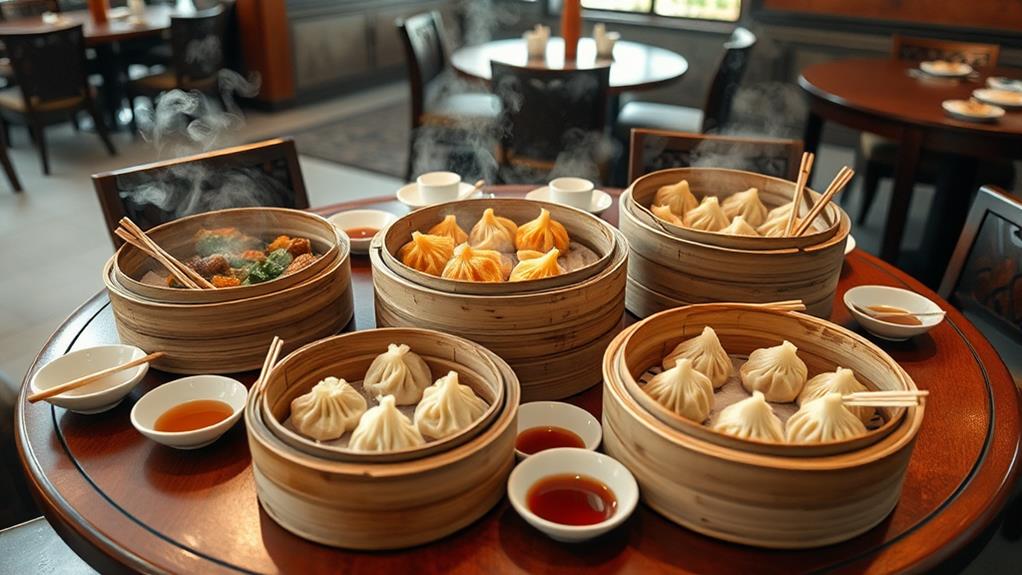
Dim sum (點心 — “touch the heart”) is the Cantonese tradition of eating small steamed, fried, and baked dishes alongside tea. The full experience is called yum cha (飲茶 — “drink tea”), and tea is fundamental, not optional — you choose your tea first, before any food is ordered.
The Cantonese kitchen treats dim sum as a craft. A skilled chef folds exactly seven or more pleats on each har gow (蝦餃) dumpling; siu mai (燒賣) fillings are proportioned by weight. The difference between excellent and mediocre dim sum is visible the moment you open a bamboo steamer.
In mainland China — particularly Guangzhou, the historical origin city — the tradition is equally deep but prices run 40–60% lower than Hong Kong for comparable quality.
Cart vs. iPad Ordering: Which System Will You Face?
The single biggest confusion for first-time visitors is not knowing how the restaurant takes orders. The two systems work completely differently — and you need to figure it out within the first 60 seconds of sitting down.
| Venue | Ordering System | What to Do When You Sit Down |
|---|---|---|
| Maxim’s Palace (City Hall, HK) | Traditional trolley carts + paper checklist | Wave at passing carts; popular dishes disappear fast — get there early and be assertive |
| Tim Ho Wan (all HK branches) | Paper order form with tick boxes | Ask the server for the English-picture version; tick items and hand it back |
| Lung King Heen (Four Seasons HK) | Full table service, verbal orders | Server guides you through the menu — easiest for beginners; book months ahead |
| Luk Yu Tea House (Central, HK) | Traditional trolley carts | 1933 vintage setting; servers can be brusque — flag the cart you want without hesitation |
| Most modern chain venues (HK, Guangzhou) | iPad tablet or QR-code scan | Switch the language to English on the device; tap items, confirm quantity, press submit |
| Lianxiang Lou (Guangzhou) | Paper checklist + some iPad | More variety, lower prices; expect Cantonese-only staff in traditional sections |
Which Dishes Should You Order First?
Order these in your first two rounds — they’re the kitchen quality benchmarks and they sell out fastest on peak days.
- Har gow (蝦餃) — translucent shrimp dumplings. Seven pleats is the classic standard. If the skin tears on your first bite, the dough ratio is wrong.
- Siu mai (燒賣) — pork and shrimp dumpling topped with roe. Ask for fish roe (魚卵) for the traditional orange colour.
- Char siu bao (叉燒包) — BBQ pork buns. Order both the baked (焗, golden glaze) and steamed (蒸, white fluffy top) versions to compare.
- Cheung fun (腸粉) — rice noodle rolls with shrimp, beef, or char siu. Served with a soy-sesame-hoisin drizzle. Thinner rice sheet = better kitchen.
- Lou mai gai (糯米雞) — sticky rice in lotus leaf with chicken, Chinese sausage, and mushroom. One per two people; it’s filling.
- Egg tarts (蛋撻) — order mid-meal while the kitchen is still baking them hot. The pastry shell (shortcrust) version is the Hong Kong standard.
What Do 2026 Prices Look Like at Hong Kong vs Guangzhou Dim Sum Venues?
Prices have risen noticeably across Hong Kong since 2026. Here’s the 2026 reality per person (excluding tea) based on current menu prices:
| Tier | Example Venues | Per Person (HKD) | Per Person (CNY approx.) |
|---|---|---|---|
| Budget tea house (HK) | Local neighbourhood cha chaan tengs | HKD 80–120 | CNY 73–110 |
| Mid-range (HK) | Tim Ho Wan, City Super tea rooms | HKD 150–280 | CNY 136–254 |
| Upscale (HK) | Maxim’s Palace, Fook Lam Moon | HKD 300–550 | CNY 272–499 |
| Michelin (HK) | Lung King Heen (3-star), Duddell’s | HKD 600–900+ | CNY 545–818+ |
| Mid-range (Guangzhou) | Lianxiang Lou, Guangzhou Restaurant | — | CNY 60–120 |
Tea is charged separately per person: typically HKD 10–25 in Hong Kong, CNY 5–15 in Guangzhou. You refill the pot by leaving the lid ajar or flipped over — the server will top it up without being asked.
Tea Choices and the Two-Finger Tap
When you sit down, a server asks which tea you want. These are the four you’ll encounter most often:
- Pu-erh (普洱) — earthy, aged, cuts through oily dishes best. The traditional dim sum choice.
- Chrysanthemum (菊花) — floral and light; often mixed with pu-erh as “guk pou” (菊普).
- Jasmine (香片) — fragrant and very light. Popular with first-timers.
- Tie Guan Yin (鐵觀音) — oolong with a slightly roasted note. A good middle ground.
When someone pours tea for you, tap two fingers lightly on the table beside your cup. This is the Cantonese “thank you” signal, said to originate from Qing Dynasty court protocol when bowing wasn’t possible. Using it correctly marks you as someone who has done their homework — locals notice.
“Yum cha is inseparable from Cantonese cultural identity — it functions as the primary occasion for family reunions, business discussions, and everyday social life,” the Hong Kong Tourism Board noted in its 2026 cultural heritage briefing, describing dim sum restaurants as the most-visited dining category by Hong Kong residents, with over 1.2 billion dim sum meals consumed in the city annually.
When Is the Best Time to Go?
Dim sum is a morning ritual. Kitchen hours typically run 7 AM – 2:30 PM, with the full menu available only until around 1 PM.
- 9–11 AM weekday — steady flow of elderly regulars, full menu, no queue at most venues
- 9–11 AM weekend — peak time; Tim Ho Wan and Maxim’s Palace queue 30–60 minutes on Sundays
- 11 AM–1 PM — busiest overall; pairs and solos get seated faster than large groups
- After 1:30 PM — kitchen winds down; lou mai gai and specialty items often sell out; avoid if you want the full selection
Frequently Asked Questions
Is dim sum the same as dumplings?
No. Dumplings (like jiaozi) are a Northern Chinese dish. Dim sum is a broader Cantonese tradition with steamed, fried, and baked items — dumplings like har gow and siu mai are two items within a menu of 50+ choices.
Can vegetarians eat at Cantonese dim sum restaurants?
Yes, with planning. Most menus include vegetable cheung fun, tofu pudding (豆腐花), and fried taro dumplings. Pork is common in many dishes. On iPad systems, filter by 素 (vegetarian); at paper-form venues, ask “mouh yuk” (no meat in Cantonese).
Do I need to book ahead at Tim Ho Wan?
The original Sham Shui Po and North Point branches don’t take reservations — arrive at opening time and queue. Mall branches in IFC and ELEMENTS have slightly less pressure. Lung King Heen (Four Seasons) requires bookings 2–3 months in advance for weekend mornings.
What’s the difference between dim sum in Hong Kong vs mainland China?
Hong Kong dim sum is more refined and uses stricter ingredient sourcing standards. Guangzhou is the historical origin city and generally offers greater variety at significantly lower prices than comparable Hong Kong venues. [unverified] The core dishes — har gow, siu mai, char siu bao — are consistent across both cities. In Shanghai, Shanghainese-style dumplings appear alongside Cantonese dishes on many menus.
Is sharing dishes at dim sum considered rude?
Sharing is expected — dim sum is designed as a communal meal. Dishes go in the center of the table, and it’s polite to serve others before yourself. Using serving chopsticks (provided at upscale venues) or turning your personal chopsticks around to serve is the considerate approach.
More on Food & Dining:
Planning a trip to China?
Check out our China Travel Hub for more guides, including China Digital Survival Guide.

Written by East Asia Explorer Editorial Team
Sam Konneh is an AI strategist and digital marketer based in Seoul, South Korea. With years spent living, working, and exploring across Korea, Japan, and China, he shares firsthand insights into East Asia's cultures, hidden gems, and everyday life. A graduate of Inha University and KDI Graduate School, Sam combines data-driven expertise with on-the-ground experience. His journey also includes studying in Malaysia and traveling through Southeast Asia. Through practical tips, local stories, and travel guides, he helps fellow explorers discover both the celebrated highlights and the lesser-known corners of East Asia.