Last Updated: August 25, 2026 | Originally Published: October 9, 2024
- Abalone (전복) is Jeju’s iconic dish — jeonbokjuk porridge costs ₩15,000-25,000 at Dongmun Traditional Market restaurants.
- Haenyeo female divers, UNESCO-listed since 2016, harvest most of Jeju’s premium abalone, sea urchin, and conch by hand — no scuba gear.
- Braised cutlassfish (갈치조림, galchi jorim) runs ₩12,000-18,000 at local spots; tourist restaurants near Jeju Airport charge 2-3× more.
- Get to Dongmun Traditional Market from Jeju International Airport on Bus 100 (₩1,400, ~30 min) — the most reliable seafood market on the island.
Jeju Island is not just South Korea’s top tourist destination — it is the country’s most concentrated source of premium wild-caught seafood.
The island’s cold, clean waters produce abalone, sea urchin, and cutlassfish of a quality rarely found on the Korean mainland.
What makes Jeju’s seafood scene genuinely different is the haenyeo (해녀) — the island’s legendary female free-divers who surface up to 100 times a day to collect abalone, conch, and sea cucumber without oxygen tanks.
According to the Korea Tourism Organization, South Korea welcomed 16.8 million international visitors in 2026 — and Jeju remains one of the top two domestic destinations, drawing over 14 million visitors annually.
This guide tells you exactly which 10 dishes to try, where to find them, and what they actually cost.
Read our full South Korea Travel Guide 2026 for everything you need to plan your Korea trip.
The Haenyeo: Why Jeju Seafood Is Different
Before diving into dishes, understand who catches this food.
Jeju’s haenyeo are women — most now in their 60s and 70s — who dive to depths of 10-20 metres on a single breath to harvest abalone, sea urchin, turban shells, and conch.
UNESCO added the haenyeo culture to its Intangible Cultural Heritage list in 2016. There are roughly 3,500 active haenyeo remaining on Jeju, down from over 25,000 in the 1960s, according to the Korea Tourism Organization.
If you want to see haenyeo dive, head to Seongsanpo Port (성산포항) near Seongsan Ilchulbong before 11AM. That’s when most diving crews surface and sell their morning catch directly at the dock.
Haenyeo sell their daily catch at small dock markets near Seongsanpo Port and the Jeju Haenyeo Museum in Gujwa-eup. Abalone bought here is typically ₩30,000-50,000 cheaper per kg than in restaurant-adjacent tourist stalls.
Getting to Jeju’s Best Seafood Markets
Two markets dominate Jeju’s seafood scene: Dongmun Traditional Market (동문전통시장) in Jeju City and Seogwipo Maeil Olle Market (서귀포매일올레시장) in the south.
Dongmun Traditional Market is Jeju’s largest and most accessible market. It runs 6AM-10PM daily and covers two floors of seafood stalls, restaurants, and ingredient vendors. From Jeju International Airport, take Bus 100 (₩1,400 adult fare, ~30 minutes).
Seogwipo Maeil Olle Market is smaller and more local-facing. It opens 7AM-8PM daily. To get there from Jeju City, take Bus 600 (~1 hour, ₩1,400). It’s the better choice for hairtail fish (galchi) and sea urchin.
Restaurants within 500m of Jeju International Airport and inside Jeju City’s tourist shopping strips consistently charge 2-3× market rates for abalone and sea urchin. Always ask to see the menu price before ordering; abalone dishes that cost ₩20,000 at Dongmun Market can run ₩60,000 at tourist-strip restaurants.
1. Abalone Dishes (전복, Jeonbok)
Abalone is Jeju’s most famous seafood export — and the haenyeo harvest it wild.
Farm-raised abalone now dominates the mainland market, but Jeju’s haenyeo-caught wild abalone has a firmer texture and a deeper brine flavour that chefs consistently prefer.
At Dongmun Traditional Market, look for the three classic preparations:
- Jeonbokjuk (전복죽): Creamy abalone porridge with sesame oil. Expect to pay ₩15,000-25,000 per bowl.
- Jeonbok-gui (전복구이): Grilled abalone, typically served live on the shell. Priced by weight — around ₩50,000-100,000/kg at market restaurants.
- Jeonbok-hoe (전복회): Raw abalone slices with vinegar gochujang. Available at the Dongmun Market raw fish section from about 8AM.
Wild abalone from Jeju is noticeably more expensive than farmed equivalents sold on the mainland. The price gap is most justified for jeonbok-gui, where texture is everything.
Order jeonbokjuk for breakfast — Dongmun Market’s rice porridge stalls open at 6AM and serve freshly made batches. By 9AM, most tables are full. Pair it with a small side of kimchi and a glass of Hallasan soju for a proper Jeju morning.
2. Braised Cutlassfish (갈치조림, Galchi Jorim)
Cutlassfish (galchi) is Jeju’s most beloved everyday dish, far more than the tourist-facing menus suggest.
The fish is a long, silver, ribbon-shaped species caught year-round in Jeju waters but most abundant and richest in fat from October through February.
Two preparations dominate:
- Galchi jorim (갈치조림): Braised in a spicy-sweet red sauce with radish and green onion. Costs ₩12,000-18,000 at local restaurants near Seogwipo Maeil Olle Market.
- Galchi gui (갈치구이): Grilled cutlassfish, salted and charred. Simple, available almost everywhere, ₩8,000-12,000.
Ask locals for “Jeju galchi” specifically — Jeju-caught cutlassfish is noticeably fatter than the Mokpo variety often substituted in mainland restaurants.
3. Hairtail Fish Specialties (갈치, Galchi)
While galchi jorim is the cooked preparation, hairtail fish also appears raw (galchi hoe) at market stalls — this is rarer and worth trying.
For grilled hairtail, the best stretch of restaurants is along the Seogwipo Old Town seafood alley near the market entrance.
A full grilled hairtail set (fish, rice, kimchi, seaweed soup) runs ₩15,000-20,000 and is filling enough for two people eating light.
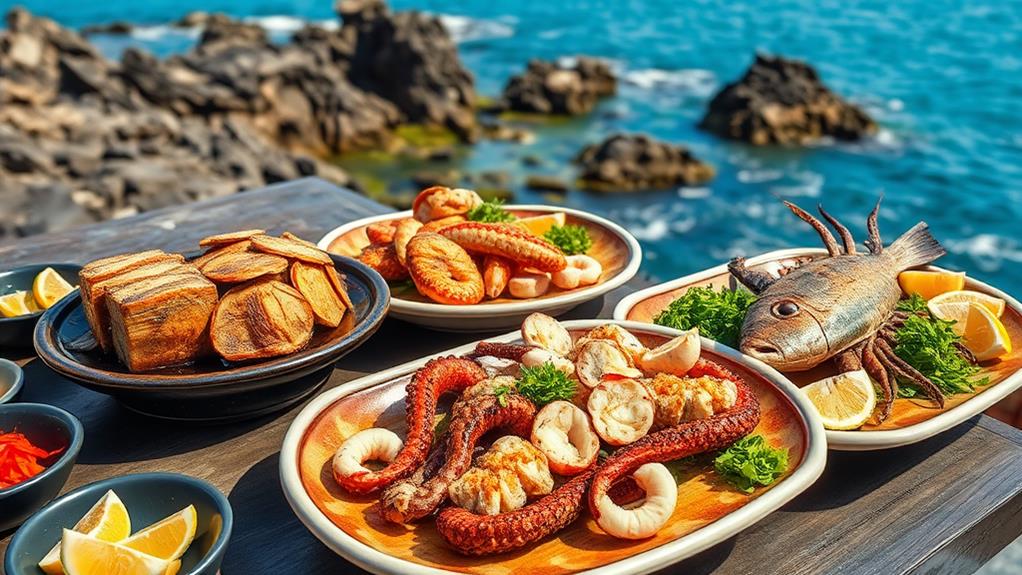
4. Octopus Delicacies (낙지/문어, Nakji/Muneo)
Jeju’s octopus preparations cover a wide range — from the fiery nakji bokkeum to the confronting sannakji (live octopus).
| Dish | Preparation | Typical Price |
|---|---|---|
| Nakji bokkeum (낙지볶음) | Spicy stir-fried octopus with gochujang | ₩12,000-16,000 |
| Sannakji (산낙지) | Live raw octopus, wriggling at the table | ₩15,000-25,000 |
| Muneo-sukhoe (문어숙회) | Parboiled octopus with vinegared gochujang | ₩18,000-28,000 |
Chew sannakji (live octopus) thoroughly before swallowing. The suckers remain active after slicing and can adhere to the throat. Restaurants serving sannakji are required to warn diners — if yours doesn’t, ask. Children under 12 and people with swallowing difficulties should avoid this dish.
5. Sea Urchin (성게, Seonge)
Jeju’s purple sea urchin (seonge) is harvested by haenyeo from rocky coastal shallows, most prolifically in spring and early summer.
The roe has a creamy, intensely briny sweetness that’s different from Japanese uni — slightly more oceanic, less butter-forward.
At Dongmun Market, fresh sea urchin rice (성게밥, seonge-bap) costs ₩20,000-35,000 per bowl and comes with a small salted seaweed side. Sea urchin miyeok guk (seaweed soup) is ₩10,000-15,000 and a lighter way to taste it.
Peak season is April through June. Off-season (October-February), haenyeo shift to abalone; sea urchin becomes scarcer and less fresh.
6. Raw Fish Platters (회, Hoe)
Jeju’s hoe (Korean-style sashimi) platters typically arrive with yellowtail (방어, bang-eo), sea bream (참돔, chamdom), and flounder (광어, gwang-eo).
The Dongmun Market hoe section, a row of glassed-in tanks on the ground floor, lets you choose your fish live and pay by weight before it’s sliced upstairs.
Expect to pay ₩30,000-60,000 for a platter for two, including wrapping leaves, sauces, and side dishes. Grilled fish leftovers are often cooked into a miso stew at the end — ask for it.
Bang-eo (yellowtail) is Jeju’s prestige winter hoe fish — fat content peaks December through February. If you visit in winter, order the bang-eo set specifically. Summer’s best choice is chamdom (sea bream), which is lighter and more delicate.
7. Grilled Mackerel (고등어구이, Godeungeo-gui)
Jeju mackerel, known for its higher fat content than mainland varieties, is grilled whole over charcoal and served with rice, kimchi, and doenjang jjigae.
A full grilled mackerel set at a local restaurant near Seogwipo’s port runs ₩10,000-15,000.
The best mackerel season is autumn (September-November), when the fish have fattened on the warm summer current. Mackerel caught in Jeju’s Chagwido waters is considered premium by local chefs.
8. Jeju Black Pork Seafood Combination (흑돼지, Heukdwaeji)
Jeju Black Pork is a distinct breed raised on volcanic soil. Restaurants combine it with abalone or octopus for a surf-and-turf specific to the island.
A typical set (pork belly + grilled abalone + wrapping vegetables + sauces) costs ₩30,000-45,000 per person at mid-range Jeju City restaurants.
Pair it with Hallasan Makgeolli (한라산 막걸리) — Jeju’s local rice wine — which has a mildly sweet, tangy flavour that cuts the richness of both the pork and abalone fat.
9. Conch Soup (소라국, Sora-guk)
Conch (sora, 소라) is another haenyeo-harvested shellfish. The soup version uses a clear broth made from kelp and dried anchovy, with chunks of conch meat, radish, and spring onion.
Sora-guk runs ₩8,000-12,000 at local restaurants and is lighter than abalone dishes — a good option for people wanting to eat haenyeo-harvested seafood at a lower price point.
Conch is also served raw (sora hoe) with vinegar gochujang at market stalls for around ₩5,000-8,000 per portion.
10. Seafood Hotpot (해물탕, Haemul-tang)
Haemul-tang (seafood hotpot) is the most communal dish on this list — a boiling cauldron of spicy red broth packed with clams, mussels, shrimp, crab, and white fish, served bubbling at the table.
At Dongmun Market-adjacent restaurants, a pot serving two to three people runs ₩35,000-55,000. Mid-range restaurants in Jeju City charge ₩50,000-80,000 for equivalent portions.
Order with a portion of udon noodles to finish the broth at the end — this “sari” (사리) add-on costs ₩1,000-2,000 and is worth it.
For haemul-tang at local prices, walk two streets back from any tourist-facing seafood row and look for restaurants with Korean-only signage and plastic stools. The difference is immediate — same quality, meaningfully lower prices.
Price Summary: What to Expect to Pay
| Dish | Local Market Price | Tourist Restaurant |
|---|---|---|
| Jeonbokjuk (abalone porridge) | ₩15,000-25,000 | ₩35,000-50,000 |
| Galchi jorim (braised cutlassfish) | ₩12,000-18,000 | ₩30,000-45,000 |
| Sea urchin rice (seonge-bap) | ₩20,000-35,000 | ₩45,000-65,000 |
| Hoe platter (for 2) | ₩30,000-60,000 | ₩70,000-120,000 |
| Haemul-tang (for 2-3) | ₩35,000-55,000 | ₩55,000-90,000 |
- Dongmun Traditional Market (Bus 100 from airport, ₩1,400) is the most cost-efficient place for abalone and hoe.
- Haenyeo-caught seafood (wild abalone, conch, sea urchin) is significantly better quality than mainland equivalents — pay the premium for jeonbok-gui specifically.
- Sea urchin peaks April-June; cutlassfish October-February; yellowtail hoe December-February.
- Tourist restaurants near the airport charge 2-3× market rates — walk two streets back to find local pricing.
Frequently Asked Questions
What is the best time of year to visit Jeju for seafood?
Spring (April-June) is peak season for sea urchin and abalone. Autumn (September-November) is best for mackerel, cutlassfish, and yellowtail. Jeju’s seafood markets run year-round, so there’s never a bad time — just different seasonal highlights.
How do I get from Jeju International Airport to Dongmun Traditional Market?
Take Bus 100 from the airport arrivals level. The fare is ₩1,400 (cash or T-money card) and the journey takes about 30 minutes. Dongmun Market is a 5-minute walk from the Dongmun Rotary bus stop.
What are haenyeo and can tourists watch them dive?
Haenyeo are Jeju’s female free-divers who harvest seafood without oxygen equipment. UNESCO recognized their culture as Intangible Heritage in 2016. Watch them dive at Seongsanpo Port (near Seongsan Ilchulbong) before 11AM, or visit the Jeju Haenyeo Museum in Gujwa-eup for context. The Jeju Haenyeo Festival in September includes diving demonstrations.
How does Jeju seafood differ from mainland Korean seafood?
Jeju seafood is predominantly wild-caught by haenyeo, which means higher quality abalone, conch, and sea urchin than the farmed equivalents common on the mainland. Jeju also has unique varieties like Jeju Black Pork combined with seafood, and higher-fat local mackerel and cutlassfish from surrounding cold waters.
Are there any seafood festivals on Jeju Island?
Yes. The Jeju Haenyeo Festival (September, Gujwa-eup) celebrates the diving tradition with live demonstrations. The Jeju Seogwipo Chilsimni Festival (April) includes fresh seafood markets and cooking events. Check the Korea Tourism Organization’s annual events calendar for exact dates.
Is Jeju safe for solo female travellers exploring seafood markets?
Jeju’s markets — Dongmun and Seogwipo Maeil Olle — are busy, well-lit, and family-oriented. Both are safe for solo travellers at any hour they’re open. The main risk is price confusion, not safety: always confirm dish prices before ordering in tourist-facing areas.
What drinks pair well with Jeju’s seafood dishes?
Hallasan Soju (한라산 소주), brewed in Jeju from local tangerine botanical, is the island standard and pairs with everything from abalone to octopus. Hallasan Makgeolli (₩3,000-5,000 per bottle at convenience stores) is milder and works well with braised cutlassfish. For non-alcoholic, try Jeju citrus tea or barley tea.
What is the K-ETA and do I need one for Jeju?
Most nationalities visiting South Korea (including Jeju) require a K-ETA — an electronic travel authorization. It costs ₩10,000 (~$7.50 USD), valid for 2 years, and is applied for at k-eta.go.kr. Apply at least 72 hours before departure. Some nationalities (US, UK, EU) were granted K-ETA exemptions through 2026; check the current exemption list on the Ministry of Justice website.
Last updated: July 30, 2026. Prices in KRW; USD conversions approximate at ₩1,350/USD. Seasonal availability varies year to year.
Related Guides
More on Hiking & Nature:

Written by East Asia Explorer Editorial Team
Sam Konneh is an AI strategist and digital marketer based in Seoul, South Korea. With years spent living, working, and exploring across Korea, Japan, and China, he shares firsthand insights into East Asia's cultures, hidden gems, and everyday life. A graduate of Inha University and KDI Graduate School, Sam combines data-driven expertise with on-the-ground experience. His journey also includes studying in Malaysia and traveling through Southeast Asia. Through practical tips, local stories, and travel guides, he helps fellow explorers discover both the celebrated highlights and the lesser-known corners of East Asia.