Last Updated: July 4, 2026 | Originally Published: July 8, 2026
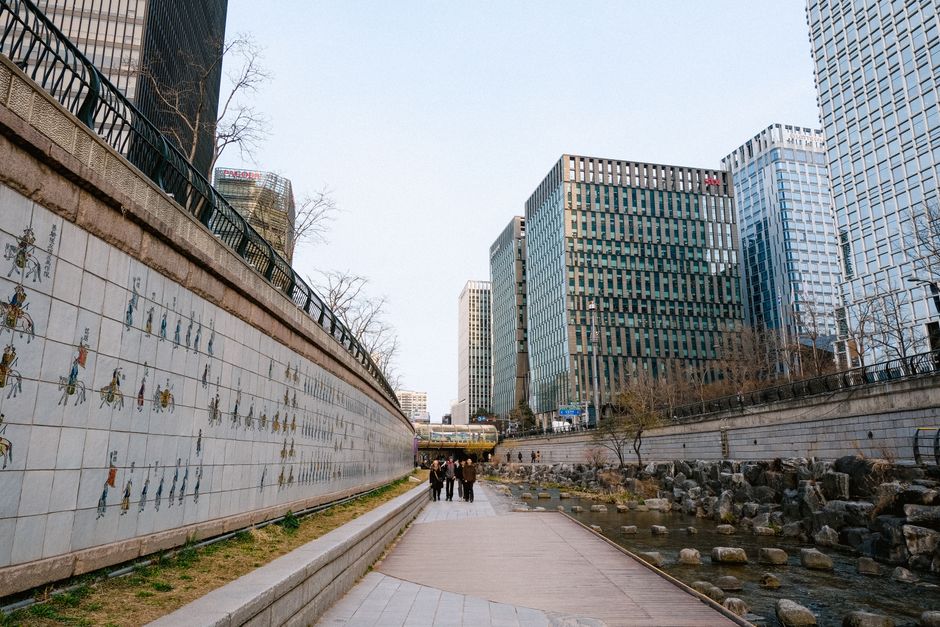
- Cheonggyecheon is a 10.9-kilometre restored urban stream running east through central Seoul—once buried under a highway, now a landscaped walkway with waterfalls, stepping stones, and seasonal light installations. It is free and open 24/7.
- Start at Cheonggye Plaza (Line 5 Gwanghwamun, Exit 5; Line 1 Jonggak, Exit 5)—a 1-minute walk. Look for the giant spiral Spring sculpture.
- The most scenic stretch is the 2 km between Cheonggye Plaza and Dongdaemun, which takes about 40–60 minutes at a gentle walking pace. The full 10.9 km path reaches the Han River.
- Visit in November for the Seoul Lantern Festival, when the stream fills with thousands of illuminated lantern floats. Visit at sunset any month for the transition from day to night lighting.
Seoul buried a river under a highway in the 1960s and called it progress. In 2005 it ripped the highway out, dug up the river, and called that progress too. Both assessments were correct in their own decades.
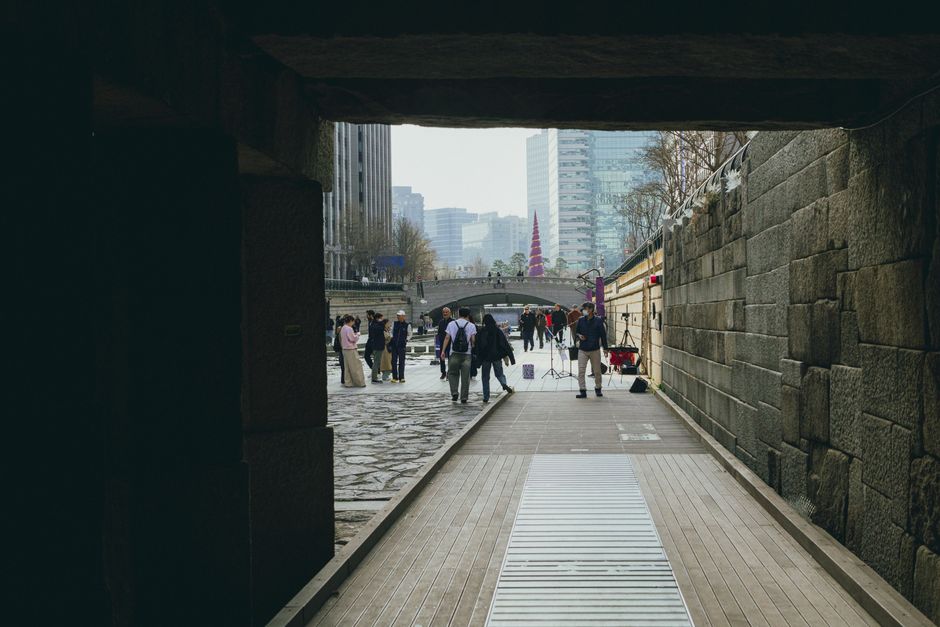
The result today is a 10.9-kilometre ribbon of water, stone and willow trees slicing through the densest part of downtown, with traffic roaring above and strollers strolling below.
I walked the Dongdaemun-to-Plaza stretch on a humid August evening and found it about 4 degrees cooler than street level. Couples sat on the stone steps with convenience-store beers. An old man was feeding something to a heron.
It was the quietest kilometre in central Seoul, and it was under a flyover.
A short history of Cheonggyecheon
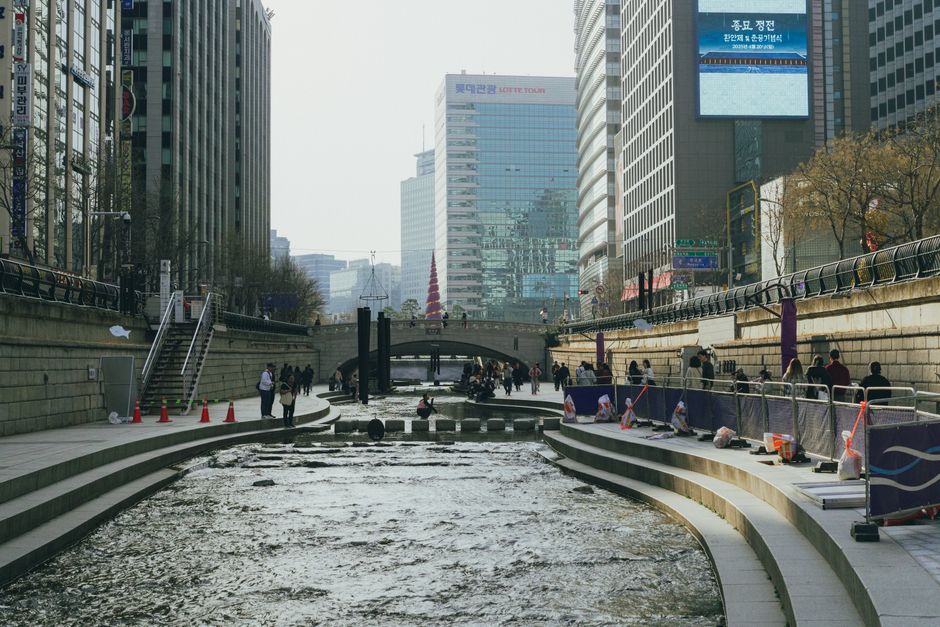
The stream has been a central feature of Seoul since the Joseon era, when it was called Gaecheon (“open stream”) and served as a natural drainage channel and a place for laundry, trade and social gathering. By the early 20th century it had become an open sewer lined with slums.
In the 1960s, under the Park Chung-hee administration’s modernisation drive, the stream was covered with concrete and a 16-metre-wide elevated highway was built directly above it.
The Cheonggye Overpass stood for nearly 40 years, a symbol of post-war industrial Seoul and a daily headache for the roughly 170,000 cars that used it.
In 2003, then-mayor Lee Myung-bak launched a roughly 386 billion KRW restoration project. The highway was demolished, the stream was daylighted, and the Cheonggyecheon opened to the public in October 2005.
It has since become the most visible urban-restoration project in East Asia and a case study in what happens when a city chooses water over asphalt. The Korea Tourism Organization features Cheonggyecheon as a signature urban attraction.
What to see along Cheonggyecheon
Cheonggye Plaza and the Spring sculpture. The starting point at the western end, marked by a 20-metre-tall red-and-blue spiral sculpture by Claes Oldenburg and Coosje van Bruggen. The plaza has a small waterfall and is the kickoff point for the full stream walk.
At night the sculpture and waterfall are lit in colour.
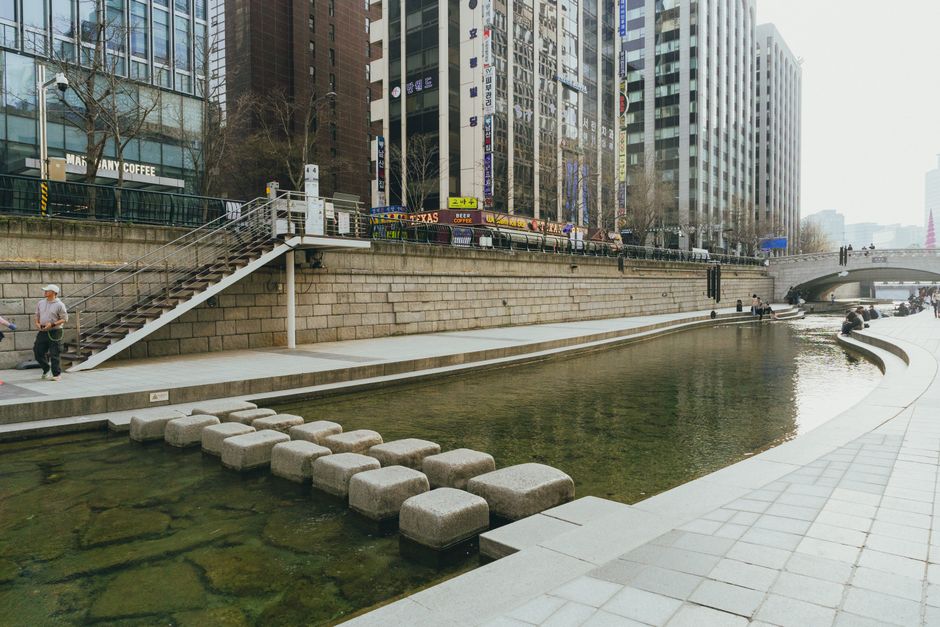
The two-tiered walking path. The stream has a lower path at water level with stepping-stone crossings and an upper path at street level. The lower path feels removed from the city; the upper path is faster but busier. Both run the entire length.
22 bridges and landmarks. The 10.9 km stretch passes under 22 bridges, each with its own character. Notable ones include Mojeongyo (the oldest stone bridge on the stream), Gwangtonggyo (restored Joseon-era bridge with stone animal carvings), and the environment-friendly sections near Dongdaemun with reed beds and heron habitats.
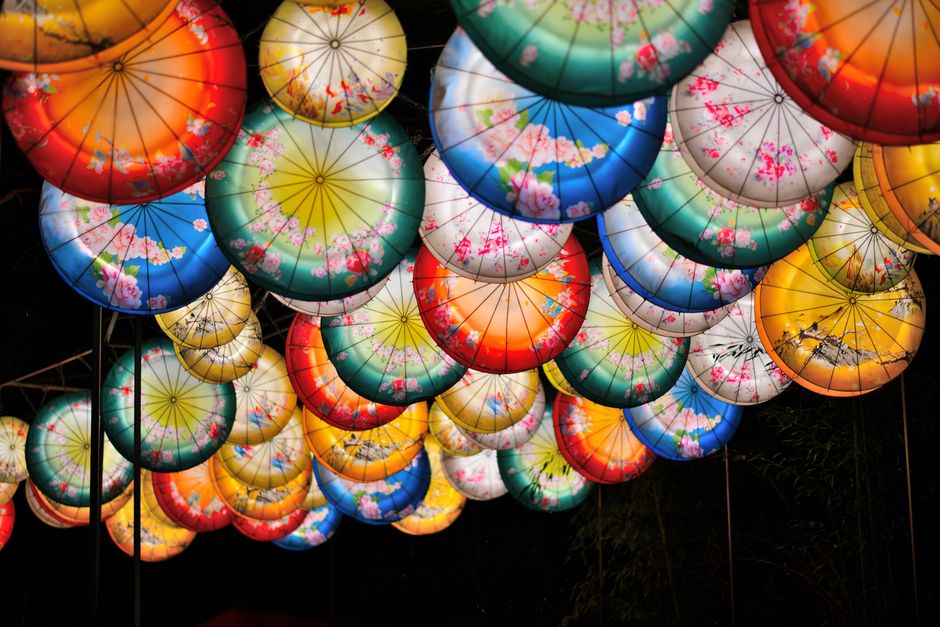
Seoul Lantern Festival (November). For roughly two weeks each November, the stream between Cheonggye Plaza and Supyo Bridge fills with hundreds of illuminated floating lanterns—traditional and contemporary designs, some the size of small cars. Free entry. Crowds are heavy; go on a weeknight for breathing room.
Seasonal decorations. The stream gets themed light installations throughout the year: a Christmas lantern display in December, lotus lanterns for Buddha’s Birthday in spring, and general night-lighting in summer. Even without a festival, the under-bridge LED strips and water-reflected city lights make the evening walk worthwhile.
Tickets & opening hours (2026)
| What | Hours | Price | Note |
|---|---|---|---|
| Stream walkway | 24/7 | Free | Lighting on from sunset |
| Seoul Lantern Festival | ~17:00–22:00 (November) | Free | Exact dates announced in October |
| Cheonggyecheon Museum | 09:00–18:00 (closed Mondays) | Free | Near Dongdaemun section |
“The Cheonggyecheon restoration turned a buried stream and elevated highway into a 10.9 km urban ecological park. Since its opening in 2005, it has lowered surrounding temperatures by up to 3.6 degrees Celsius and introduced over 600 species of plants, fish, and birds to downtown Seoul.”
How to get there
| Entry point | Subway | Walk from station |
|---|---|---|
| Cheonggye Plaza (west end) | Line 5 Gwanghwamun Exit 5 or Line 1 Jonggak Exit 5 | ~1 minute |
| Mid-stream (Insadong area) | Line 1 Jonggak Exit 4 or Line 3 Anguk Exit 5 | ~3–5 minutes |
| Dongdaemun section | Line 2/4/5 Dongdaemun History & Culture Park Exit 1 | ~3 minutes |
The stream runs east–west across Jongno, so multiple stations serve different sections. For the classic walk, Visit Seoul recommends starting at Cheonggye Plaza and walking east. There are access staircases roughly every 200–300 metres along the entire 10.9 km, so you can drop in and out anywhere.
Best time to visit
The stream works in every season, but the experience changes dramatically with the calendar. Spring (April–May) brings cherry blossoms along the upper path and comfortable walking temperatures. The water level rises after spring rain, and the stepping stones become a bit more splash-prone.
Summer (June–August) is hot at street level but cooler down by the water—studies show the stream lowers ambient temperature by up to 3.6 degrees Celsius compared to adjacent roads. The under-bridge sections act as shaded corridors.
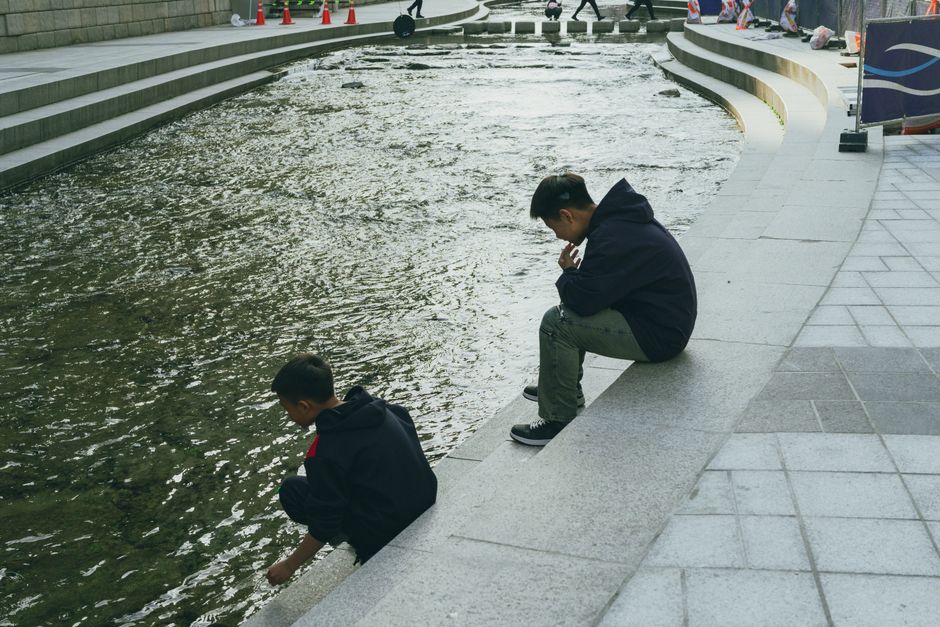
Evening walks are the summer move, and you will see locals with feet in the water.
Autumn (September–November) is the photogenic peak, with foliage colours along the upper bank and the November Lantern Festival. Winter (December–February) means parka-level cold, but the Christmas light installations and general night lighting make a short evening walk worth the chill.
Cheonggyecheon at a glance
| Detail | Info |
|---|---|
| Best for | Evening walks, photography, lantern festivals, urban nature |
| Time needed | 40–60 minutes (Plaza to Dongdaemun); 3–4 hours (full 10.9 km) |
| Cost | Free |
| Best time | Sunset, any season; November for the Lantern Festival |
| Facilities | Public toilets at access points; convenience stores at street level |
Where to eat nearby
Gwangjang Market (3-minute walk from mid-stream): Slide off the stream at Jongno 5-ga and hit Seoul’s most famous street-food market for bindaetteok (mung-bean pancake), mayak gimbap and yukhoe. About 5,000–15,000 KRW for a satisfying market meal.
Jonggak / Jongno area (upper path): The streets directly above the mid-section of the stream are packed with office-worker lunch spots, Korean BBQ, and pojangmacha (tent bars) in the evening. Good for pre-walk or post-walk eating at local prices.
Gwanghwamun area (western end): The area around Gwanghwamun Square has sit-down Korean and international restaurants, plus food courts in the nearby underground arcades. Budget about 10,000–20,000 KRW for a meal.
Dongdaemun area (eastern end): Street-food carts, the Dongdaemun Grilled Fish Alley behind Doota Mall, and Gwangjang Market again (because it sits between both sections). If you do the whole Plaza-to-Dongdaemun walk, you earn the street food.
Combine it into a Seoul day
Morning: Gyeongbokgung Palace (9:00–11:00 AM, Line 3 Gyeongbokgung, Exit 5). Walk to Gwanghwamun Square (5 minutes) to see the statues of King Sejong and Admiral Yi Sun-sin. Have lunch at the Jonggak-area restaurants above the stream.
Afternoon: Insadong for antiques and tea (Line 3 Anguk, Exit 6). Then drop down to Cheonggyecheon at the Jonggak access point around 16:30 and walk the stream east toward Dongdaemun as the sun sets and the city lights come on.
Evening: Arrive at Dongdaemun around 18:00. Hit Gwangjang Market for dinner, then either walk the LED rose garden at DDP or take a 10-minute detour to the Dongdaemun shopping malls if the retail adrenaline is still running.
Is Cheonggyecheon worth visiting?
It is not a “destination” in the palace-or-temple sense. It is a walk. But it is the most scenic urban walk in Seoul, it costs nothing, it is cooler than street level in summer, and it connects several major sightseeing zones along a single linear path.
For a 40-minute detour between Gwanghwamun and Dongdaemun, it delivers more atmosphere per step than any street-level alternative.
What’s nearby
- Korea Travel Guide—your hub for Seoul, Busan, and beyond
- Gwanghwamun Square Guide—directly above the Cheonggye Plaza starting point
- 24 Hours in Seoul—how to slot the stream into a tight layover
- Gwangjang Market Guide—street food 3 minutes off the stream at Jongno 5-ga
Frequently Asked Questions
What is Cheonggyecheon?
Cheonggyecheon is a 10.9-kilometre restored urban stream running east through central Seoul. Buried under a highway in the 1960s, it was daylighted in 2005 as a public walkway with waterfalls, stepping stones, and seasonal light installations.
How do you get to Cheonggyecheon?
The easiest start point is Cheonggye Plaza: Line 5 Gwanghwamun Station, Exit 5, or Line 1 Jonggak Station, Exit 5—both a 1-minute walk. Access staircases are spaced roughly every 200–300 metres along the full 10.9 km length.
Is Cheonggyecheon free?
Yes, the entire stream walk is free and open 24/7. The Seoul Lantern Festival in November is also free. The Cheonggyecheon Museum near Dongdaemun is free as well.
How long is the Cheonggyecheon walk?
The full stream is 10.9 km from Cheonggye Plaza to the Han River. The most popular section—Cheonggye Plaza to Dongdaemun—is about 2 km and takes roughly 40–60 minutes at a slow walking pace.
What is the Seoul Lantern Festival?
A free annual festival held for roughly two weeks each November, featuring hundreds of illuminated lantern floats on the stream between Cheonggye Plaza and Supyo Bridge. Crowds are heaviest on weekends; go on a weeknight.
Can you put your feet in Cheonggyecheon?
Yes, locals wade and sit at the water’s edge, especially in summer. The water is not treated for swimming, but dipping your feet on a hot day is common and acceptable.
Is Cheonggyecheon safe at night?
Yes. The stream is well-lit, regularly patrolled, and generally busy until late evening. The lower path has uneven stone surfaces without handrails near the water—watch your footing in the dark.
What happens to Cheonggyecheon during heavy rain?
The lower path can flood during monsoon season (July–August). If the water level is high or the stepping stones are submerged, stay on the upper path. Seoul’s drainage system manages major flooding, but the lower path is closed during extreme rainfall events.
More on Seoul:

Written by East Asia Explorer Editorial Team
Sam Konneh is an AI strategist and digital marketer based in Seoul, South Korea. With years spent living, working, and exploring across Korea, Japan, and China, he shares firsthand insights into East Asia's cultures, hidden gems, and everyday life. A graduate of Inha University and KDI Graduate School, Sam combines data-driven expertise with on-the-ground experience. His journey also includes studying in Malaysia and traveling through Southeast Asia. Through practical tips, local stories, and travel guides, he helps fellow explorers discover both the celebrated highlights and the lesser-known corners of East Asia.