Last Updated: August 22, 2026 | Originally Published: October 9, 2024
- Getting there: From Hiroshima Station, take Hiroden tram Line 2 or 6 to Genbaku-Dome-mae stop (¥190, 12–15 min); the Atomic Bomb Dome is immediately in front of you
- Museum tickets: ¥200 adult / ¥100 high school / free for junior high and below — open 8:30 AM–6:00 PM (closes 7:30 PM in July, August, and holiday periods)
- Time needed: 2–3 hours for the museum alone; 4–5 hours to cover the full park circuit (Dome, Cenotaph, Children’s Monument, Peace Flame, Museum)
- Best combo day: Hiroshima Peace Memorial in the morning, then JR to Miyajimaguchi (26 min) + 10-min JR ferry to Miyajima for the afternoon
Last updated: August 22, 2026
The Atomic Bomb Dome sits 160 metres from the hypocenter of the August 6, 1945 blast. The building survived because the force of the explosion came almost directly downward, leaving the iron skeleton intact while everything around it was flattened. That fact — 160 metres, almost directly overhead — is the thing I kept thinking about while standing next to it.
This guide gives you the tram line number, the ticket price, and the specific park monuments so you can plan a meaningful visit rather than arriving and wondering where to go first.
How Do I Get to Hiroshima Peace Memorial Park?
The easiest route from Hiroshima Station is by Hiroshima Electric Railway (Hiroden) tram. Take Line 2 (Miyajima-guchi direction) or Line 6 (Eba direction) to the Genbaku-Dome-mae stop. Journey time is 12–15 minutes. Fare is ¥190 (flat rate for the tram network).
You exit the tram directly in front of the Atomic Bomb Dome. The Peace Memorial Park entrance is a 3-minute walk across the Motoyasu River bridge.
| Route | From | Time | Fare | Stop/Station |
|---|---|---|---|---|
| Hiroden Line 2 or 6 | Hiroshima Station | 12–15 min | ¥190 | Genbaku-Dome-mae |
| Hiroden Line 2 or 6 | Hondori (central Hiroshima) | 5 min | ¥190 | Genbaku-Dome-mae |
| City bus | Hiroshima Station | 20–30 min | ¥230 | Heiwa Koen (Peace Park) |
| Taxi | Hiroshima Station | 10 min | ¥1,200–1,600 | Park entrance |
How Do I Get to Hiroshima by Shinkansen?
Hiroshima is on the Sanyo Shinkansen line, directly accessible from Tokyo, Osaka, Kyoto, and Fukuoka. The Nozomi from Tokyo takes approximately 4 hours (¥18,000+). The Hikari from Osaka takes 1 hour 45 minutes (¥5,590). The Sakura from Fukuoka (Hakata) takes about 1 hour 15 minutes.
Note: the Japan Rail Pass covers Hikari and Sakura trains on the Sanyo Shinkansen, but not the Nozomi. From Tokyo, JR Pass holders must use the Hikari or Kodama (adding 1–2 hours to the journey).
What Are the Peace Memorial Museum Tickets and Opening Hours?
The Hiroshima Peace Memorial Museum charges ¥200 for adults, ¥100 for high school students, and is free for junior high school age and below. There are no timed-entry slots — tickets are purchased at the door.
Standard hours are 8:30 AM to 6:00 PM (last entry 5:30 PM). In July, August, and the weeks around Peace Memorial Day (August 6), hours extend to 7:30 PM. The museum is closed December 31.
Allow 2–3 hours for the museum. The main building covers the pre-bombing era, the bombing itself, and the post-war recovery movement. The East Building focuses on the human impact — photographs, artifacts, and survivor testimony (hibakusha accounts).
What Is the Atomic Bomb Dome (Genbaku Dome)?
The Atomic Bomb Dome (Genbaku Dome) was originally the Hiroshima Prefectural Industrial Promotion Hall, designed by Czech architect Jan Letzel and completed in 1915. It was the closest major building to the hypocenter that remained partially standing after the bomb detonated approximately 600 metres overhead on August 6, 1945.
The dome was designated a UNESCO World Heritage Site in 1996 at the request of the City of Hiroshima, as a permanent reminder of nuclear destruction and a symbol of the peace movement. It is now legally protected from demolition or alteration.
The structure is viewable from outside the fence perimeter at all hours. There is no entry into or onto the dome itself — it is preserved in its damaged state as a heritage monument.
“The Hiroshima Peace Memorial (Genbaku Dome) is an outstanding example of architecture related to the atomic bombing of Hiroshima, and serves as a universal symbol of the aspiration for world peace and the elimination of nuclear weapons.”
What Is the Memorial Cenotaph and How Is It Designed?
The Memorial Cenotaph (officially, the Cenotaph for the Atomic Bomb Victims) stands at the center of Peace Memorial Park. Architect Kenzo Tange designed the arched structure so that its arch precisely frames the Peace Flame in the middle ground and the Atomic Bomb Dome in the background — all three aligned on a single axis.
This alignment is intentional. Standing at the cenotaph, you see the flame (burning since 1964) centered within the arch, and the dome framed behind it. The inscription on the cenotaph reads: “Let all the souls here rest in peace; for we shall not repeat the evil.”
The Peace Flame has burned continuously since it was lit on August 1, 1964. It is pledged to burn until all nuclear weapons are eliminated worldwide. The flame sits on a stone lantern in the reflecting pool between the cenotaph and the dome.
What Is the Children’s Peace Monument?
The Children’s Peace Monument was built in 1958 in memory of Sadako Sasaki, a girl who survived the 1945 bombing but developed leukemia in 1955 from radiation exposure. She began folding 1,000 origami paper cranes — a Japanese tradition said to grant a wish to anyone who folds that many — hoping to recover.
Sadako died before completing her 1,000 cranes. Classmates completed the remaining cranes and raised funds for the monument. Today, chains of 1,000 paper cranes from schools and groups worldwide are donated to the monument year-round.
The monument features a bronze figure of Sadako at the top, holding a golden crane. It is located in the northern section of Peace Memorial Park, a short walk from the cenotaph.
What Is the National Peace Memorial Hall for the Atomic Bomb Victims?
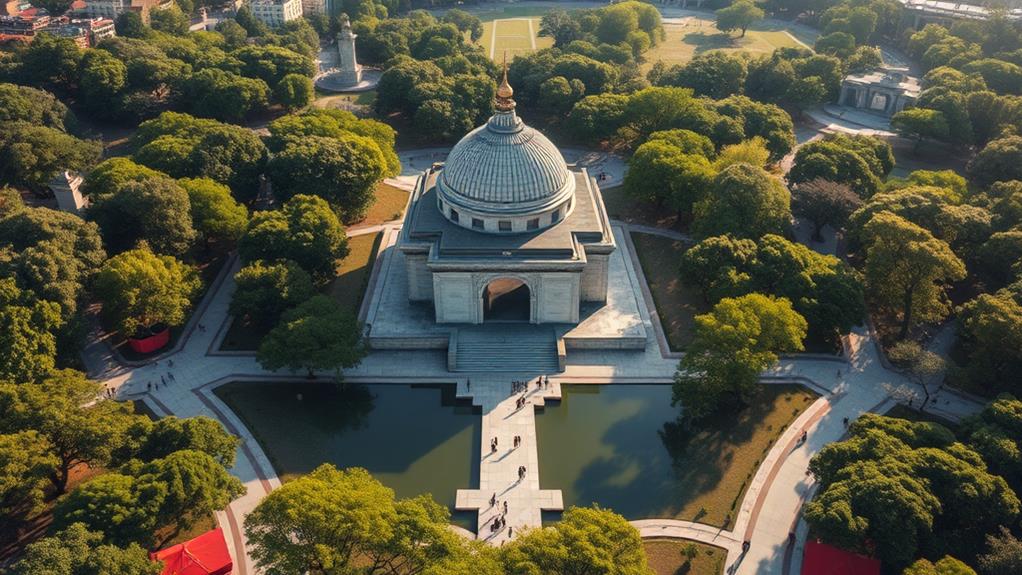
Most visitors miss this one. The National Peace Memorial Hall for the Atomic Bomb Victims sits across the Motoyasu River near Motoyasu Bridge, a short walk from the museum — and it’s free, opened by the Japanese national government in 2002.
Below ground, the Hall of Remembrance holds a 360-degree panorama built from 140,000 ceramic tiles — one for each life estimated lost by the end of 1945. The image recreates the view from the hypocenter, based on a US military photograph taken two months after the bombing.
At the center, a fountain shaped like a clock is frozen at 8:15 AM — the exact moment of detonation. Curators continue collecting names and photographs of victims from surviving family members as the hibakusha generation ages.
How Do I Plan the Park Circuit?
The full park circuit covers four major monuments and the museum. Here’s a practical route from the Genbaku-Dome-mae tram stop:
- Exit tram → Atomic Bomb Dome (15 min, view from perimeter)
- Cross Motoyasu River bridge into the park → Hiroshima Peace Memorial Museum (2–3 hours)
- Exit museum through East Building → Memorial Cenotaph (10 min, alignment view)
- Continue northeast → Children’s Peace Monument (10 min)
- Walk east along the river → Peace Bell (you can ring it — free) (5 min)
- Return to tram or continue to Orizuru Tower (adjacent to Dome, ¥1,700 for glass slide + crane folding)
The full circuit, excluding the museum interior, takes about 1.5–2 hours on foot. With the museum, allow a full half-day minimum (4–5 hours total).
Can I Combine Hiroshima with a Miyajima Day Trip?
Yes — and it’s one of the best day-trip combinations in Japan. From Hiroshima Station, take the JR Sanyo Line to Miyajimaguchi Station (26 minutes, ¥410). From the station, a JR West ferry crosses to Miyajima Island (10 minutes, ¥210 — covered by Japan Rail Pass). The famous floating torii gate of Itsukushima Shrine is a 5-minute walk from the ferry terminal.
The recommended sequence: Peace Memorial in the morning (arrive by 8:30 AM when the museum opens), leave by 1:00 PM, and reach Miyajima by 2:00 PM for the afternoon.
Where to Eat in Hiroshima
Hiroshima is famous for its distinct style of okonomiyaki — the local version layers ingredients rather than mixing them, and always includes a base of yakisoba noodles. This makes it noticeably different from the Osaka/Kansai version, where everything is mixed into a thick batter.
Okonomimura (お好み村) in Naka Ward is a 6-floor building with over 20 individual okonomiyaki stalls, each run by a different family for decades. Prices run ¥800–1,200. The building is a 10-minute walk from the Peace Park or accessible by tram to Hatchobori stop.
Near the Peace Park, several restaurants along the Omotesando shopping arcade serve Hiroshima oysters (the region produces the majority of Japan’s farmed oysters) — grilled on the half-shell, in ramen, or deep-fried as kaki furai (¥1,000–1,500).
What Happens on August 6 at Hiroshima?
The Hiroshima Peace Memorial Ceremony takes place every August 6 at 8:15 AM — the exact time the bomb detonated. The ceremony is held at the Memorial Cenotaph and includes a moment of silence, the tolling of the Peace Bell, the release of doves, and the reading of a peace declaration by the Mayor of Hiroshima.
The public can attend. Arrive well before 8:00 AM to find a space near the cenotaph — the area fills quickly. Foreign dignitaries, survivors (hibakusha), and delegations from dozens of countries typically attend.
According to the Japan National Tourism Organization (JNTO), this ceremony is one of Japan’s most significant annual commemorations and draws international visitors specifically for August 6. Overnight accommodation in Hiroshima on August 5 books out months in advance.
Practical Tips for Visiting
- The museum audio guide in English is available at the ticket counter at no extra charge — it significantly enriches the experience
- Photography is permitted throughout the park and at the Atomic Bomb Dome exterior. Inside the museum, photography is restricted in certain gallery sections — follow posted signs
- The park has public restrooms near the museum entrance and near the Children’s Peace Monument
- There are no bag check facilities at the museum. If you have luggage, use coin lockers at Hiroshima Station before taking the tram
- The Peace Park is quiet and reflective in tone — maintain that atmosphere near the cenotaph and monuments
Take Hiroden tram Line 2 or 6 from Hiroshima Station to Genbaku-Dome-mae (¥190, 12–15 min). The museum costs ¥200 for adults and opens at 8:30 AM. Allow 4–5 hours for the full park circuit: Atomic Bomb Dome (UNESCO 1996) → Museum → Cenotaph (aligned by Kenzo Tange to frame the Peace Flame and Dome) → Children’s Peace Monument (Sadako Sasaki, 1,000 cranes) → Peace Bell. Combine with Miyajima in the afternoon via JR to Miyajimaguchi (26 min) + 10-min ferry.
Frequently Asked Questions
Is entry to the Peace Memorial Park free?
The park itself is free and open 24 hours. The Hiroshima Peace Memorial Museum charges ¥200 for adults, ¥100 for high school students, and is free for junior high school age and below. No booking is required.
What tram goes to the Peace Memorial from Hiroshima Station?
Take Hiroden Line 2 (toward Miyajima-guchi) or Line 6 (toward Eba) from Hiroshima Station to the Genbaku-Dome-mae stop. The fare is ¥190 (flat rate). Journey time is 12–15 minutes.
How long should I spend at Hiroshima Peace Memorial?
Allow at least 2–3 hours for the museum alone. The full park circuit (Dome, museum, cenotaph, Children’s Monument, Peace Bell) takes 4–5 hours. A half-day (morning departure from your hotel) is the minimum — it leaves the afternoon free for Miyajima.
Is the Japan Rail Pass valid for travel to Hiroshima?
Yes — Hiroshima is on the Sanyo Shinkansen. JR Pass covers Hikari and Sakura services but not the Nozomi. From Osaka to Hiroshima on the Hikari takes 1 hour 45 minutes. From Tokyo on the Hikari (with possible transfer at Shin-Osaka), allow 5–6 hours.
Can I visit Hiroshima and Miyajima in one day?
Yes, comfortably. Spend the morning at Peace Memorial (8:30 AM–1:00 PM), then take the JR Sanyo Line to Miyajimaguchi (26 min, ¥410), then the JR ferry to Miyajima (10 min, ¥210, covered by JR Pass). You’ll have 3–4 hours on Miyajima for the torii gate, Itsukushima Shrine, and Mt Misen ropeway before the last ferry back.
What is the best time of year to visit Hiroshima Peace Memorial?
Spring (March–May) and autumn (October–November) offer mild weather. August 6 (Peace Memorial Ceremony) is historically significant but crowds are large and accommodation books out months in advance. The museum and park are worth visiting year-round — there is no bad season.
Are there restrooms on the way between Peace Memorial Park and the Atomic Bomb Dome?
Yes. Public restrooms are available at the museum entrance, near the Children’s Peace Monument, and at the north end of the park near the Peace Bell. The Orizuru Tower (adjacent to the Dome) also has facilities for the ¥1,700 entry price.
What is the Orizuru Tower?
The Orizuru Tower is a 13-story building immediately adjacent to the Atomic Bomb Dome, opened in 2016. It includes an observation deck with views over the Dome and river, a paper crane folding workshop, and a glass slide on the 13th floor. Entry is ¥1,700. It gives a unique elevated perspective on the Dome’s surviving iron skeleton.
More on Transportation:

Written by East Asia Explorer Editorial Team
Sam Konneh is an AI strategist and digital marketer based in Seoul, South Korea. With years spent living, working, and exploring across Korea, Japan, and China, he shares firsthand insights into East Asia's cultures, hidden gems, and everyday life. A graduate of Inha University and KDI Graduate School, Sam combines data-driven expertise with on-the-ground experience. His journey also includes studying in Malaysia and traveling through Southeast Asia. Through practical tips, local stories, and travel guides, he helps fellow explorers discover both the celebrated highlights and the lesser-known corners of East Asia.