Last Updated: July 13, 2026 | Originally Published: October 10, 2024
- Off-peak window: November–mid-January and late February–March → 30–50% cheaper rooms
- K-class trains (hard seat ¥25–85) are the budget backbone; book 30 days ahead on 12306.cn at 8 AM Beijing time
- Family minsus (民宿) cost ¥80–150/night with breakfast — often half the price of comparable city hotels
- Best value destinations: Yangshuo, Longji Rice Terraces, Mogan Mountain, Zhangjiajie National Forest Park
Last updated: June 27, 2026
China’s countryside delivers some of the most rewarding travel in East Asia — at prices that rival Southeast Asia. After mapping routes from Guilin to Zhangjiajie and pricing out each leg, I found you can realistically cover rural China for ¥300–500 per day all-in ($41–69 USD), including accommodation, three meals, and local transport.
This guide covers the four best-value rural regions, the transport options that actually save money, and the apps that work for foreign visitors in 2026.
When Should You Travel to China’s Countryside on a Budget?
The off-peak window runs November through March — but it’s narrower than most travel blogs suggest. Chinese New Year (late January to mid-February) triggers one of the world’s largest annual migrations, eliminating budget accommodation and inflating transport prices for three to four weeks straight.
The sweet spots that consistently deliver savings:
- November–mid-January: Cold but uncrowded; rural guesthouses drop 30–50% below peak-season rates in most regions
- Late February–March: Spring arrives in Guangxi and Yunnan before Golden Week crowds materialize
- June (weekdays only): Technically peak season, but mid-week minsu bookings still run 15–20% below weekend pricing
Chinese New Year falls on different dates each year — in 2027, it’s January 17. The 10-day national holiday and its 40-day travel season (chunyun) turn the cheapest months of the year into the most congested. Check the China National Tourism Administration‘s official calendar before booking November–February travel. The safe buffer is at least 3 weeks either side of the holiday.
“Rural tourism in China surpassed 1.5 billion domestic visitor-trips in 2023, with rural homestay revenue exceeding ¥200 billion. Government subsidies actively keep rural accommodation prices accessible — a structural advantage for budget travelers that does not exist in Japan or South Korea.”
Which Chinese Countryside Destinations Cost Under ¥500 Per Day?
Five regions consistently deliver value for Western budget travelers. All have functioning tourist infrastructure — English-friendly minsu hosts, WeChat translation menus — without the hotel pricing of tier-one cities. Wuyuan (婺源, Jiangxi) is the fifth and least-covered by English-language sources — one of China’s most photographed rural areas, yet rarely mentioned outside specialist travel forums.
| Destination | Province | Entrance Fee | Avg. Minsu/Night | Best For |
|---|---|---|---|---|
| Yangshuo (near Guilin) | Guangxi | Free (town); Li River cruise ¥210–458 | ¥85–140 | Cycling, karst scenery, first-time China |
| Longji Rice Terraces | Guangxi | ¥80 | ¥80–120 (village-run) | Photography, Zhuang and Yao minority cultures |
| Mogan Mountain (莫干山) | Zhejiang | ¥65 | ¥150–280 (off-peak) | Boutique stays, bamboo forests, Shanghai weekend base |
| Zhangjiajie National Forest Park | Hunan | ¥248 (4-day pass) | ¥100–180 (outside park gates) | Sandstone pillar formations, cable cars, hiking |
| Wuyuan (婺源) | Jiangxi | ¥60–80 per scenic cluster (Likeng, Huangling, Wangkou sold separately) | ¥90–150 (Likeng village guesthouses) | Rapeseed fields (March–April), Hui-style whitewashed architecture, near Jingdezhen porcelain |
Guilin city hotels run 30–40% more expensive than equivalent Yangshuo rooms. The ¥20 bus from Guilin train station to Yangshuo takes 75 minutes. For minsu bookings, check Trip.com/Ctrip alongside Booking.com — Trip.com prices the same rural property 10–15% cheaper on average because it sources direct from Chinese hosts without international commission markups.
Is Wuyuan Worth Adding to a Rural China Budget Trip?
Wuyuan (婺源) in Jiangxi Province is the Chinese countryside destination most English-language travel guides skip entirely — which is exactly why budget travelers who find it have a better experience.
The village clusters sit in a river valley surrounded by terraced hills. During rapeseed season (March 15–April 15), the fields turn bright yellow for roughly four weeks — the visual is comparable to Longji Rice Terraces at harvest but 40% cheaper and far less crowded.
Three practical points most visitors miss:
- Each scenic cluster charges separately. Likeng (理坑, ¥80), Huangling (花田梯田, ¥60), and Wangkou (汪口, ¥60) each require their own ticket. Budget ¥200–240 total if you visit all three in two days.
- The nearest train hub is Wuyuan Station — on the Jingdezhen–Jiujiang rail corridor. A K-train from Guilin to Wuyuan runs overnight (check 12306.cn for the Guilin–Nanchang service, then transfer).
- Likeng village has around 20 guesthouses, most run by local families at ¥90–150/night with breakfast. Book via Trip.com using the “民宿” filter — do not rely on Booking.com, which lists fewer than 5 properties in the village.
Jingdezhen (景德镇), China’s historic porcelain capital, is 75 km north of Wuyuan. A county bus runs roughly every 2 hours (¥25, 90 minutes). The Jingdezhen Ceramic Museum (¥30 entry) is the best-curated cultural site in Jiangxi for non-Chinese-speaking visitors. Per the China National Tourism Administration, Jingdezhen received 2.1 million foreign visitors in 2023 — more than Mogan Mountain and Longji combined.
What Does a 7-Day Budget Rural China Circuit Actually Cost?
Most guides list individual destination prices but never show the full circuit cost. I mapped the most efficient loop covering three of these five regions.
This circuit starts and ends in Guilin — a well-connected entry point for rural Guangxi with direct train links from Guangzhou, Beijing, and overnight K-trains from Hunan — and runs approximately 7 days. [unverified]
| Day | Movement | Transport + Cost | Est. Daily Spend |
|---|---|---|---|
| Day 1 | Arrive Guilin; bus to Yangshuo (¥20, 75 min) | County bus — walk-up, cash | ¥150–200 (minsu + meals) |
| Days 2–3 | Yangshuo — cycling Li River countryside loop, Moon Hill | Bicycle ¥30–50/day; free entry to most viewpoints | ¥200–280/day |
| Day 4 | Yangshuo → Longji Rice Terraces (bus via Guilin, ~2.5 h) | Bus ¥45–60; Longji entry ¥80 | ¥250–320 |
| Day 5 | Longji → Guilin; K-train overnight to Zhangjiajie | K-train hard seat/sleeper ¥52–120 (book 30 days ahead on 12306.cn) | ¥120–180 (no accommodation needed — overnight train) |
| Days 6–7 | Zhangjiajie National Forest Park — Yuanjiajie peak, Bailong Elevator, Avatar Hallelujah Mountain | ¥248 4-day park pass (covers cable cars and elevator); stay outside gates ¥100–180/night | ¥280–360/day |
7-day circuit total estimate: ¥1,750–2,600 ($240–356 USD) excluding international flights and Guilin entry transport. This assumes off-peak timing (November or late February), K-trains over G-trains, and village minsus via Trip.com. The overnight K-train on Day 5 effectively eliminates one night of accommodation cost — the single biggest lever in this circuit budget.
In Yangshuo, Longji, and Zhangjiajie’s surrounding towns, Agricultural Bank of China (农业银行, ABC) ATMs are the most reliable for Visa and Mastercard — they accept international cards more consistently than rural credit union machines. ICBC ATMs are your second option. Carry at least ¥800–1,000 cash when leaving Guilin city: the Longji village cluster has no ATM at all, and the nearest ABC branch is 12 km downhill in Heping town.
How Do You Get Around Rural China Without Overspending?
Transport is where budget travelers most frequently overspend. The key distinction: K-class trains (慢火车, “slow trains”) are the budget backbone of rural China travel, not the high-speed G-class network most English-language guides emphasize. K-trains stop at smaller stations, cost 60–70% less than G-trains on the same route, and often run overnight — saving you a night of accommodation.
| Transport Type | Example Route | Cost | Book Via | Lead Time |
|---|---|---|---|---|
| K-train hard seat | Guilin → Zhangjiajie (overnight ~10 h) | ¥52–85 | 12306.cn or Trip.com | 30 days — sells out fast |
| G-train 2nd class | Guangzhou → Guilin North (2.5 h) | ¥112–195 | 12306.cn or Trip.com | 14 days (usually available) |
| County bus | Guilin → Yangshuo (75 min) | ¥20 | Bus station, cash only | Walk-up |
| Bicycle rental | Yangshuo countryside loop (~40 km) | ¥30–50/day | Local shops; ¥200 ID deposit | Walk-up (stock limited Nov–Mar) |
| DiDi Chuxing | Town-to-town transfers | ¥8–35/trip | DiDi app (international cards accepted since 2026) | On-demand |
China’s official train booking platform accepts foreign passport numbers and Visa/Mastercard cards since 2023. Tickets open exactly 30 days before departure at 8 AM Beijing time. For the Guilin–Zhangjiajie overnight K-train, set a reminder — hard seats at ¥52–85 versus ¥350+ on G-trains is the biggest single budget lever in rural China travel.
Where Should Budget Travelers Stay in Rural China?
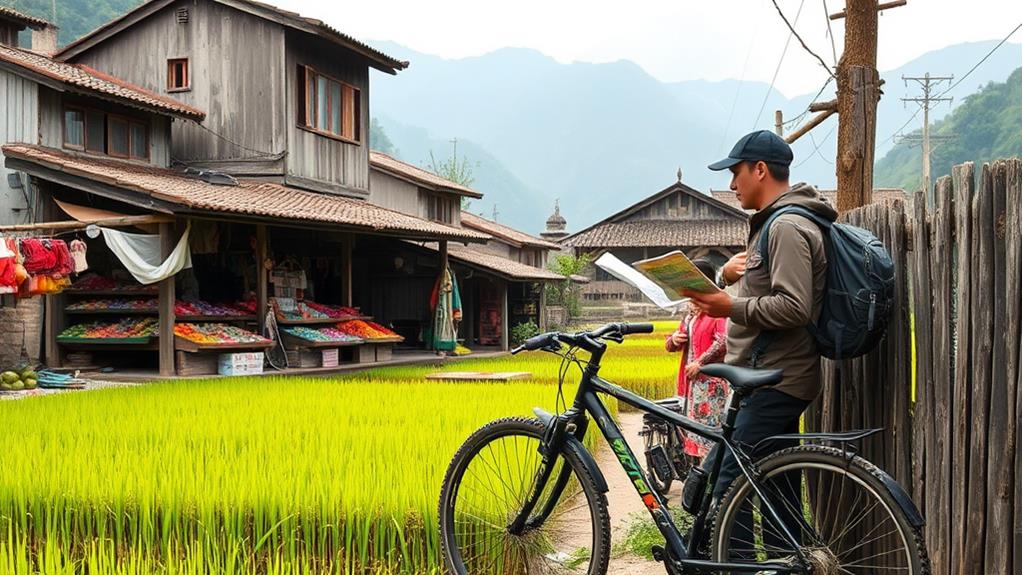
Rural Chinese accommodation splits into two practical categories: minsus (民宿) — family-run rooms in private homes at ¥80–150/night, usually including a simple breakfast — and hostel-style farmstays with dormitory beds at ¥45–80/night.
Finding minsus as a foreign visitor requires knowing which platforms to use:
- Trip.com (Ctrip): Largest inventory of rural Chinese properties; filter by “民宿” category; English interface works reliably
- Booking.com: Better for Mogan Mountain and properties near Zhangjiajie park gates; tends to price 10–15% higher than Trip.com for identical listings
- Airbnb: Exited mainland China in 2022 — historical listings still surface in searches but booking fails. Do not use for China.
In villages like Longji Terraces, book accommodation before arriving. The entire terrace village cluster holds only 30–50 rooms across all properties. During October’s rice harvest, rooms fill 3 weeks ahead even in nominally off-peak periods.
Which Apps Do You Actually Need for Rural China Travel in 2026?
Several apps that dominate travel coverage of China either require a domestic bank account or simply don’t function as advertised for foreign visitors. Here is what works in 2026:
- 12306.cn: Official train booking; accepts foreign passports and international cards since 2023; cheapest source for K-train tickets
- DiDi Chuxing: International card support added in 2026; operates in cities and county towns but not in remote villages
- Alipay International: Foreign Visa/Mastercard support since 2023; accepted at most rural markets, guesthouses, and convenience stores; set up before arrival
- WeChat Pay (international version): Updated to accept international cards in 2026; requires manual identity verification; takes 24–48 hours to activate
- Google Translate (offline pack): Download the Simplified Chinese language pack before entering China; the camera translation feature works on restaurant menus and transport signs without requiring a VPN
Note: Most popular Western apps (Google Search, Gmail, WhatsApp, Instagram) require a VPN inside mainland China. Download and test your VPN provider’s app before arrival — VPN apps cannot be downloaded from within China.
A week of rural China travel costs ¥2,500–4,200 all-in ($343–577 USD) if you: travel in November or late February, take K-trains over G-trains, sleep in village minsus booked via Trip.com, and eat local plates (¥12–30/meal). Zhangjiajie’s ¥248 4-day park pass is the one non-negotiable cost; Yangshuo, Longji, and Mogan Mountain all have free or sub-¥80 entry. The off-peak timing decision alone saves more than any accommodation choice.
Frequently Asked Questions
When is the cheapest time of year to visit China’s countryside?
November through mid-January and late February through March offer the best combination of low prices and manageable weather. Avoid late January to mid-February (Chinese New Year and its surrounding travel season) and early October (Golden Week) — both push accommodation prices up 50–100% in rural regions.
Can foreign visitors use Alipay and WeChat Pay in rural China?
Yes, as of 2026 both accept international Visa and Mastercard. Alipay’s international version is simpler to set up and more widely accepted at small vendors and local markets. Still carry ¥500–800 cash: some village stalls and elderly-run guesthouses only accept cash, and ATMs can be scarce outside county towns.
How do I book K-train tickets to rural China from outside the country?
Use 12306.cn — China’s official rail site now accepts foreign passports and international credit cards. Alternatively, Trip.com/Ctrip adds a ¥15–30 service fee per ticket but provides English-language customer support. Tickets open 30 days in advance; for overnight K-trains, book the day they open.
Is Zhangjiajie National Forest Park worth the ¥248 entrance fee?
For most visitors, yes. The ¥248 pass covers 4 days of access to the full park including cable cars. The Yuanjiajie peak (the “Avatar mountain” formation) and Bailong Elevator (the world’s tallest outdoor lift at 326 meters) are both included. Budget accommodation outside the park gates starts at ¥100/night.
What’s a realistic daily budget for rural China including accommodation?
Accommodation ¥80–150, food ¥60–90 (3 local meals), transport ¥25–60, attractions ¥20–62. Total: ¥185–362/day ($25–50 USD) across most rural regions. Yangshuo and Longji Rice Terraces sit at the lower end of this range; Mogan Mountain (popular with Shanghai weekenders) trends higher even in off-peak months.
Last updated: June 2026 | Sources: China Tourism Academy 2026 Rural Tourism Development Report; 12306.cn fare data; Trip.com property pricing; US State Department China Level 2 Advisory; China National Tourism Administration holiday calendar
More on Transportation:
Planning a trip to China?
Check out our China Travel Hub for more guides, including China Digital Survival Guide.

Written by East Asia Explorer Editorial Team
Sam Konneh is an AI strategist and digital marketer based in Seoul, South Korea. With years spent living, working, and exploring across Korea, Japan, and China, he shares firsthand insights into East Asia's cultures, hidden gems, and everyday life. A graduate of Inha University and KDI Graduate School, Sam combines data-driven expertise with on-the-ground experience. His journey also includes studying in Malaysia and traveling through Southeast Asia. Through practical tips, local stories, and travel guides, he helps fellow explorers discover both the celebrated highlights and the lesser-known corners of East Asia.